JEE PYQ: Motion in a Straight Line - Question ID a9bd9ee36820 (JEE Main 2025)
A person travelling on a straight line moves with a uniform velocity for a distance and with a uniform velocity for the next distance. The average velocity in this motion is . If is then __________ .
Your Answer
Step-by-step Explanation
In kinematics, the average velocity over a journey is defined as the total displacement divided by the total time taken. Mathematically, When an object moves in segments with different constant velocities, we compute the time taken for each segment separately and then sum them to find the total time.
Step-by-Step Derivation:Given data:
- First segment: distance , velocity .
- Second segment: distance , velocity (to be found).
- Average velocity over the entire journey: .
Step 1: Express the time for each segment.
Time for the first segment:
Time for the second segment:
Step 2: Compute the total displacement and total time.
Total displacement:
Total time:
Step 3: Write the average velocity formula and substitute.
Average velocity:
Simplify the numerator and denominator by factoring out :
Step 4: Solve for .
Invert both sides:
Multiply both sides by :
Subtract from both sides:
Cancel the common factor of :
Hence,
1. Misidentifying total displacement: Students sometimes mistakenly add the distances incorrectly, e.g., is crucial. 2. Incorrect time expressions: Forgetting to divide the distance by the velocity for each segment leads to wrong total time. 3. Algebraic slips: When solving the equation for , a small arithmetic error can yield an incorrect answer. Always double-check each algebraic manipulation.
Related Questions from Motion in a Straight Line
A gas balloon is going up with a constant velocity of . When this balloon reached a height of 75 m , a stone is dropped from it and balloon keeps moving up with the same velocity. The height of the balloon when the stone hits the ground is m. (Take )
The velocity versus time plot of a particle is shown in the figure, for a time interval of 40 s . The total distance travelled by the particle and the average velocity during this period are, respectively
.
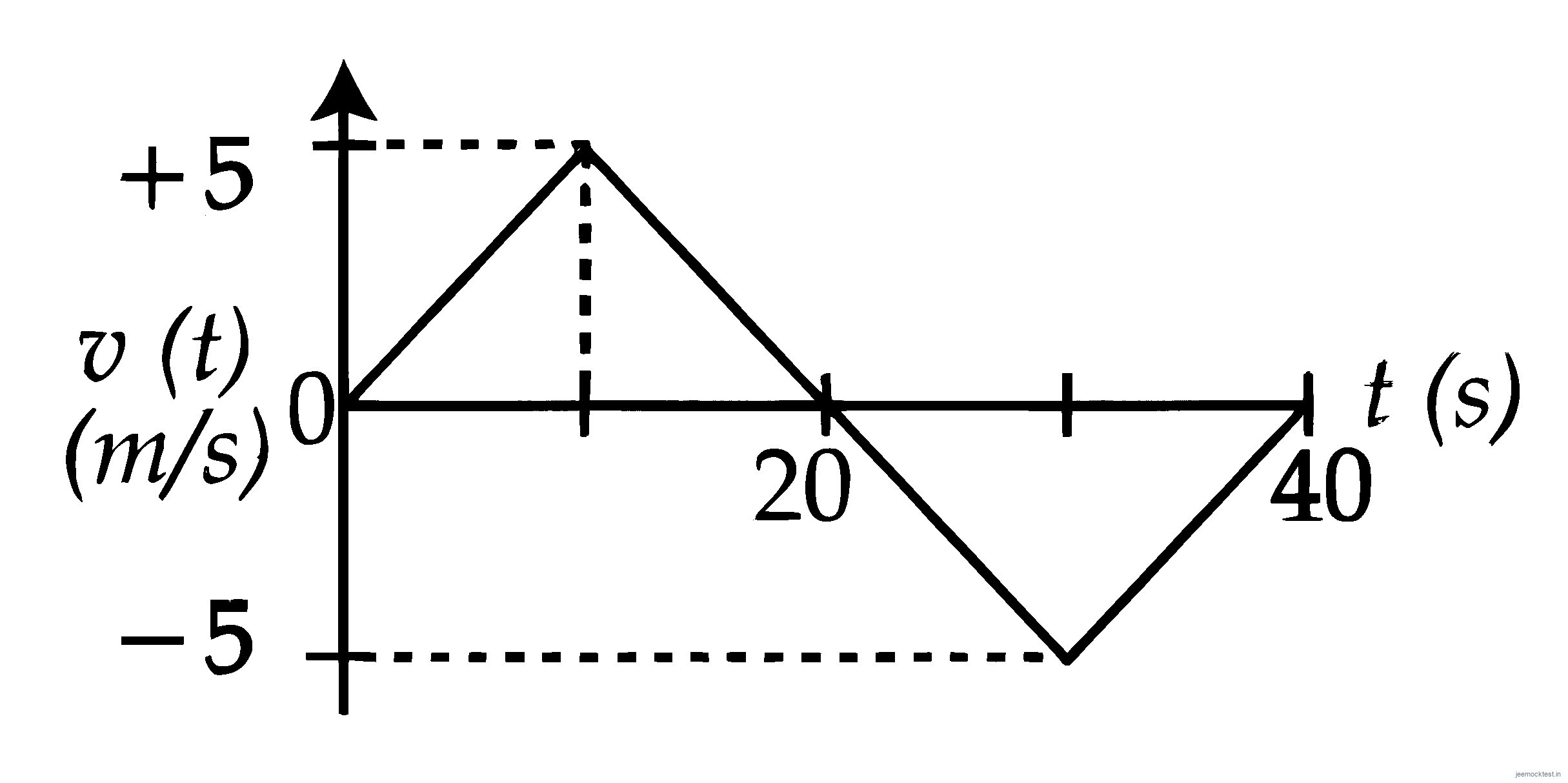
Two cars and are moving in the same direction along a straight line with speeds and , respectively such that car is moving ahead of car . A person in car throws a stone with a speed so that it hits the car with a speed of . The value of is .
A particle starts moving from time and its coordinate is given as
A. The particle returns to its original position (origin) 0.866 units later
B. The particle is 1 unit away from origin at its turning point
C. Acceleration of the particle is non-negative
D. The particle is 0.5 units away from origin at its turning point
E. Particle never turns back as acceleration is non-negative
Choose the correct answer from the options given below :