JEE PYQ: Motion in a Straight Line - Question ID 9f389321e511 (JEE Main 2022)
A particle is moving in a straight line such that its velocity is increasing at 5 ms1 per meter. The acceleration of the particle is _____________ ms2 at a point where its velocity is 20 ms1.
Your Answer
Step-by-step Explanation
When a particle moves in a straight line, its acceleration is defined as the rate of change of velocity with respect to time: However, in this problem, the velocity is given to be increasing at a rate of per meter. This implies that the change in velocity depends on the displacement (), not directly on time. To relate these quantities, we use the chain rule of calculus: Here:
- is the velocity of the particle.
- represents the rate of change of velocity with respect to displacement, which is given as per meter.
Given:
- The velocity increases at a rate of per meter, i.e., .
- The velocity at the point of interest is .
- (since and ).
- Misinterpreting the given rate: Students often confuse with . The problem states that velocity increases "per meter," not "per second," so is the correct quantity to use. Always read the units carefully.
- Incorrect application of the chain rule: Some students forget to multiply by when converting to . Remember that is the key relationship here.
- Unit confusion: Mixing up the units of (which is ) with those of acceleration () can lead to errors. Always verify the units at each step to ensure consistency.
- Assuming constant acceleration: The problem does not state that acceleration is constant. The given rate () may vary, but we are only asked for the acceleration at a specific velocity. Avoid unnecessary assumptions.
Related Questions from Motion in a Straight Line
A gas balloon is going up with a constant velocity of . When this balloon reached a height of 75 m , a stone is dropped from it and balloon keeps moving up with the same velocity. The height of the balloon when the stone hits the ground is m. (Take )
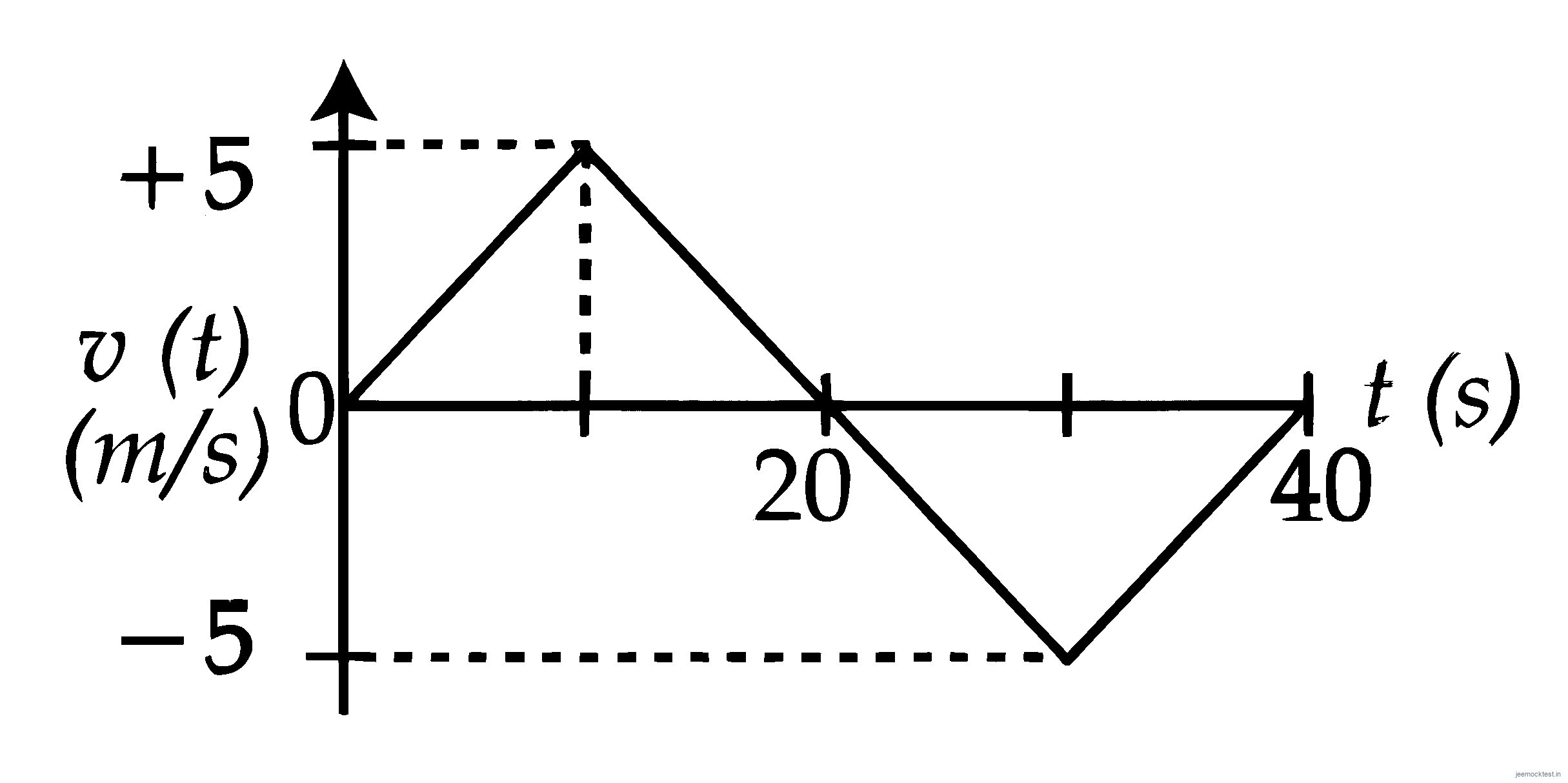
The velocity versus time plot of a particle is shown in the figure, for a time interval of 40 s . The total distance travelled by the particle and the average velocity during this period are, respectively
.
Two cars and are moving in the same direction along a straight line with speeds and , respectively such that car is moving ahead of car . A person in car throws a stone with a speed so that it hits the car with a speed of . The value of is .
A particle starts moving from time and its coordinate is given as
A. The particle returns to its original position (origin) 0.866 units later
B. The particle is 1 unit away from origin at its turning point
C. Acceleration of the particle is non-negative
D. The particle is 0.5 units away from origin at its turning point
E. Particle never turns back as acceleration is non-negative
Choose the correct answer from the options given below :