JEE PYQ: Motion in a Straight Line - Question ID 9da4accc5022 (JEE Main 2002)
Select Option
Step-by-step Explanation
In this problem, we analyze the motion of two identical cars that come to rest under the influence of braking. The key concept here is kinematic motion under uniform deceleration. When a car decelerates uniformly (constant braking force), its motion can be described using the following kinematic equation:
Where:
- = final velocity (0, since the car stops),
- = initial velocity at the instant braking begins,
- = acceleration (deceleration, so negative in sign),
- = stopping distance (the distance traveled while braking).
Since the cars are identical, they experience the same braking force, and hence the same magnitude of deceleration, denoted as . This assumption is crucial: identical cars imply identical braking systems and thus identical deceleration.
We are to find the ratio of stopping distances for two cars with initial speeds and .
Step-by-Step Derivation:Let’s denote:
- Car 1: initial speed = , stopping distance =
- Car 2: initial speed = , stopping distance =
Both cars come to rest, so final velocity for both.
Apply the kinematic equation to Car 1:
Solve for :
Now apply the same equation to Car 2:
Solve for :
But from Car 1, we have , so we can also write:
Wait — this seems to suggest , which would imply a ratio . But let's double-check the algebra carefully.
Actually, from Car 1:
From Car 2:
Wait — no. Let's simplify carefully:
But , so . Therefore:
So , hence the ratio .
Alternatively, a simpler approach:
From , with :
So stopping distance is proportional to , since is constant.
Therefore:
Thus, the ratio of stopping distances is .
Common Traps & Exam Tip:Many students make the following mistakes:
- Assuming stopping distance is proportional to speed: They think if speed doubles, stopping distance doubles. But in reality, stopping distance depends on kinetic energy, which is proportional to . So if speed becomes 4 times, stopping distance becomes 16 times — not 4 times.
- Ignoring the fact that deceleration is the same: Since the cars are identical, they have the same braking force and mass, so same deceleration. Students sometimes assume different decelerations based on speed, which is incorrect.
- Misapplying the kinematic equation: Forgetting that is negative (deceleration) and incorrectly solving for . Always ensure the sign of acceleration is consistent with the direction of motion.
Exam Tip: Remember that for uniform deceleration, stopping distance . This is a direct consequence of the work-energy principle: the work done by braking force equals the change in kinetic energy. Since work = force × distance, and force is constant, .
So, the correct answer is D: .
Related Questions from Motion in a Straight Line
A gas balloon is going up with a constant velocity of . When this balloon reached a height of 75 m , a stone is dropped from it and balloon keeps moving up with the same velocity. The height of the balloon when the stone hits the ground is m. (Take )
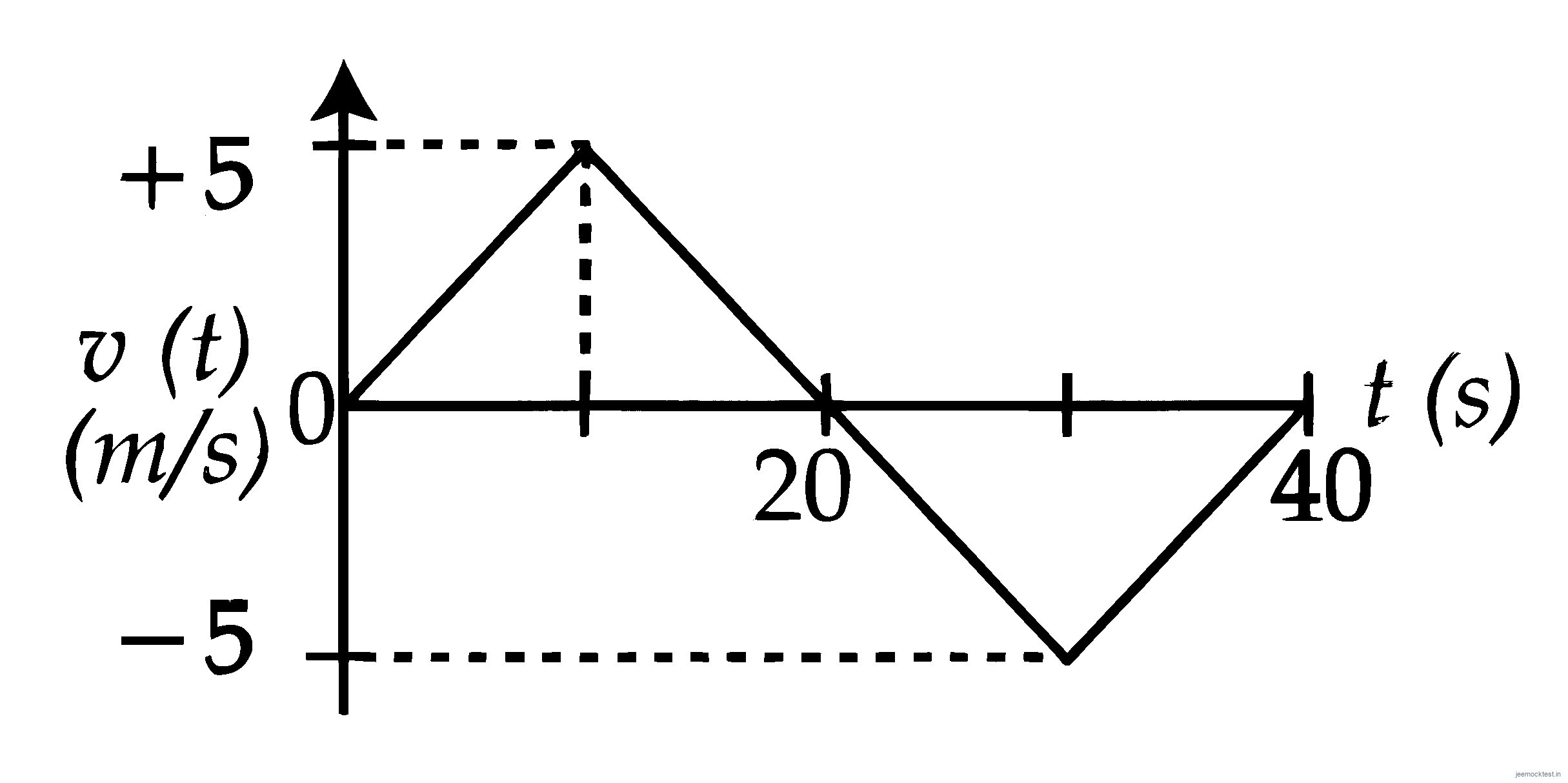
The velocity versus time plot of a particle is shown in the figure, for a time interval of 40 s . The total distance travelled by the particle and the average velocity during this period are, respectively
.
Two cars and are moving in the same direction along a straight line with speeds and , respectively such that car is moving ahead of car . A person in car throws a stone with a speed so that it hits the car with a speed of . The value of is .
A particle starts moving from time and its coordinate is given as
A. The particle returns to its original position (origin) 0.866 units later
B. The particle is 1 unit away from origin at its turning point
C. Acceleration of the particle is non-negative
D. The particle is 0.5 units away from origin at its turning point
E. Particle never turns back as acceleration is non-negative
Choose the correct answer from the options given below :