JEE PYQ: Motion in a Straight Line - Question ID 8ce9a4360053 (JEE Main 2023)
The distance travelled by a particle is related to time t as . The velocity of the particle at t=5s is :-
Select Option
Step-by-step Explanation
In kinematics, the position of a particle moving along a straight line is often given as a function of time, . The instantaneous velocity of the particle at any time is defined as the derivative of the position function with respect to time. Mathematically, This formula arises from the fundamental definition of velocity as the rate of change of displacement.
In this problem, the position function is given as . To find the velocity at a specific time (here, s), we must differentiate with respect to and then substitute the value of .
Step-by-Step Derivation:
Step 1: Write the given position function.
The distance travelled by the particle is given by:
where is in meters and is in seconds.
Step 2: Differentiate the position function to find velocity.
Velocity is the time derivative of position:
Using the power rule of differentiation, , we get:
So, the velocity as a function of time is:
Step 3: Substitute s to find the velocity at that instant.
Step 4: Match with the given options.
The calculated velocity at s is , which corresponds to option D.
Trap 1: Confusing distance with displacement.
Some students mistakenly think that represents displacement, but in this context, it's given as the distance travelled. However, since the motion is along a straight line and the function is increasing, distance and displacement are numerically equal. Still, it's crucial to recognize that velocity is the derivative of position (or displacement), not necessarily distance.
Trap 2: Forgetting to differentiate.
A common error is to directly substitute into and assume that m is the velocity. This is incorrect because velocity is the rate of change of position, not the position itself.
Trap 3: Misapplying differentiation rules.
Students sometimes differentiate incorrectly, such as writing or . Always apply the power rule carefully: .
Exam Tip:
Whenever you see a position-time function, immediately think: "Velocity is the derivative of position with respect to time." This is a fundamental concept in kinematics and appears frequently in JEE problems. Practice differentiating polynomial functions quickly and accurately.
Related Questions from Motion in a Straight Line
A gas balloon is going up with a constant velocity of . When this balloon reached a height of 75 m , a stone is dropped from it and balloon keeps moving up with the same velocity. The height of the balloon when the stone hits the ground is m. (Take )
The velocity versus time plot of a particle is shown in the figure, for a time interval of 40 s . The total distance travelled by the particle and the average velocity during this period are, respectively
.
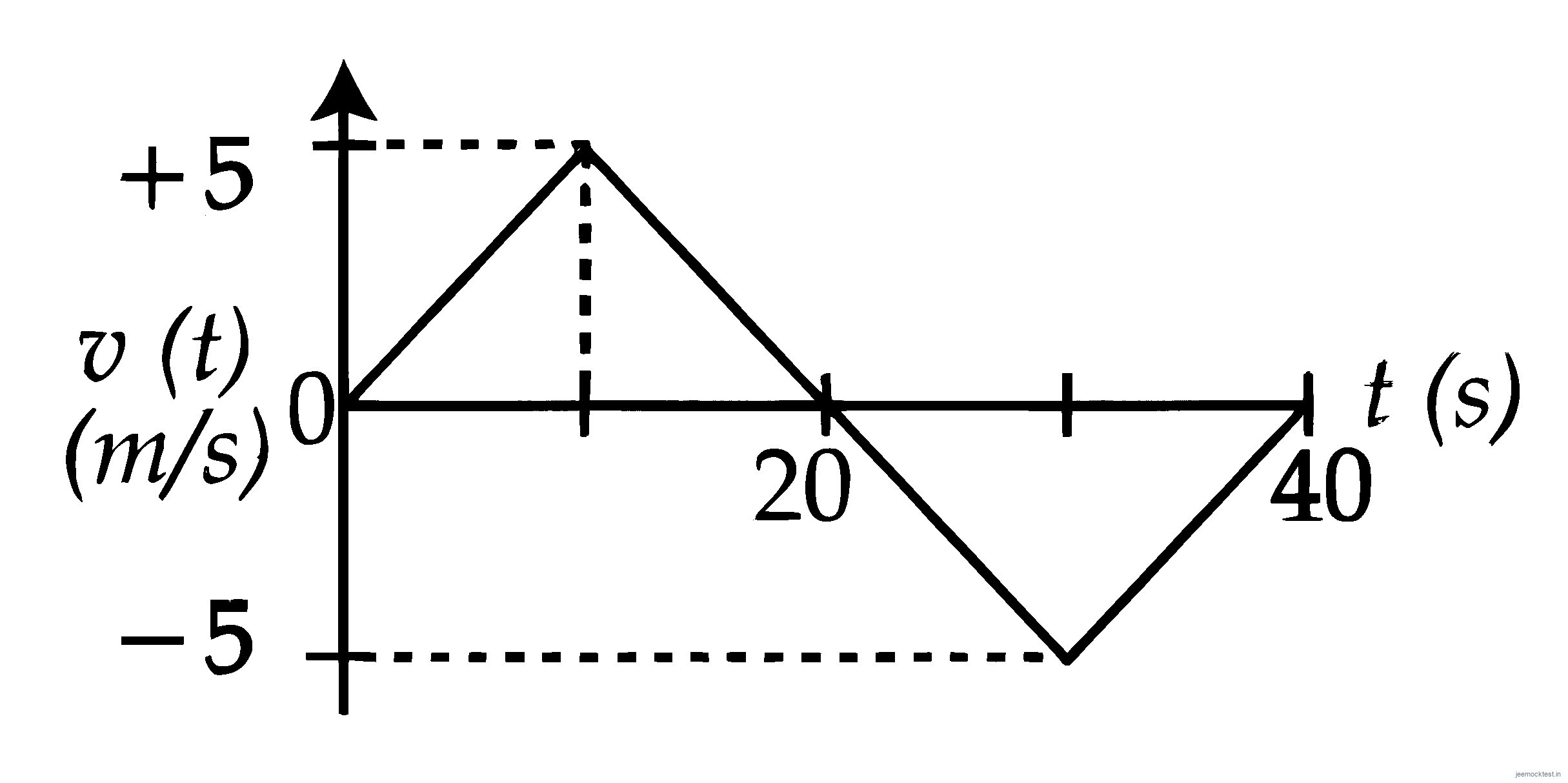
Two cars and are moving in the same direction along a straight line with speeds and , respectively such that car is moving ahead of car . A person in car throws a stone with a speed so that it hits the car with a speed of . The value of is .
A particle starts moving from time and its coordinate is given as
A. The particle returns to its original position (origin) 0.866 units later
B. The particle is 1 unit away from origin at its turning point
C. Acceleration of the particle is non-negative
D. The particle is 0.5 units away from origin at its turning point
E. Particle never turns back as acceleration is non-negative
Choose the correct answer from the options given below :