JEE PYQ: Motion in a Straight Line - Question ID 6f21fa5c9d50 (JEE Main 2003)
Select Option
Step-by-step Explanation
In problems involving braking distances, the key physics concept is the work-energy theorem. When brakes are applied, the kinetic energy of the car is dissipated by the work done by the braking force. Assuming the braking force is constant, the work done by the brakes equals the change in kinetic energy of the car.
The relevant formulas are:
- Kinetic energy: , where is the mass of the car and is its speed.
- Work done by braking force: , where is the magnitude of the braking force and is the stopping distance.
Since the car comes to rest, the work done by the brakes equals the initial kinetic energy:
From this, we can express the stopping distance as:
Notice that the stopping distance depends on the square of the speed. This is the crucial insight for solving the problem.
Step-by-Step Derivation:
Step 1: Convert speeds to consistent units
The given speeds are in km/hr. To make calculations easier, convert them to m/s:
However, since we are dealing with ratios, we can avoid explicit conversion by working directly with the ratio of speeds.
Step 2: Express stopping distance in terms of speed
From the work-energy relation:
Let be the stopping distance at speed , and be the stopping distance at speed . Then:
Taking the ratio of to :
Step 3: Substitute the given values
Given , , and :
Thus:
Conclusion: The minimum stopping distance at 100 km/hr is 24 m, which corresponds to option C.
Common Traps & Exam Tip:
Trap 1: Linear thinking
Many students mistakenly assume that doubling the speed doubles the stopping distance. This leads them to choose 12 m (option A). However, stopping distance depends on the square of the speed, not the speed itself.
Trap 2: Ignoring unit consistency
While the ratio method avoids explicit unit conversion, some students convert speeds incorrectly, leading to calculation errors. Always ensure units are consistent when performing numerical calculations.
Exam Tip:
When dealing with braking or stopping distances, always check if the relationship is linear or quadratic with respect to speed. The work-energy theorem is a powerful tool for such problems, and recognizing the dependence is key to avoiding mistakes.
Related Questions from Motion in a Straight Line
A gas balloon is going up with a constant velocity of . When this balloon reached a height of 75 m , a stone is dropped from it and balloon keeps moving up with the same velocity. The height of the balloon when the stone hits the ground is m. (Take )
The velocity versus time plot of a particle is shown in the figure, for a time interval of 40 s . The total distance travelled by the particle and the average velocity during this period are, respectively
.
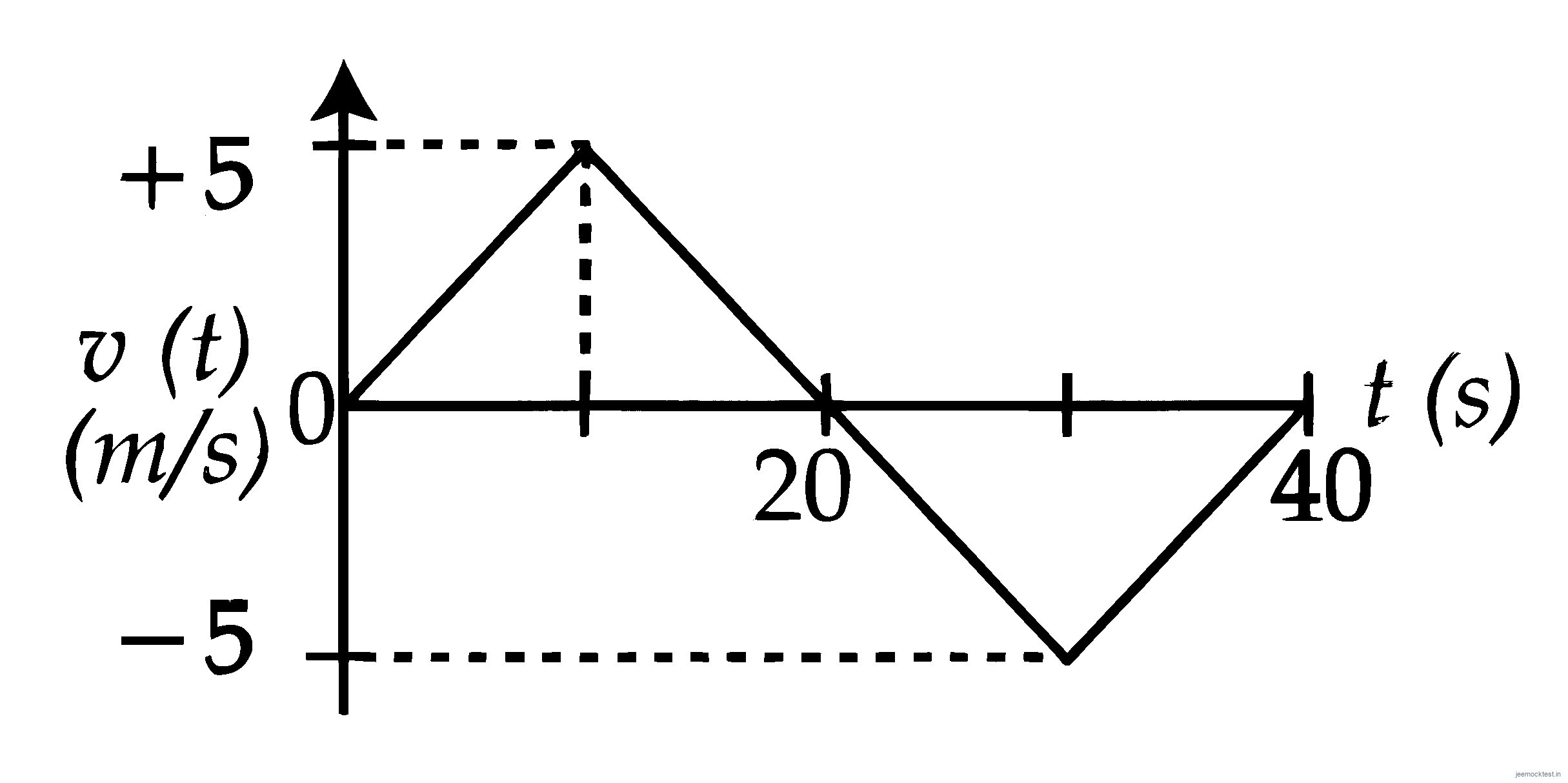
Two cars and are moving in the same direction along a straight line with speeds and , respectively such that car is moving ahead of car . A person in car throws a stone with a speed so that it hits the car with a speed of . The value of is .
A particle starts moving from time and its coordinate is given as
A. The particle returns to its original position (origin) 0.866 units later
B. The particle is 1 unit away from origin at its turning point
C. Acceleration of the particle is non-negative
D. The particle is 0.5 units away from origin at its turning point
E. Particle never turns back as acceleration is non-negative
Choose the correct answer from the options given below :