JEE PYQ: Motion in a Straight Line - Question ID 6dbf0a9a7b1a (JEE Main 2020)
[g is the acceleration due to gravity]
Select Option
Step-by-step Explanation
When an object moves with constant acceleration, its motion can be described using the kinematic equations. The key formulas we will use are:
- Displacement as a function of time:
- Velocity as a function of time:
Here, is the initial velocity, is the acceleration, is the time, and is the displacement.
In this problem:
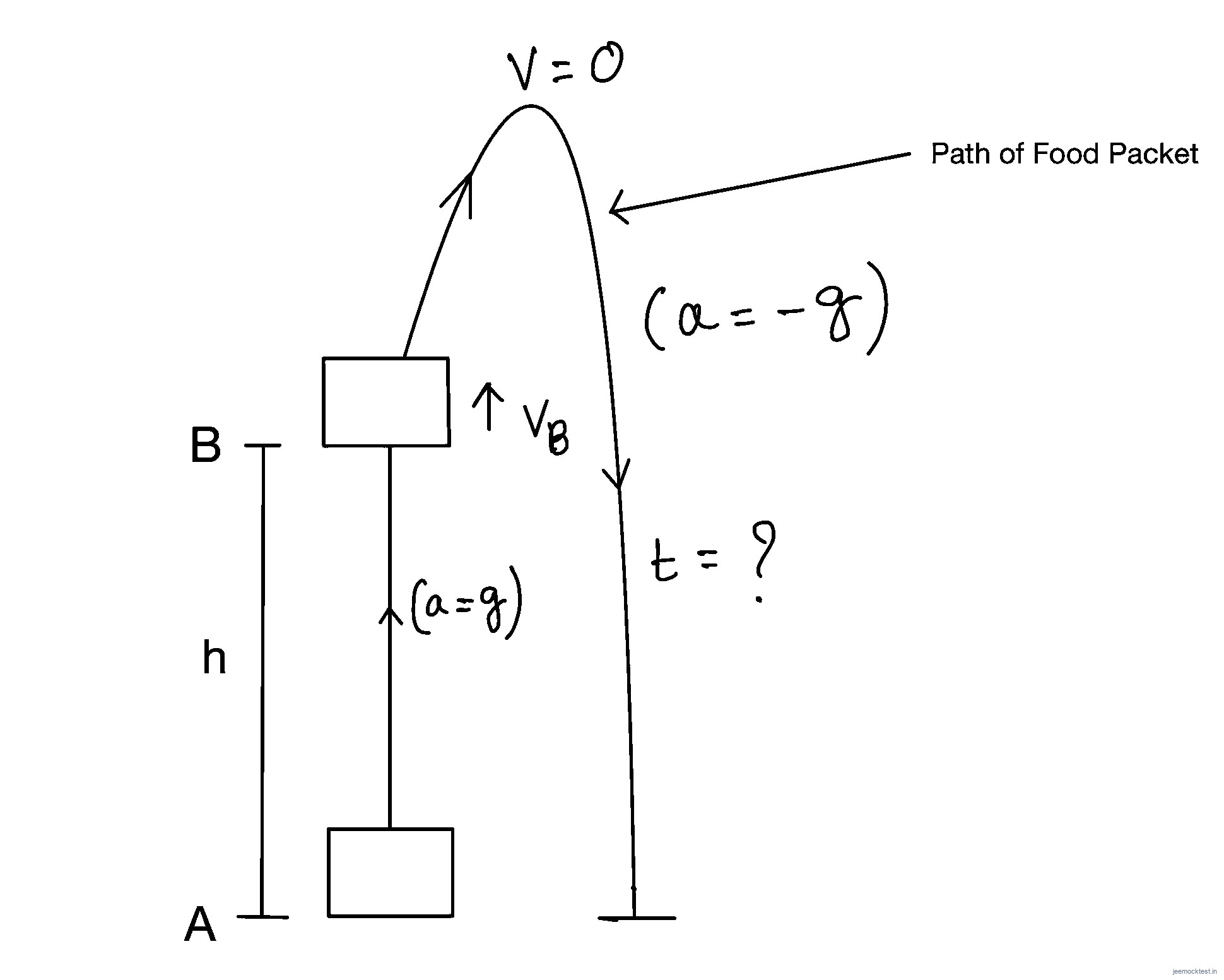
- The helicopter starts from rest and accelerates upward with acceleration . This means its initial velocity is , and its acceleration is (taking upward as positive).
- When the helicopter reaches height , a food packet is dropped. At that instant, the packet has the same velocity as the helicopter (since it was inside the helicopter).
- Once dropped, the packet is under the influence of gravity alone, so it experiences acceleration (downward).
We need to find the time taken by the packet to reach the ground after being dropped from height .
Step-by-Step Derivation:Step 1: Find the velocity of the helicopter (and packet) at height
The helicopter starts from rest () and accelerates upward with acceleration . Let be the time taken by the helicopter to reach height . Using the displacement formula:
Solving for :
Now, the velocity of the helicopter (and packet) at height is:
So, when the packet is dropped, it has an initial upward velocity .
Step 2: Motion of the packet after being dropped
After being dropped, the packet moves under gravity with:
- Initial velocity: (upward)
- Acceleration: (downward)
- Displacement: (since it moves from height to the ground, which is downward)
Using the displacement formula:
Substituting the values:
Simplify:
Multiply both sides by :
Rearrange:
Multiply through by to simplify:
Divide the entire equation by to make it dimensionless:
Let . Then , and the equation becomes:
This is a quadratic equation in :
Solve for using the quadratic formula , where , , and :
Simplify the discriminant:
Thus:
We discard the negative root because time cannot be negative:
Substitute back :
Calculate the numerical value of :
Thus:
This matches option A.
Common Traps & Exam Tip:Students often make the following mistakes in this problem:
- Ignoring the initial velocity of the packet: Many assume the packet is dropped from rest, leading to the incorrect formula . However, the packet inherits the velocity of the helicopter at height , which is .
- Sign errors in acceleration: Some students take upward as negative or downward as positive, leading to incorrect signs in the kinematic equations. Always define a consistent coordinate system (e.g., upward as positive).
- Solving the quadratic equation incorrectly: The quadratic equation has two roots, but only the positive root is physically meaningful. Students sometimes pick the wrong root or make algebraic errors in solving the quadratic.
- Approximation errors: The exact solution is , and . Students may miscalculate this or confuse it with other numerical approximations.
Exam Tip: Always break the problem into two parts:
- Motion of the helicopter until the packet is dropped.
- Motion of the packet after being dropped.
Related Questions from Motion in a Straight Line
A gas balloon is going up with a constant velocity of . When this balloon reached a height of 75 m , a stone is dropped from it and balloon keeps moving up with the same velocity. The height of the balloon when the stone hits the ground is m. (Take )
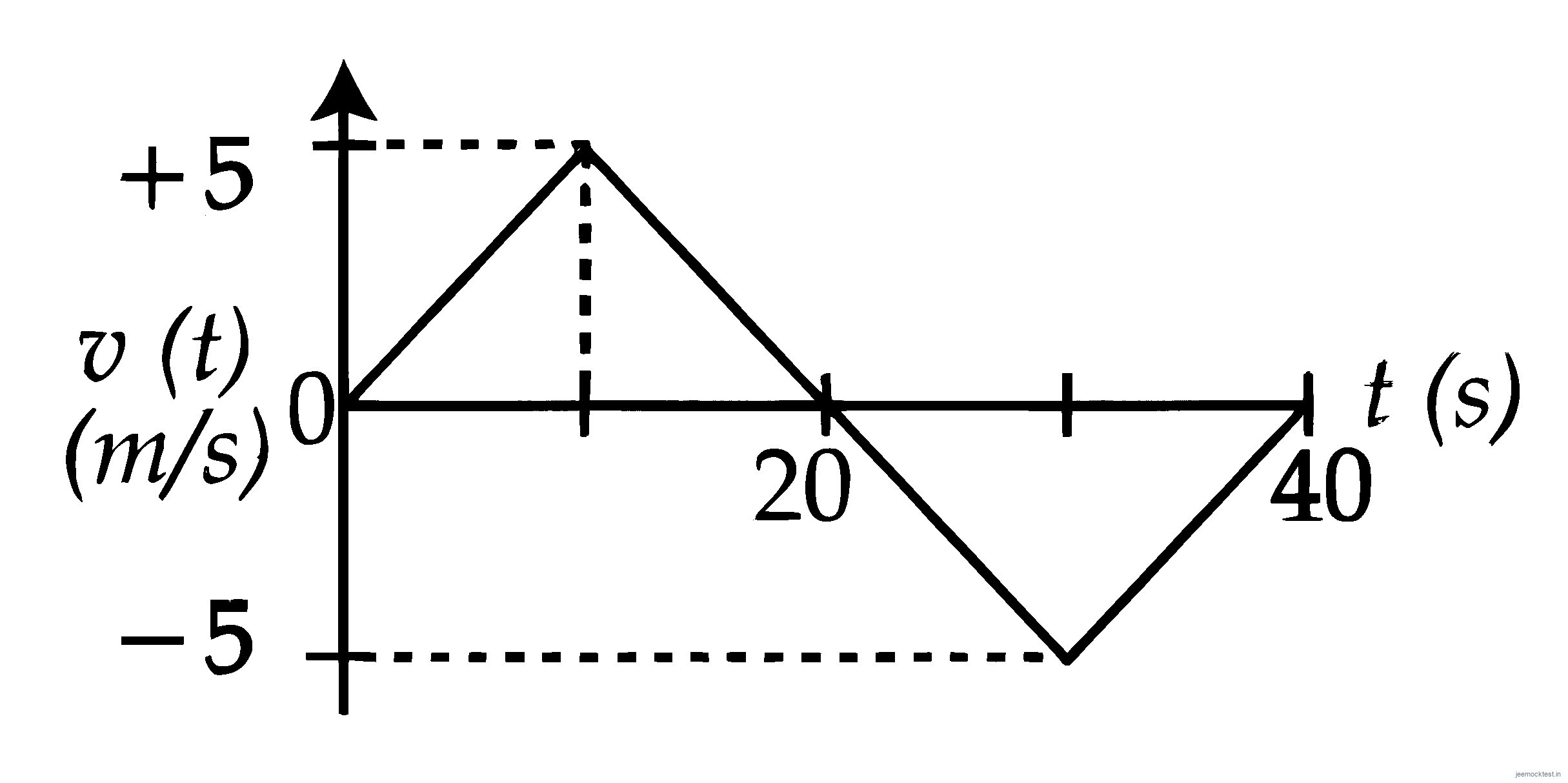
The velocity versus time plot of a particle is shown in the figure, for a time interval of 40 s . The total distance travelled by the particle and the average velocity during this period are, respectively
.
Two cars and are moving in the same direction along a straight line with speeds and , respectively such that car is moving ahead of car . A person in car throws a stone with a speed so that it hits the car with a speed of . The value of is .
A particle starts moving from time and its coordinate is given as
A. The particle returns to its original position (origin) 0.866 units later
B. The particle is 1 unit away from origin at its turning point
C. Acceleration of the particle is non-negative
D. The particle is 0.5 units away from origin at its turning point
E. Particle never turns back as acceleration is non-negative
Choose the correct answer from the options given below :