JEE PYQ: Motion in a Straight Line - Question ID 6bd5e2b4601d (JEE Main 2023)
Two trains 'A' and 'B' of length '' and '' are travelling into a tunnel of length '' in parallel tracks from opposite directions with velocities and , respectively. If train 'A' takes less time than train 'B' to cross the tunnel then. length '' of tunnel is :
(Given )
Select Option
Step-by-step Explanation
In problems involving trains crossing tunnels, the effective distance a train must cover is the sum of the tunnel length () and the train’s own length ( or ). This is because the train is considered to have completely crossed the tunnel only when its last carriage exits the tunnel.
The key formula is: where the distance is , and the speed must be in consistent units (here, converted from km/h to m/s).
Since the trains are moving in opposite directions, their relative speed is the sum of their individual speeds. However, in this problem, each train’s time to cross the tunnel is calculated independently, so relative speed is not directly needed.
Step-by-Step Derivation:Step 1: Convert velocities to m/s
Train A’s speed:
Train B’s speed:
Step 2: Express the time taken by each train to cross the tunnel
For Train A (length ):
For Train B (length ):
Step 3: Use the given time difference
The problem states that Train A takes less time than Train B: Substitute the expressions for and :
Step 4: Solve for in terms of
Multiply through by (LCM of 20 and 30) to eliminate denominators: Simplify: Given that (from the problem statement), substitute: Now, compute :
Step 5: Verify the answer matches the options
The calculated tunnel length is , which corresponds to option C.
Common Traps & Exam Tip:
Trap 1: Forgetting to add the train’s length to the tunnel length. Students often mistakenly use only as the distance, ignoring the train’s own length.
Trap 2: Incorrect unit conversion. Failing to convert km/h to m/s leads to wrong numerical results. Always double-check unit consistency.
Trap 3: Misinterpreting the time difference. Some students reverse the order of and , leading to a negative time difference. Carefully read the problem statement to avoid this.
Exam Tip: When dealing with trains and tunnels, always draw a quick sketch to visualize the scenario. This helps in identifying the correct effective distance (tunnel length + train length).
Related Questions from Motion in a Straight Line
A gas balloon is going up with a constant velocity of . When this balloon reached a height of 75 m , a stone is dropped from it and balloon keeps moving up with the same velocity. The height of the balloon when the stone hits the ground is m. (Take )
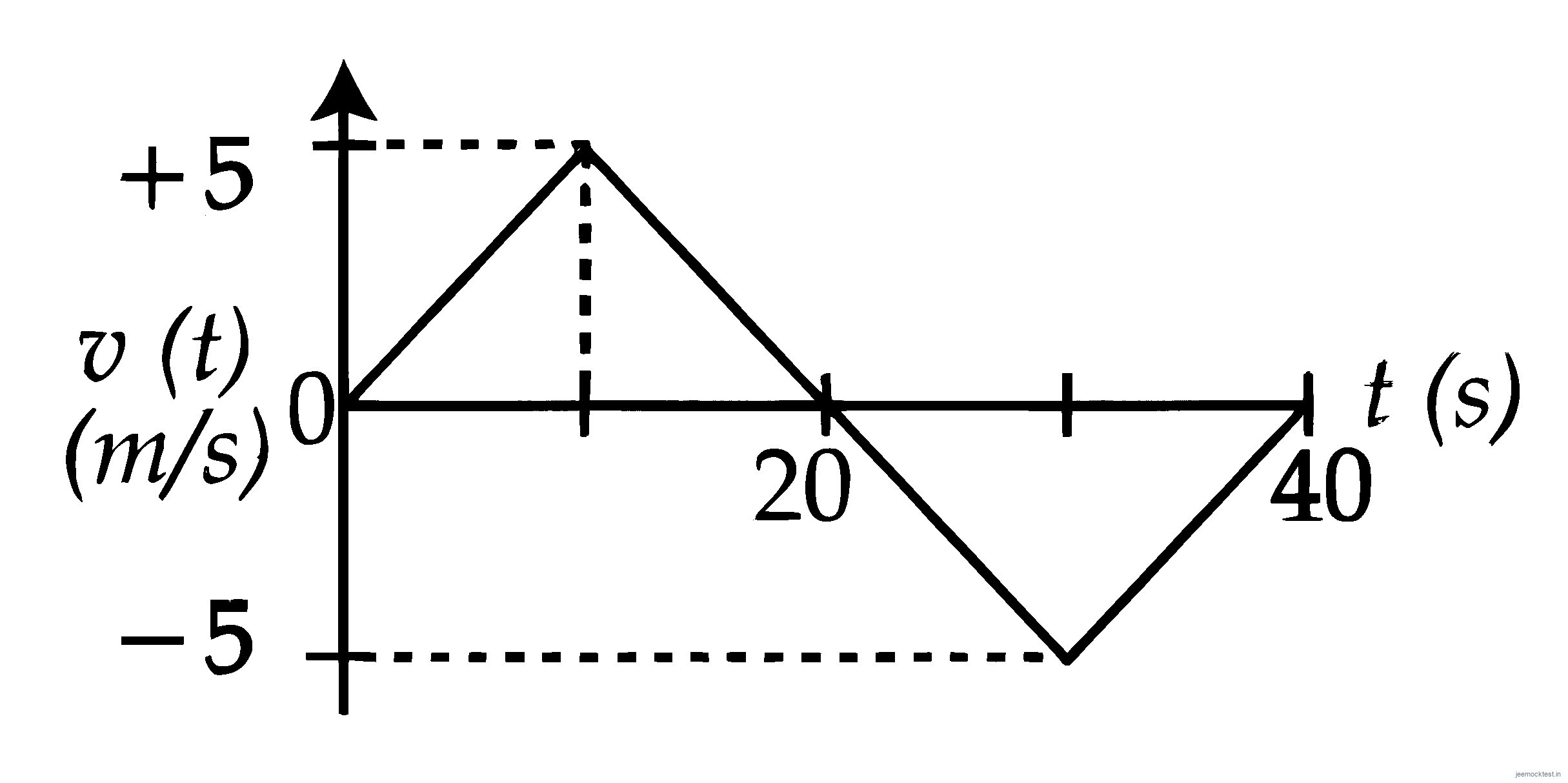
The velocity versus time plot of a particle is shown in the figure, for a time interval of 40 s . The total distance travelled by the particle and the average velocity during this period are, respectively
.
Two cars and are moving in the same direction along a straight line with speeds and , respectively such that car is moving ahead of car . A person in car throws a stone with a speed so that it hits the car with a speed of . The value of is .
A particle starts moving from time and its coordinate is given as
A. The particle returns to its original position (origin) 0.866 units later
B. The particle is 1 unit away from origin at its turning point
C. Acceleration of the particle is non-negative
D. The particle is 0.5 units away from origin at its turning point
E. Particle never turns back as acceleration is non-negative
Choose the correct answer from the options given below :