JEE PYQ: Motion in a Straight Line - Question ID 667801bfc50f (JEE Main 2022)
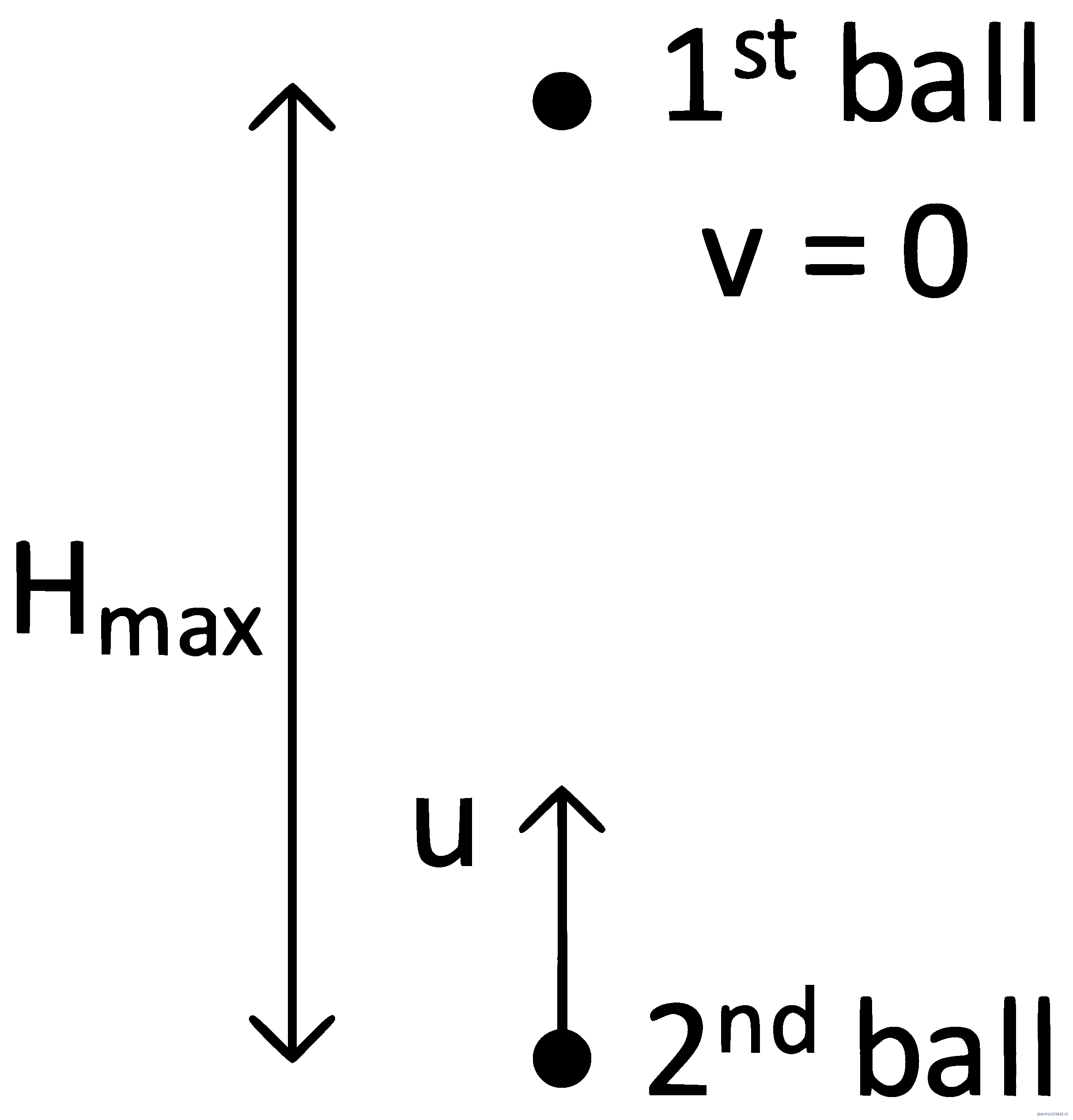
A juggler throws balls vertically upwards with same initial velocity in air. When the first ball reaches its highest position, he throws the next ball. Assuming the juggler throws n balls per second, the maximum height the balls can reach is
Select Option
Step-by-step Explanation
To solve this problem, we rely on the kinematic equations governing motion under constant acceleration (gravity, , acting downward). The key concepts and formulas are:
- Vertical motion under gravity: When an object is thrown upward, its acceleration is (assuming upward as positive). The velocity decreases linearly with time until it momentarily becomes zero at the highest point.
- Time to reach maximum height (): If a ball is thrown upward with initial velocity , the time to reach the highest point is given by:
- Maximum height (): Using the displacement equation: Substituting : So,
- Frequency of throwing balls (): The juggler throws balls per second. This means the time interval between consecutive throws is:
- Key insight: The problem states that the next ball is thrown when the first ball reaches its highest point. This implies that the time between throws () is equal to the time taken by a ball to reach its maximum height (). Therefore: From this, we can solve for :
We now derive the maximum height in terms of and .
- From the key insight above, we have:
- Substitute into the expression for maximum height:
- Thus, the maximum height reached by the balls is:
- Comparing with the given options, this matches option D.
Students often make the following mistakes:
- Misinterpreting the throwing frequency: Some confuse (balls per second) with the time interval. They may incorrectly set instead of . Always remember: if balls are thrown per second, the time between throws is .
- Incorrect sign convention: Taking as positive when upward is positive leads to errors in the kinematic equations. Always define a consistent sign convention (e.g., upward positive, so acceleration is ).
- Confusing and : Some students directly equate , ignoring the formula. Always derive from first principles.
- Algebraic errors: Squaring and simplifying is a common source of mistakes. Double-check each algebraic step.
Exam Tip: In juggling or periodic motion problems, always relate the time between events (here, throws) to the kinematic time (here, time to reach max height). This connection is the key to solving such problems.
Related Questions from Motion in a Straight Line
A gas balloon is going up with a constant velocity of . When this balloon reached a height of 75 m , a stone is dropped from it and balloon keeps moving up with the same velocity. The height of the balloon when the stone hits the ground is m. (Take )
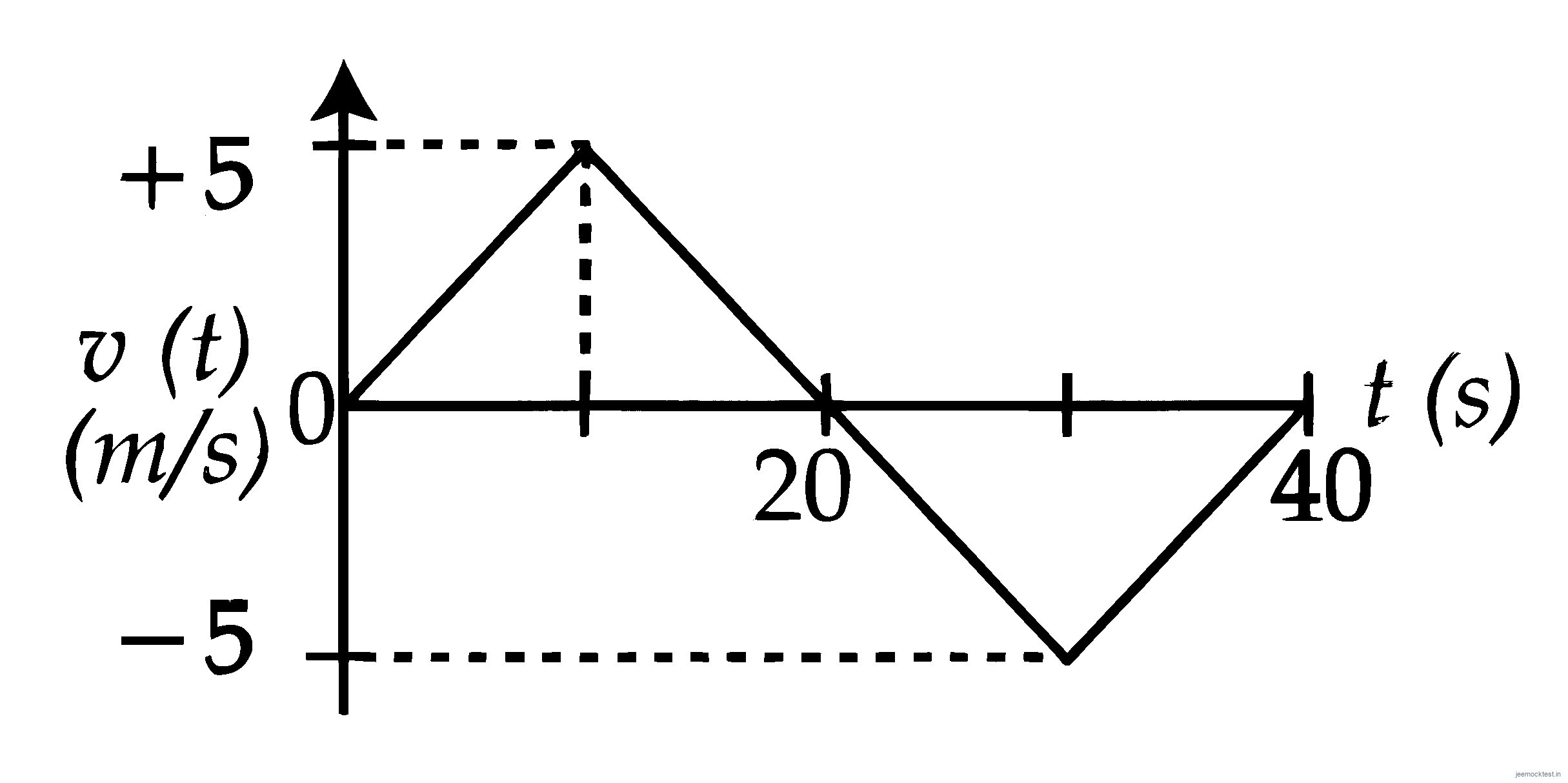
The velocity versus time plot of a particle is shown in the figure, for a time interval of 40 s . The total distance travelled by the particle and the average velocity during this period are, respectively
.
Two cars and are moving in the same direction along a straight line with speeds and , respectively such that car is moving ahead of car . A person in car throws a stone with a speed so that it hits the car with a speed of . The value of is .
A particle starts moving from time and its coordinate is given as
A. The particle returns to its original position (origin) 0.866 units later
B. The particle is 1 unit away from origin at its turning point
C. Acceleration of the particle is non-negative
D. The particle is 0.5 units away from origin at its turning point
E. Particle never turns back as acceleration is non-negative
Choose the correct answer from the options given below :