JEE PYQ: Motion in a Straight Line - Question ID 63a001282c8f (JEE Main 2021)
Select Option
Step-by-step Explanation
In problems involving uniformly accelerated motion in a straight line, the following kinematic relations are fundamental:
-
Velocity–displacement relation (no time involved):
where
= initial velocity,
= final velocity,
= uniform acceleration,
= displacement. - Velocity at any intermediate point can be found by applying the same relation to the segment of interest.
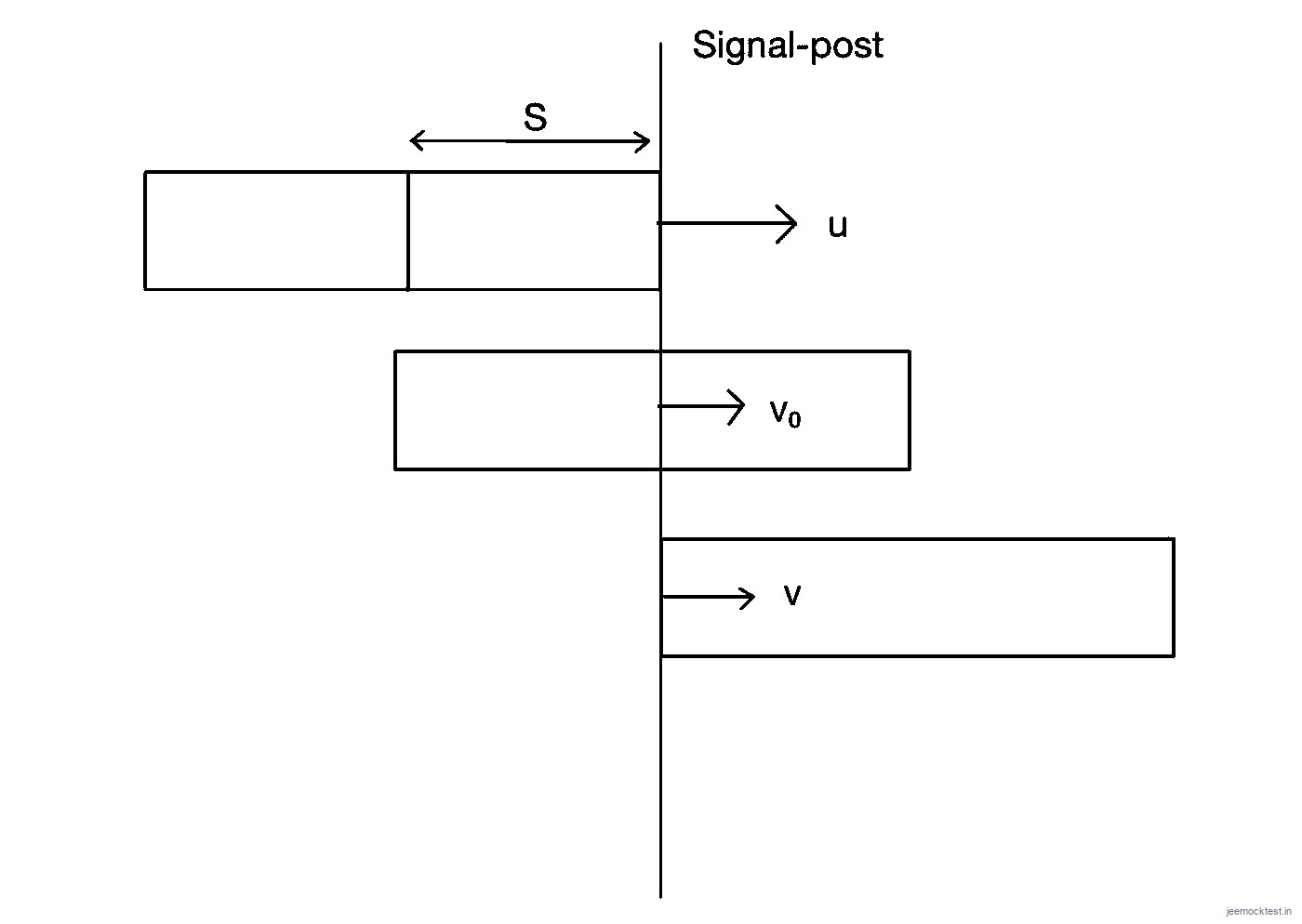
Here the train’s engine (front) passes the signal post with speed and the last compartment (rear) passes it with speed . We are to find the speed of the middle point of the train as it passes the same signal post.
Step-by-Step Derivation:1. Let the total length of the train be . 2. When the engine (front) passes the signal post, its velocity is . 3. When the last compartment (rear) passes the same post, the engine has moved forward by distance and its velocity has increased to . 4. Apply the velocity–displacement relation over the entire train length : 5. Now consider the middle point of the train. As the engine moves from the signal post to the position where the middle point reaches the post, the engine covers a distance . 6. Let be the velocity of the middle point when it passes the post. Applying the same kinematic relation over the half-length gives 7. Substitute from step 4: 8. Therefore the required velocity is
Common Traps & Exam Tip:
• Many students mistakenly take the arithmetic mean (option A), forgetting that velocity under uniform acceleration does not vary linearly with distance.
• Others confuse the velocity–displacement relation with the velocity–time relation and arrive at incorrect expressions.
• Exam Tip: Always write down the kinematic relation that connects the known quantities (here ) and then apply it to the segment of interest.
Related Questions from Motion in a Straight Line
A gas balloon is going up with a constant velocity of . When this balloon reached a height of 75 m , a stone is dropped from it and balloon keeps moving up with the same velocity. The height of the balloon when the stone hits the ground is m. (Take )
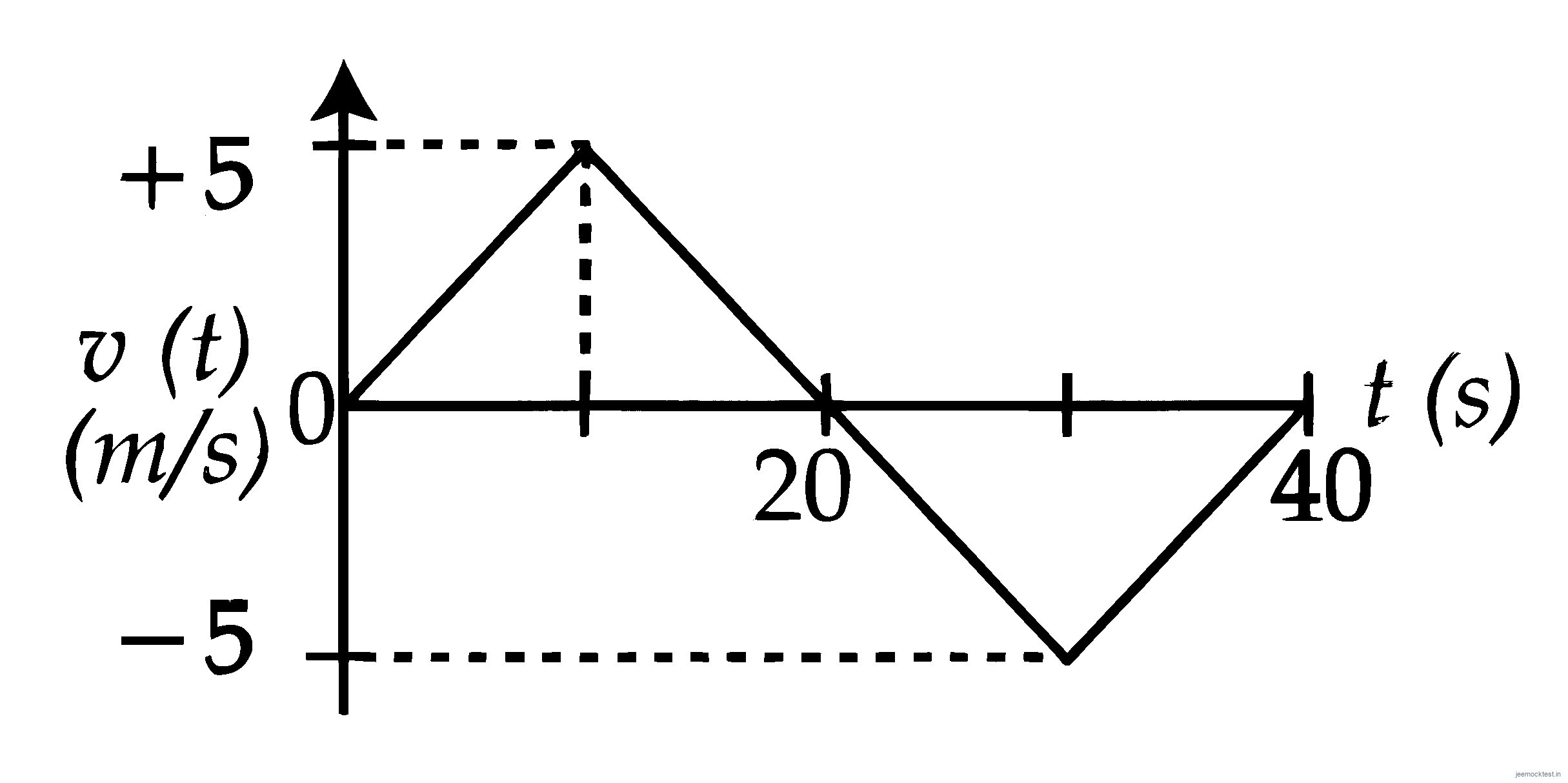
The velocity versus time plot of a particle is shown in the figure, for a time interval of 40 s . The total distance travelled by the particle and the average velocity during this period are, respectively
.
Two cars and are moving in the same direction along a straight line with speeds and , respectively such that car is moving ahead of car . A person in car throws a stone with a speed so that it hits the car with a speed of . The value of is .
A particle starts moving from time and its coordinate is given as
A. The particle returns to its original position (origin) 0.866 units later
B. The particle is 1 unit away from origin at its turning point
C. Acceleration of the particle is non-negative
D. The particle is 0.5 units away from origin at its turning point
E. Particle never turns back as acceleration is non-negative
Choose the correct answer from the options given below :