JEE PYQ: Motion in a Straight Line - Question ID 62e6b08b1cf2 (JEE Main 2021)
Select Option
Step-by-step Explanation
In problems involving motion with constant acceleration (or deceleration), the fundamental kinematic equations are used. The key formulas relevant here are:
- Velocity as a function of time: , where is the initial velocity, is the acceleration, and is the time.
- Displacement as a function of time: . However, in this problem, displacement is not directly required.
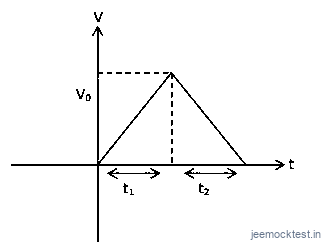
Since the scooter starts from rest, the initial velocity . The scooter first accelerates with for time , reaching a maximum velocity . Then, it decelerates with for time , coming to rest. The key insight is that the final velocity after deceleration is zero, and the velocity just before deceleration is the same as the velocity just after acceleration.
Step-by-Step Derivation:Let’s break down the motion into two phases:
Phase 1: AccelerationThe scooter starts from rest () and accelerates at for time . Using the velocity formula:
Since , Phase 2: DecelerationThe scooter now decelerates at for time and comes to rest. Here, the initial velocity for this phase is (from Phase 1), and the final velocity is . Using the velocity formula again:
(The negative sign is because deceleration is opposite to the direction of motion.) Rearranging, Equating Velocities:From Equation 1 and Equation 2, both equal , so we can set them equal to each other:
Solving for :Rearrange the equation to isolate :
This matches option C.
Common Traps & Exam Tip:Students often make the following mistakes in this question:
- Incorrect Sign Handling: Some students forget that deceleration is negative acceleration and write instead of . However, since we are dealing with magnitudes, the negative sign cancels out, and the final result remains correct. Still, it’s important to understand the direction of acceleration.
- Misapplying Formulas: Some students try to use the displacement formula unnecessarily, complicating the problem. This question only requires the velocity-time relationship.
- Confusing Ratios: Students may invert the ratio and choose (Option D) instead of . Always double-check which variable is in the numerator and denominator.
Exam Tip: For problems involving two phases of motion (acceleration followed by deceleration), always:
- Write the velocity equation for each phase.
- Equate the velocities at the transition point (since the velocity doesn’t change instantaneously).
- Solve for the required ratio or variable.
Related Questions from Motion in a Straight Line
A gas balloon is going up with a constant velocity of . When this balloon reached a height of 75 m , a stone is dropped from it and balloon keeps moving up with the same velocity. The height of the balloon when the stone hits the ground is m. (Take )
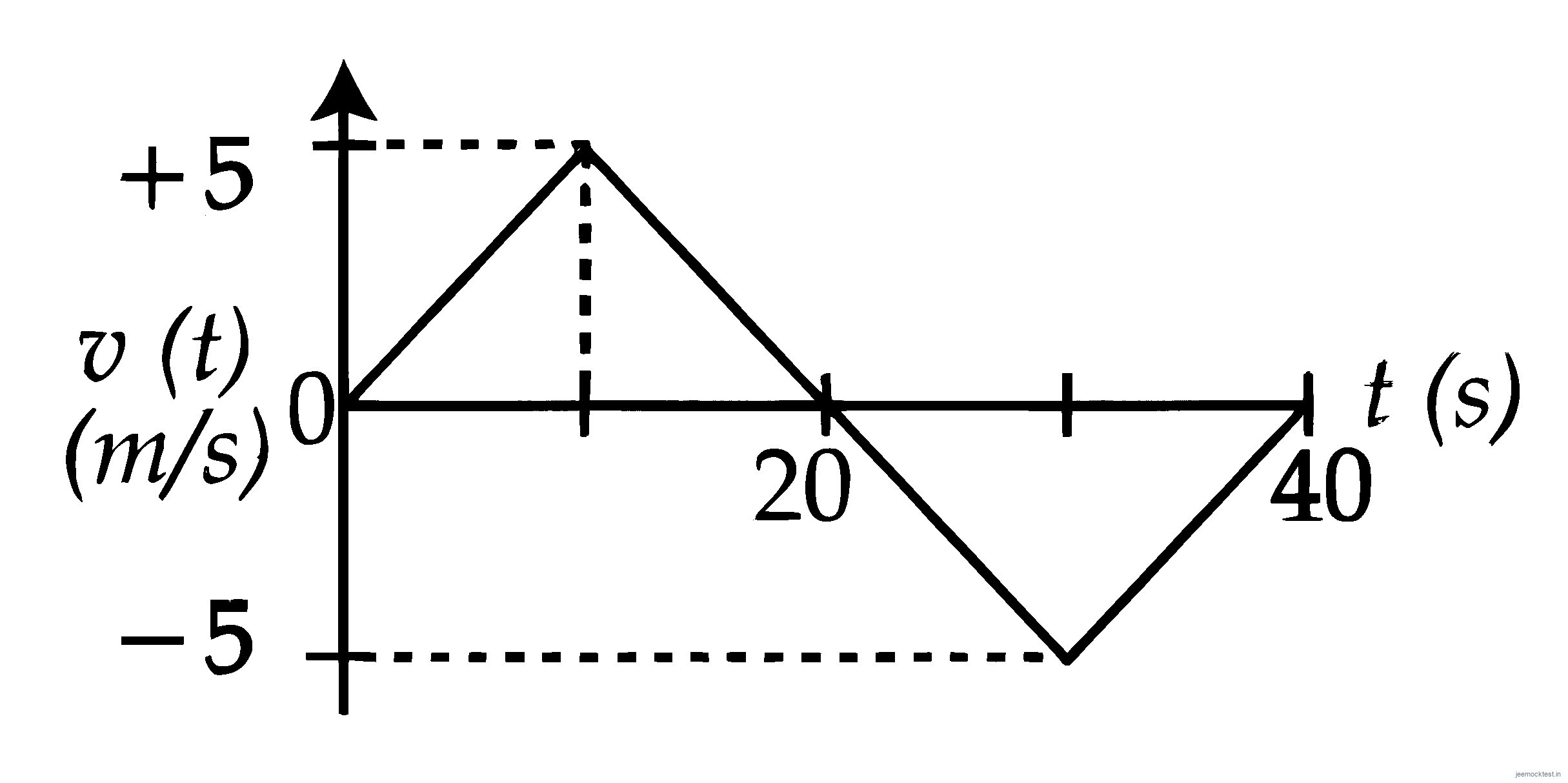
The velocity versus time plot of a particle is shown in the figure, for a time interval of 40 s . The total distance travelled by the particle and the average velocity during this period are, respectively
.
Two cars and are moving in the same direction along a straight line with speeds and , respectively such that car is moving ahead of car . A person in car throws a stone with a speed so that it hits the car with a speed of . The value of is .
A particle starts moving from time and its coordinate is given as
A. The particle returns to its original position (origin) 0.866 units later
B. The particle is 1 unit away from origin at its turning point
C. Acceleration of the particle is non-negative
D. The particle is 0.5 units away from origin at its turning point
E. Particle never turns back as acceleration is non-negative
Choose the correct answer from the options given below :