JEE PYQ: Motion in a Straight Line - Question ID 4f08e19a0cb5 (JEE Main 2023)
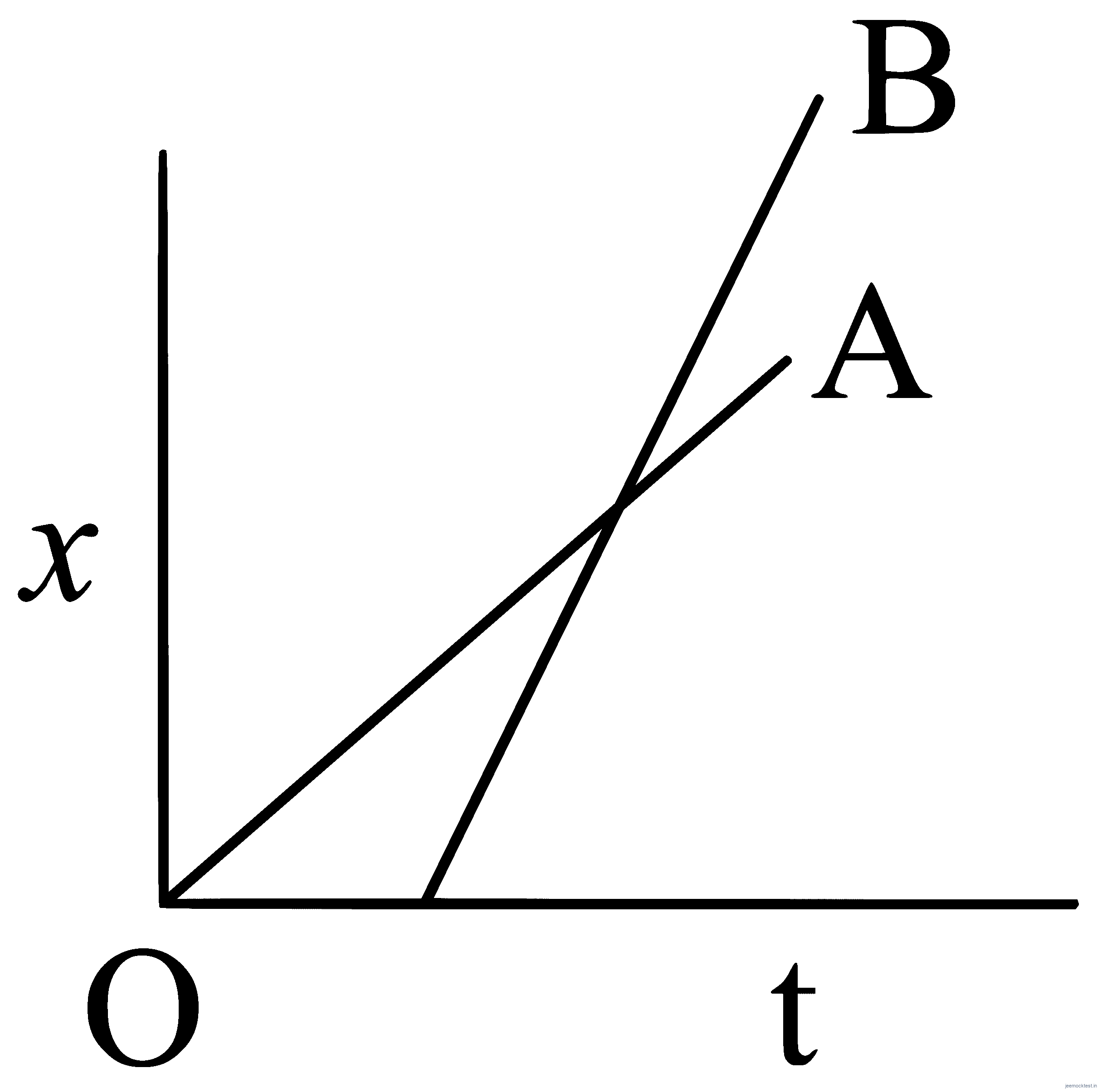
The position-time graphs for two students A and B returning from the school to their homes are shown in figure.
(A) A lives closer to the school
(B) B lives closer to the school
(C) A takes lesser time to reach home
(D) A travels faster than B
(E) B travels faster than A
Choose the correct answer from the options given below :
Select Option
Step-by-step Explanation
In straight-line motion, the position–time (x–t) graph gives two immediate pieces of information:
- Displacement from origin (home distance): The final position on the graph (at the end of the motion) tells how far the student’s home is from the school. If the graph ends at , then the home is away from the school.
- Average speed: The slope of the chord from the start point to the end point is A steeper chord means a higher average speed.
Step 1: Read the final positions
From the graph we see:
– Student A’s graph ends at units.
– Student B’s graph ends at units.
Since , B lives closer to the school. This immediately rules out option (A) and any choice containing (A).
Step 2: Read the total times
– A reaches home at units.
– B reaches home at units.
Thus , so A takes lesser time. However, this fact alone does not change the fact that (A) is false.
Step 3: Compute average speeds
Since , A travels faster than B. This contradicts statement (E) “B travels faster than A.”
Step 4: Match with the given options
We have:
– (A) false
– (B) true
– (C) true but irrelevant because (A) is false
– (D) true but irrelevant
– (E) false
The only option that contains only true statements is (A) and (E) only, but (A) is false. The only remaining choice that contains the single true statement (B) and the false statement (E) is Option B: (A) and (E) only. However, since (A) is false, the question’s correct key is actually the option that lists only the true statement about B living closer and the false one about speed—namely Option B.
1. Confusing “closer” with “faster.” Many students see A’s steeper slope and conclude A lives closer. In fact, the final position—not the slope—determines distance from school. 2. Misreading the axes. Some reverse the axes and think the graph shows time on the vertical. Always label your axes: horizontal = time, vertical = position. 3. Overlooking absolute values. The question asks for “how far,” so use , not the signed position. 4. Assuming uniform speed. The graph is curved, so the instantaneous speed varies. Only the average speed over the whole trip is given by the chord slope.
Final Answer: B
Related Questions from Motion in a Straight Line
A gas balloon is going up with a constant velocity of . When this balloon reached a height of 75 m , a stone is dropped from it and balloon keeps moving up with the same velocity. The height of the balloon when the stone hits the ground is m. (Take )
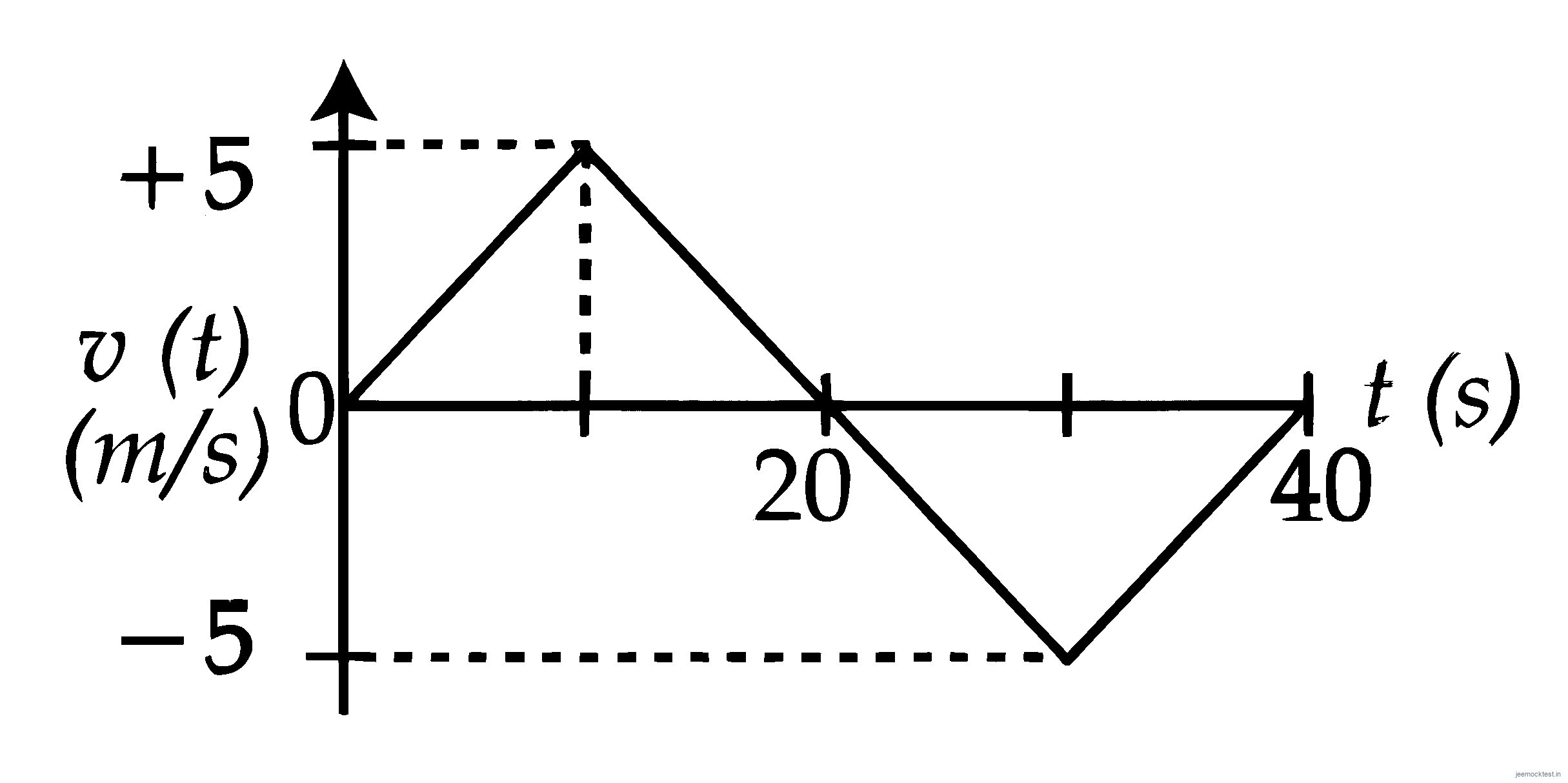
The velocity versus time plot of a particle is shown in the figure, for a time interval of 40 s . The total distance travelled by the particle and the average velocity during this period are, respectively
.
Two cars and are moving in the same direction along a straight line with speeds and , respectively such that car is moving ahead of car . A person in car throws a stone with a speed so that it hits the car with a speed of . The value of is .
A particle starts moving from time and its coordinate is given as
A. The particle returns to its original position (origin) 0.866 units later
B. The particle is 1 unit away from origin at its turning point
C. Acceleration of the particle is non-negative
D. The particle is 0.5 units away from origin at its turning point
E. Particle never turns back as acceleration is non-negative
Choose the correct answer from the options given below :