JEE PYQ: Motion in a Straight Line - Question ID 4ec63bc8cf0d (JEE Main 2023)
For a train engine moving with speed of , the driver must apply brakes at a distance of 500 before the station for the train to come to rest at the station. If the brakes were applied at half of this distance, the train engine would cross the station with speed . The value of is ____________.
(Assuming same retardation is produced by brakes)
Your Answer
Step-by-step Explanation
This problem involves uniformly decelerated motion in a straight line. The key physics concepts and formulas are:
- Kinematic equation for velocity, displacement, and acceleration: where = final velocity, = initial velocity, = acceleration (negative for deceleration), = displacement.
- Retardation (deceleration): The brakes produce a constant negative acceleration (retardation) , which we can determine from the first scenario.
- Consistency of retardation: The same braking force implies the same magnitude of retardation in both scenarios.
Step 1: Determine the retardation from the first scenario.
Given: Initial speed , Final speed (comes to rest), Braking distance .
Using the kinematic equation: Substitute : The negative sign indicates deceleration (retardation). The magnitude of retardation is .
Step 2: Apply the same retardation in the second scenario.
Now, brakes are applied at half the distance, i.e., . Initial speed remains , Retardation . We want to find the final speed when the train reaches the station (after traveling 250 m under braking).
Using the same kinematic equation: Substitute values: Thus,
Step 3: Identify .
The question states that the train crosses the station with speed . From above, , so:
Common Traps & Exam Tip:- Sign confusion in acceleration: Many students forget that retardation means negative acceleration. Always assign the correct sign based on the direction of motion.
- Misinterpreting "half the distance": Some students mistakenly think the braking distance is halved from the station, not from the original braking point. Clarify the reference point.
- Assuming speed halves when distance halves: Speed does not halve linearly with distance under constant deceleration. Always use the kinematic equations.
- Unit consistency: Ensure all units are consistent (m/s, m, m/s²). Double-check calculations to avoid arithmetic errors.
Exam Tip: When dealing with braking or stopping problems, always start by finding the acceleration (retardation) using the first scenario. Then apply it consistently to other scenarios.
Related Questions from Motion in a Straight Line
A gas balloon is going up with a constant velocity of . When this balloon reached a height of 75 m , a stone is dropped from it and balloon keeps moving up with the same velocity. The height of the balloon when the stone hits the ground is m. (Take )
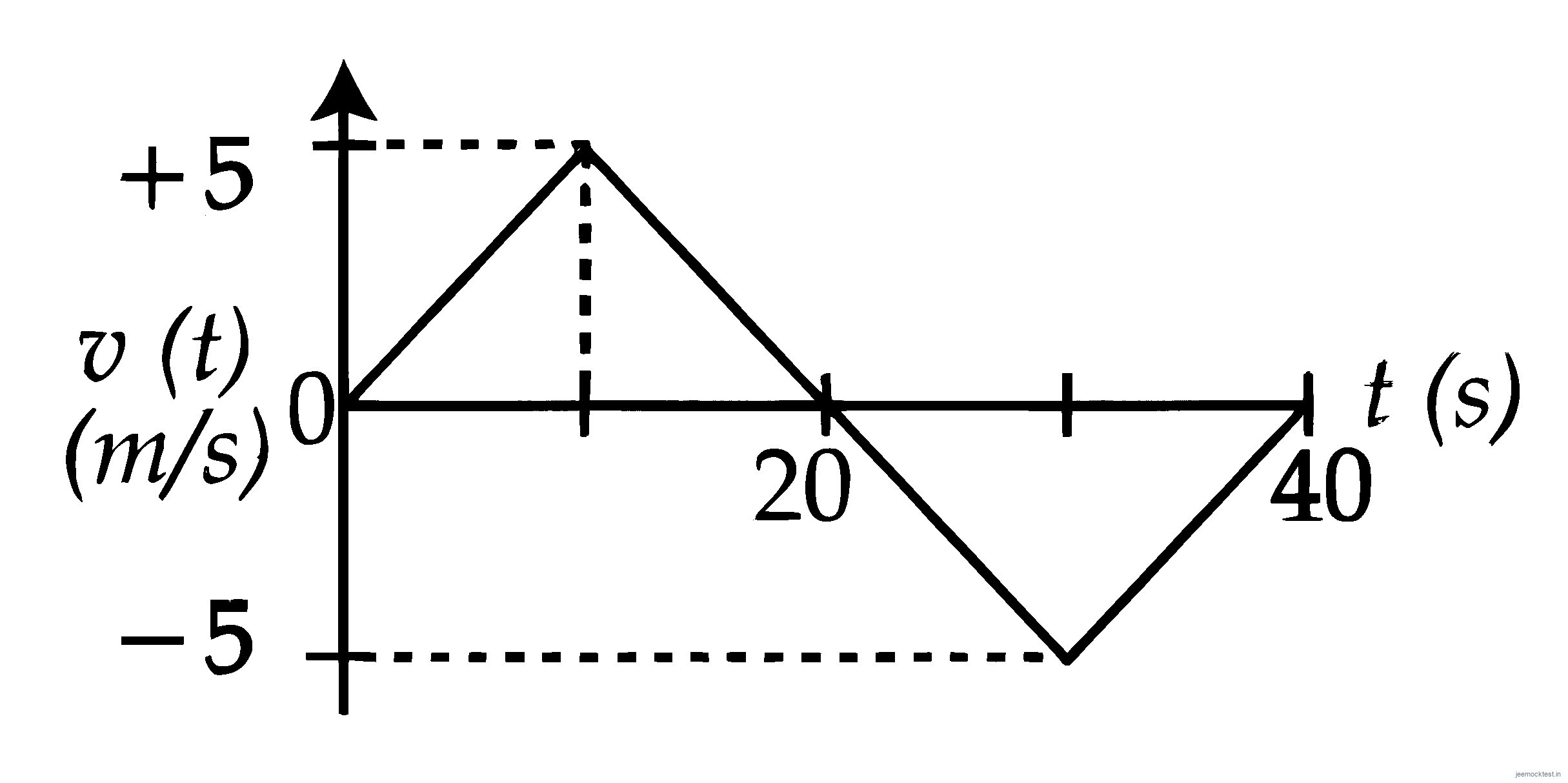
The velocity versus time plot of a particle is shown in the figure, for a time interval of 40 s . The total distance travelled by the particle and the average velocity during this period are, respectively
.
Two cars and are moving in the same direction along a straight line with speeds and , respectively such that car is moving ahead of car . A person in car throws a stone with a speed so that it hits the car with a speed of . The value of is .
A particle starts moving from time and its coordinate is given as
A. The particle returns to its original position (origin) 0.866 units later
B. The particle is 1 unit away from origin at its turning point
C. Acceleration of the particle is non-negative
D. The particle is 0.5 units away from origin at its turning point
E. Particle never turns back as acceleration is non-negative
Choose the correct answer from the options given below :