JEE PYQ: Motion in a Straight Line - Question ID 485b36ceb375 (JEE Main 2022)
A small toy starts moving from the position of rest under a constant acceleration. If it travels a distance of 10m in t s, the distance travelled by the toy in the next t s will be :
Select Option
Step-by-step Explanation
This problem tests the kinematic equations for motion under constant acceleration. When an object starts from rest () and moves with constant acceleration , the distance covered in time is given by:
Since , this simplifies to:The key insight is that under constant acceleration, the distances covered in successive equal time intervals follow a simple arithmetic progression. Specifically, if the distance covered in the first seconds is , then the distance covered in the next seconds () will be .
Step-by-Step Derivation:Step 1: Express the distance in the first seconds.
Given that the toy starts from rest and travels in seconds:Step 2: Find the distance covered in seconds.
Using the same equation for time :Step 3: Compute the distance covered in the next seconds.
The distance covered in the next seconds (i.e., from to ) is:Thus, the toy travels in the next seconds.
Common Traps & Exam Tip:Trap 1: Assuming uniform velocity. Many students mistakenly treat this as uniform motion, leading them to think the distance in the next seconds is the same (). This is incorrect because the toy is accelerating.
Trap 2: Incorrect ratio application. Some students recall that distances in successive equal time intervals under constant acceleration are in the ratio but misapply it. The correct ratio for the first two intervals is , meaning the second interval covers times the first.
Exam Tip: Always write down the kinematic equation explicitly. For constant acceleration problems, the distance covered in the -th second (or interval) can be derived using: For , this simplifies to . For the first interval (), , and for the second (), . This confirms the result.
Related Questions from Motion in a Straight Line
A gas balloon is going up with a constant velocity of . When this balloon reached a height of 75 m , a stone is dropped from it and balloon keeps moving up with the same velocity. The height of the balloon when the stone hits the ground is m. (Take )
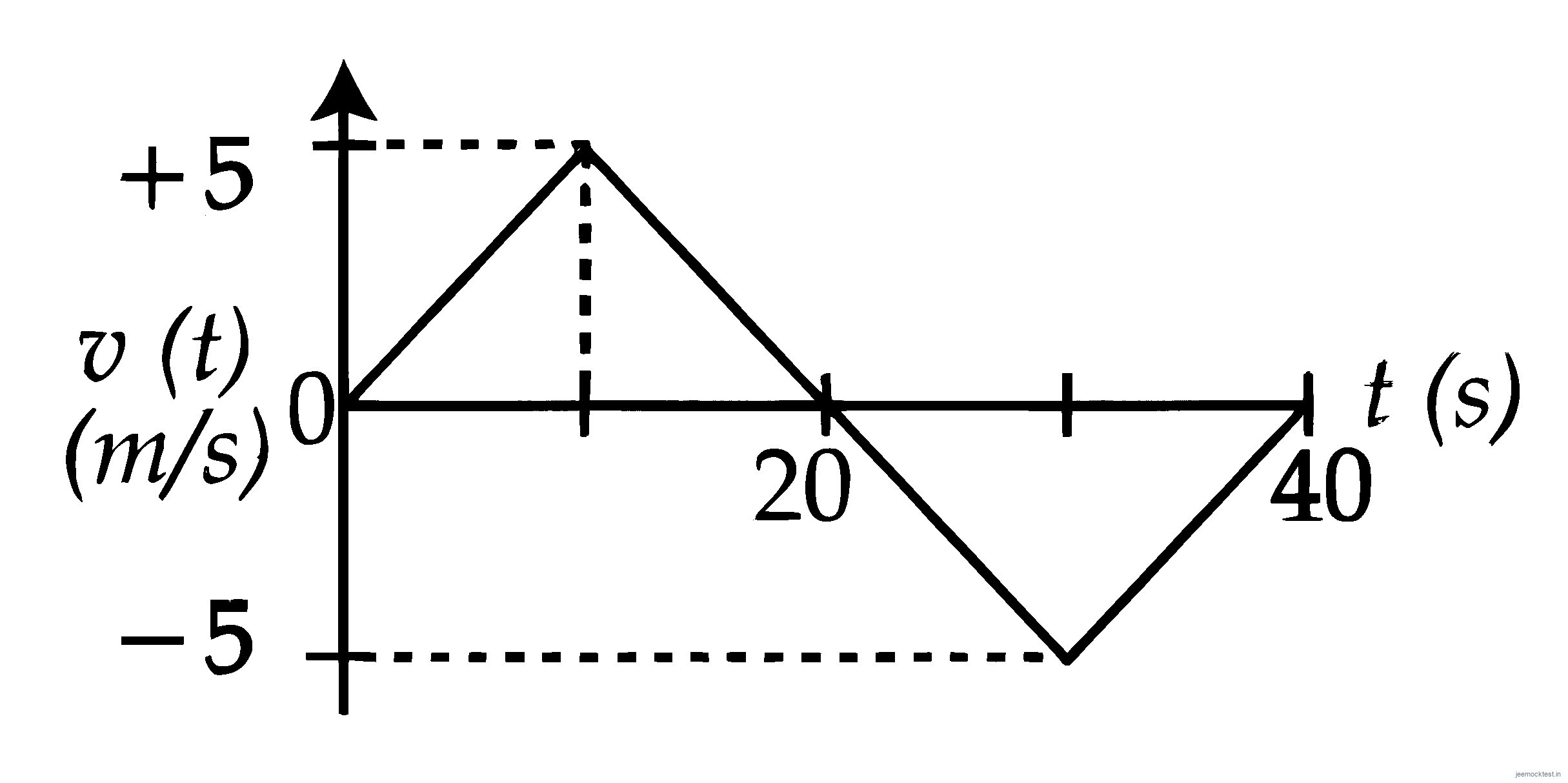
The velocity versus time plot of a particle is shown in the figure, for a time interval of 40 s . The total distance travelled by the particle and the average velocity during this period are, respectively
.
Two cars and are moving in the same direction along a straight line with speeds and , respectively such that car is moving ahead of car . A person in car throws a stone with a speed so that it hits the car with a speed of . The value of is .
A particle starts moving from time and its coordinate is given as
A. The particle returns to its original position (origin) 0.866 units later
B. The particle is 1 unit away from origin at its turning point
C. Acceleration of the particle is non-negative
D. The particle is 0.5 units away from origin at its turning point
E. Particle never turns back as acceleration is non-negative
Choose the correct answer from the options given below :