JEE PYQ: Motion in a Straight Line - Question ID 46b1612c76a7 (JEE Main 2005)
Select Option
Step-by-step Explanation
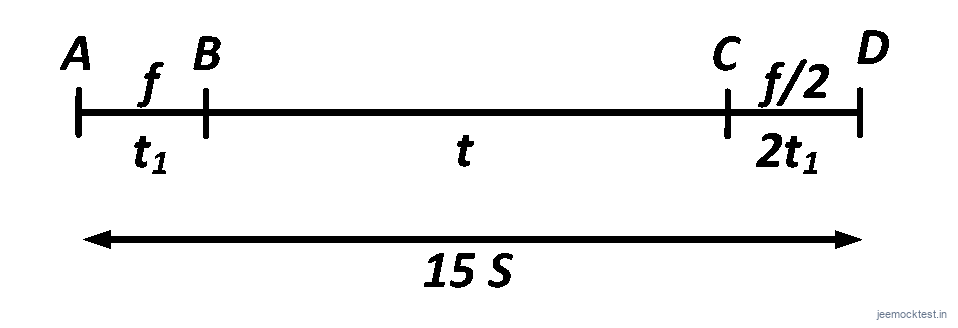
In problems involving motion in a straight line with varying acceleration, we break the journey into distinct phases and apply the kinematic equations for each phase. The key formulas used are:
- For uniformly accelerated motion (starting from rest): Here, , so these simplify to:
- For motion at constant speed: distance = speed × time, i.e., .
- For uniformly decelerated motion (coming to rest): We use the same kinematic equations but with negative acceleration. The final velocity is zero.
The total distance traversed is the sum of distances covered in all phases. We are given that this total distance is , where is the distance covered during the initial acceleration phase.
Step-by-Step Derivation:Phase 1: Acceleration from rest at rate for distance
Let be the time taken to cover distance under acceleration . Since the car starts from rest:
The velocity at the end of this phase (which is also the constant speed in the next phase) is:
Phase 2: Motion at constant speed for time
The distance covered in this phase is:
Phase 3: Deceleration at rate to come to rest
Let be the time taken to decelerate to rest. Using with , , and :
The distance covered during deceleration is:
Substituting and :Total distance traversed:
The total distance is the sum of distances in all three phases:
We are given . Substituting:Expressing in terms of :
From equation (1):
Substituting into equation (6):
Simplify : So the equation becomes: Let . Then , and the equation becomes: But , so . Substitute : Divide both sides by (assuming , ): Recall , so: Square both sides:This matches option D.
Common Traps & Exam Tip:Students often make the following mistakes in this problem:
- Incorrectly calculating the deceleration distance: Many forget that the deceleration phase uses and incorrectly apply the kinematic equations, leading to wrong expressions for . Always verify the sign of acceleration and the final velocity.
- Miscounting the total distance: Some students add the distances incorrectly or misinterpret the given total distance as , forgetting that is only the distance covered during the first phase.
- Algebraic errors in substitution: The substitution step involving is tricky. Students often make errors in simplifying or in handling the square roots. Always simplify expressions step-by-step.
- Assuming time symmetry: Some assume that the time taken to accelerate is equal to the time taken to decelerate, which is not true here because the deceleration is half the acceleration. Always derive the times using kinematic equations.
Exam Tip: Break the problem into clear phases, label all variables, and verify each step. For problems involving multiple phases, it is often helpful to express all distances and times in terms of a single variable (here, ) before substituting into the total distance equation.
Related Questions from Motion in a Straight Line
A gas balloon is going up with a constant velocity of . When this balloon reached a height of 75 m , a stone is dropped from it and balloon keeps moving up with the same velocity. The height of the balloon when the stone hits the ground is m. (Take )
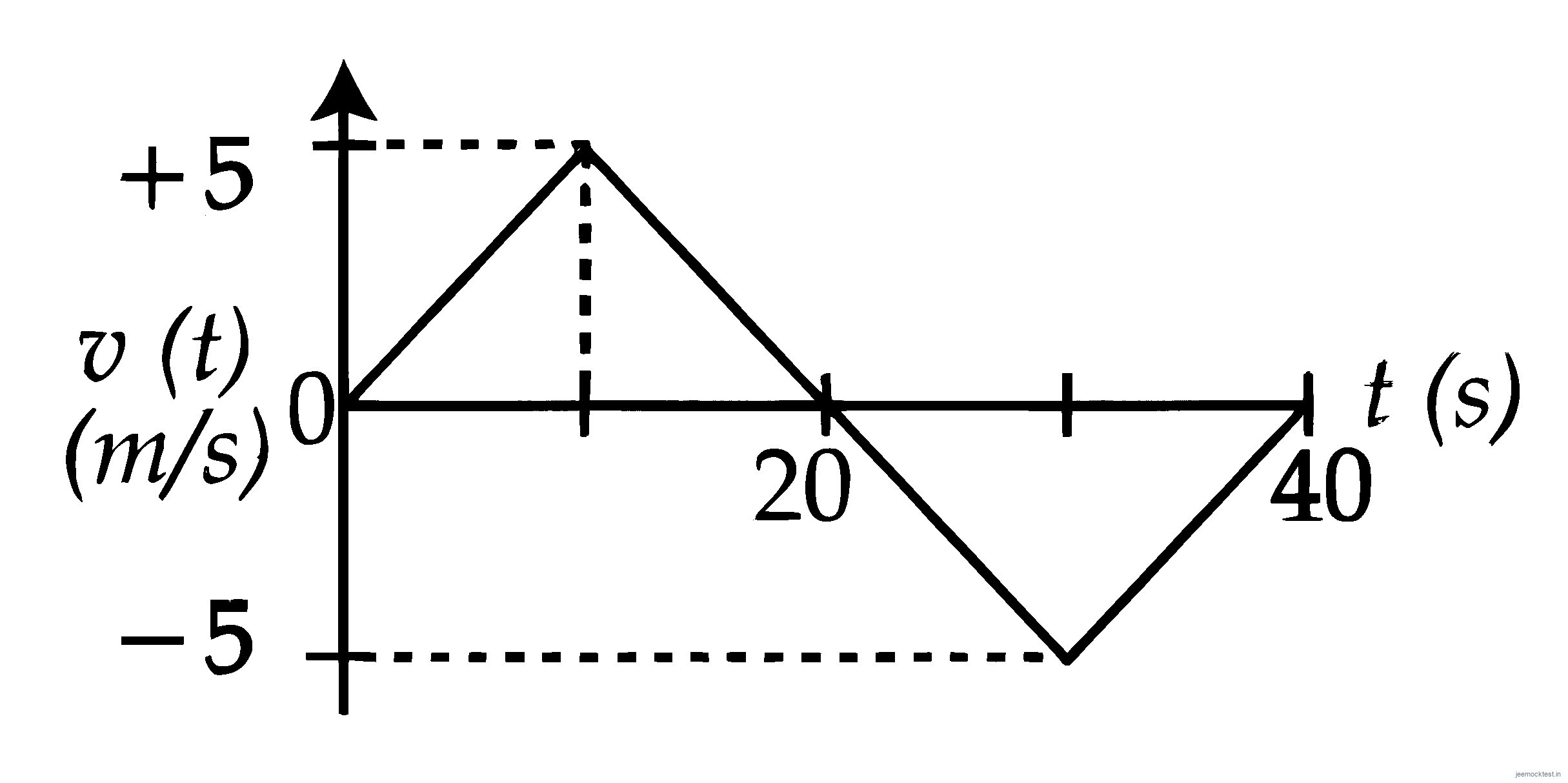
The velocity versus time plot of a particle is shown in the figure, for a time interval of 40 s . The total distance travelled by the particle and the average velocity during this period are, respectively
.
Two cars and are moving in the same direction along a straight line with speeds and , respectively such that car is moving ahead of car . A person in car throws a stone with a speed so that it hits the car with a speed of . The value of is .
A particle starts moving from time and its coordinate is given as
A. The particle returns to its original position (origin) 0.866 units later
B. The particle is 1 unit away from origin at its turning point
C. Acceleration of the particle is non-negative
D. The particle is 0.5 units away from origin at its turning point
E. Particle never turns back as acceleration is non-negative
Choose the correct answer from the options given below :