JEE PYQ: Motion in a Straight Line - Question ID 4221ac2b6548 (JEE Main 2023)
A horse rider covers half the distance with speed. The remaining part of the distance was travelled with speed for half the time and with speed for other half of the time. The mean speed of the rider averaged over the whole time of motion is . The value of is ___________.
Your Answer
Step-by-step Explanation
In problems involving mean speed (also called average speed), the key concept is:
- The mean speed over an entire journey is defined as the total distance traveled divided by the total time taken.
- Mathematically, this is expressed as:
- This is not the arithmetic mean of speeds unless the time intervals for each speed are equal.
In this problem, the journey is split into two parts:
- First half of the distance is covered at a constant speed of .
- The second half of the distance is covered in two sub-parts: for half the time at , and the other half of the time at .
We must carefully compute the time taken for each segment and then use the definition of mean speed to find the value of .
--- Step-by-Step Derivation:Let the total distance be meters.
-
First half of the distance:
Distance covered = m
Speed =
Time taken, seconds. -
Second half of the distance:
Distance to cover = m
This part is traveled in two time intervals, each of duration , where is the total time taken for the second half.
Let be the total time for the second half. Then:- For the first half of : speed =
- For the second half of : speed =
- Total time for the entire journey:
- Mean speed: This matches the given form . Hence:
Students often make the following mistakes:
- Confusing distance and time splits: The first half is a distance split, while the second half is a time split. Mixing these leads to incorrect time calculations.
- Assuming arithmetic mean: Some students incorrectly average the speeds , , and without considering the actual time or distance proportions.
- Algebraic errors in time calculation: Misapplying the relation between distance, speed, and time in the second half can lead to wrong values for .
Exam Tip: Always define the total distance as a variable (e.g., ) and express all times in terms of . This ensures consistency and avoids confusion between distance and time splits.
Related Questions from Motion in a Straight Line
A gas balloon is going up with a constant velocity of . When this balloon reached a height of 75 m , a stone is dropped from it and balloon keeps moving up with the same velocity. The height of the balloon when the stone hits the ground is m. (Take )
The velocity versus time plot of a particle is shown in the figure, for a time interval of 40 s . The total distance travelled by the particle and the average velocity during this period are, respectively
.
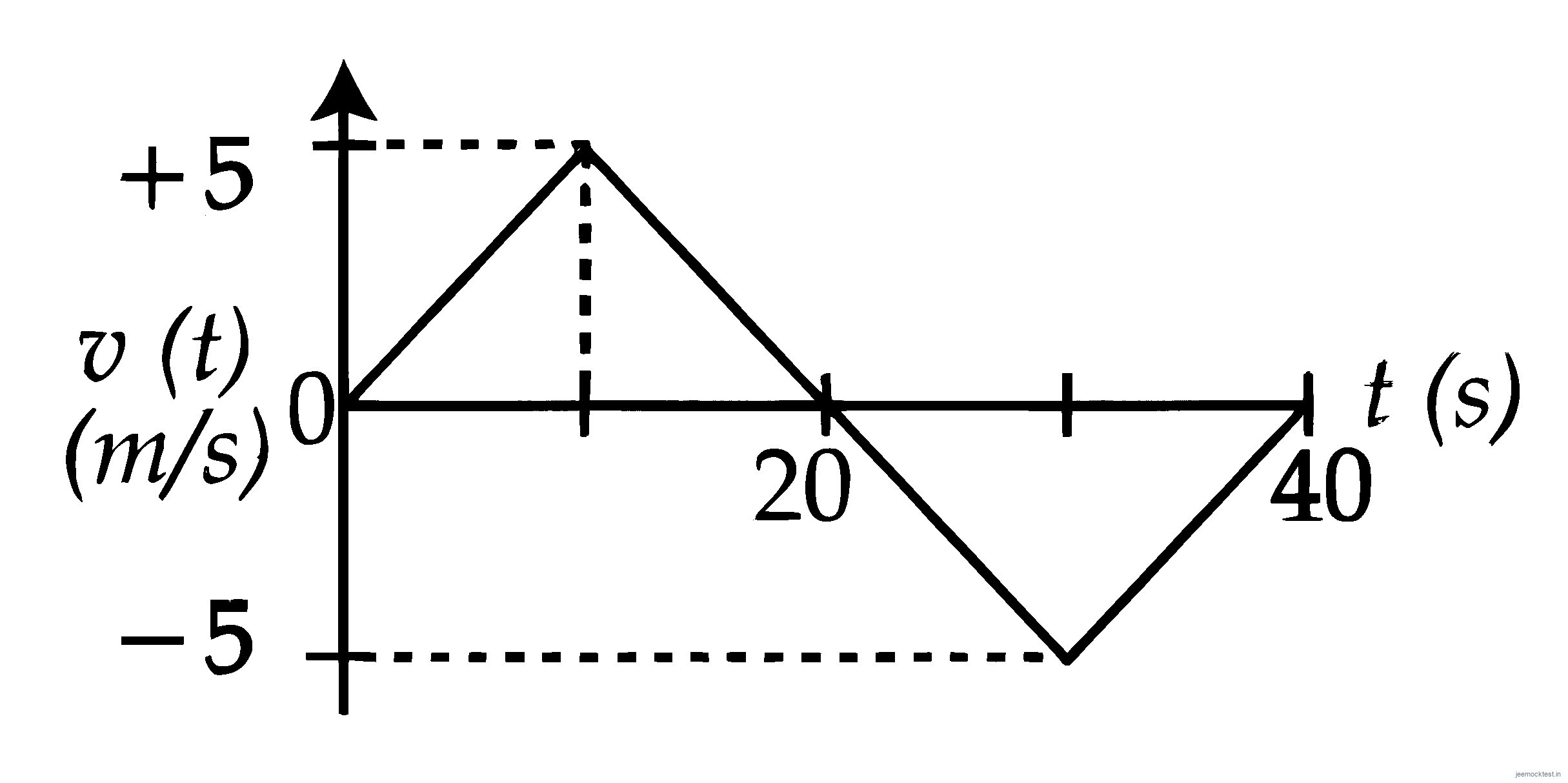
Two cars and are moving in the same direction along a straight line with speeds and , respectively such that car is moving ahead of car . A person in car throws a stone with a speed so that it hits the car with a speed of . The value of is .
A particle starts moving from time and its coordinate is given as
A. The particle returns to its original position (origin) 0.866 units later
B. The particle is 1 unit away from origin at its turning point
C. Acceleration of the particle is non-negative
D. The particle is 0.5 units away from origin at its turning point
E. Particle never turns back as acceleration is non-negative
Choose the correct answer from the options given below :