JEE PYQ: Motion in a Straight Line - Question ID 3febfbc0bc57 (JEE Main 2021)
(takes the value of g as 10 m/s2)
Select Option
Step-by-step Explanation
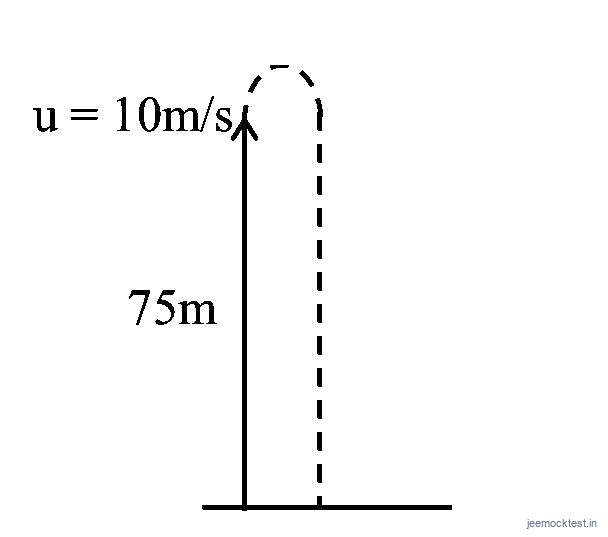
This problem involves the kinematics of two bodies moving under gravity: the balloon (moving upward at constant velocity) and the object (dropped from the balloon and falling freely under gravity). The key concepts are:
- Relative Motion: When the object is dropped, it initially has the same upward velocity as the balloon (). However, gravity acts downward, decelerating the object until its velocity becomes zero, after which it accelerates downward.
- Equations of Motion: We use the standard kinematic equations for uniformly accelerated motion:
where:
- = displacement,
- = initial velocity,
- = acceleration (here, for upward motion),
- = time,
- = final velocity.
- Time of Flight: The object is released from a height of and must fall to the ground ( relative to the release point). We calculate the time it takes for the object to reach the ground.
- Balloon’s Motion: While the object is falling, the balloon continues moving upward at . The height of the balloon at the moment the object hits the ground is calculated by adding the distance the balloon travels upward during the object’s time of flight to the initial height.
Step 1: Determine the time taken by the object to reach the ground.
The object is dropped from the balloon at with an initial upward velocity and acceleration . The displacement of the object when it hits the ground is (since it moves downward from the release point).
Using the equation: Substitute the known values: Simplify: Rearrange: Divide by 5: Solve the quadratic equation: We discard the negative root (as time cannot be negative):Step 2: Calculate the height of the balloon after 5 seconds.
The balloon moves upward with a constant velocity of . The distance traveled by the balloon in is: The initial height of the balloon when the object is dropped is . Thus, the height of the balloon when the object hits the ground is: Common Traps & Exam Tip:
Students often make the following mistakes in this problem:
- Incorrect Sign Convention: Forgetting that upward motion is positive and downward motion (including acceleration due to gravity) is negative. This leads to errors in setting up the kinematic equation.
- Ignoring Initial Velocity of the Object: Assuming the object is dropped from rest (), which is incorrect because the object inherits the balloon’s upward velocity at the moment of release.
- Misinterpreting Displacement: Using instead of for the object’s displacement, leading to incorrect time calculations.
- Forgetting the Balloon’s Motion: Some students calculate the time for the object to fall but forget that the balloon continues to rise during this time, leading to an incorrect final height.
Exam Tip: Always draw a clear diagram showing the directions of motion and label the initial conditions. Use consistent sign conventions (e.g., upward as positive) and double-check the displacement values in the kinematic equations.
Related Questions from Motion in a Straight Line
A gas balloon is going up with a constant velocity of . When this balloon reached a height of 75 m , a stone is dropped from it and balloon keeps moving up with the same velocity. The height of the balloon when the stone hits the ground is m. (Take )
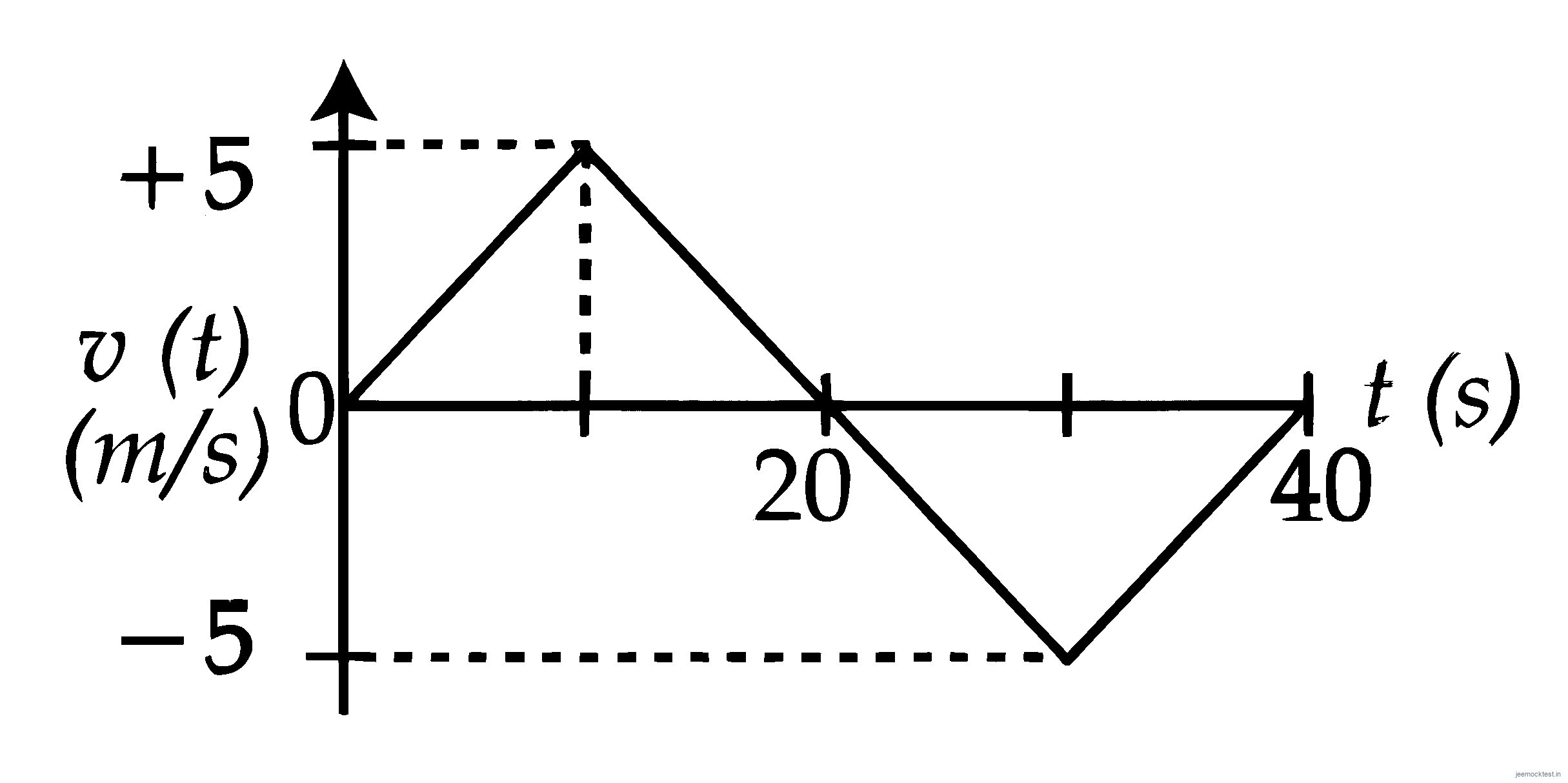
The velocity versus time plot of a particle is shown in the figure, for a time interval of 40 s . The total distance travelled by the particle and the average velocity during this period are, respectively
.
Two cars and are moving in the same direction along a straight line with speeds and , respectively such that car is moving ahead of car . A person in car throws a stone with a speed so that it hits the car with a speed of . The value of is .
A particle starts moving from time and its coordinate is given as
A. The particle returns to its original position (origin) 0.866 units later
B. The particle is 1 unit away from origin at its turning point
C. Acceleration of the particle is non-negative
D. The particle is 0.5 units away from origin at its turning point
E. Particle never turns back as acceleration is non-negative
Choose the correct answer from the options given below :