JEE PYQ: Motion in a Straight Line - Question ID 2ee3299549ea (JEE Main 2026)
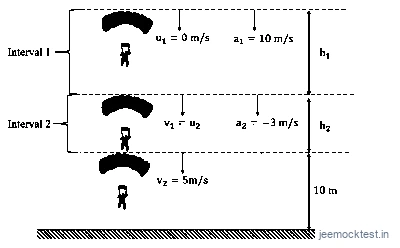
A paratrooper jumps from an aeroplane and opens a parachute after 2 s of free fall and starts deaccelerating with . At 10 m height from ground, while descending with the help of parachute, the speed of paratrooper is . The initial height of the airplane is m.
Select Option
Step-by-step Explanation
This problem involves motion in a straight line with two distinct phases:
- Free-fall phase (0–2 s): The paratrooper falls under gravity alone. We use the kinematic relation for uniformly accelerated motion: Here , .
- Decelerated descent (after 2 s): The parachute opens and the paratrooper decelerates at until reaching at above the ground. We again use the kinematic relation with (deceleration).
The total height of the airplane is the sum of the distance fallen in the free-fall phase, the distance fallen while decelerating, and the final above ground.
Step-by-Step Derivation:-
Free-fall phase (0–2 s):
Initial velocity , acceleration , time .- Distance fallen:
- Velocity at the end of free fall:
-
Decelerated descent phase:
The paratrooper now decelerates at until reaching at above ground. Let be the distance fallen during this phase.- Use the kinematic relation with , , .
- Rearrange:
-
Total height of the airplane:
1. Sign of acceleration: Many students forget that deceleration means in the upward-positive convention. 2. Final height: The above ground must be added to the distances fallen, not subtracted. 3. Velocity at parachute opening: One must compute before applying the deceleration relation.
Double-check each phase separately and sum the distances carefully to avoid off-by-ten errors.
Related Questions from Motion in a Straight Line
A gas balloon is going up with a constant velocity of . When this balloon reached a height of 75 m , a stone is dropped from it and balloon keeps moving up with the same velocity. The height of the balloon when the stone hits the ground is m. (Take )
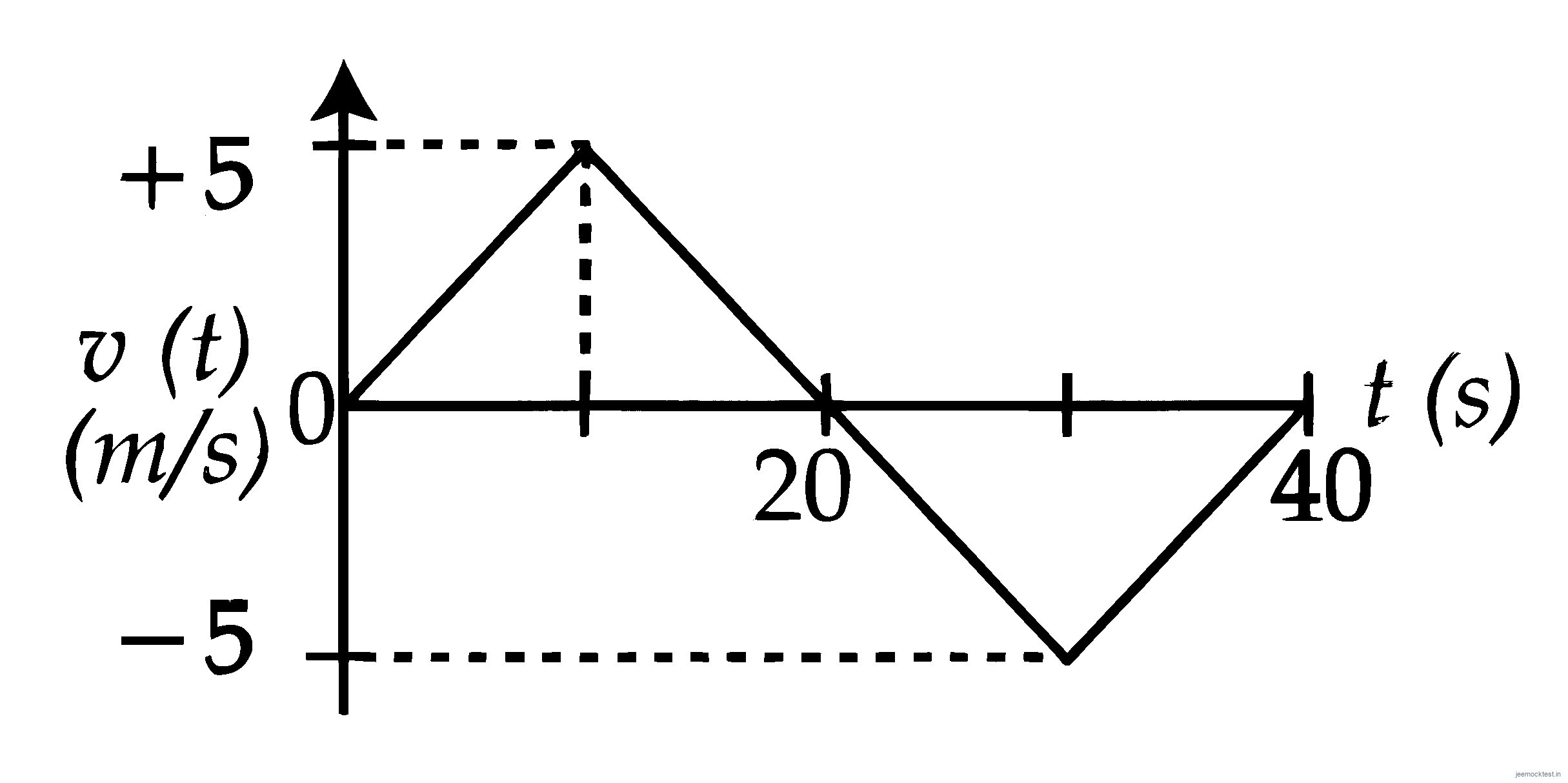
The velocity versus time plot of a particle is shown in the figure, for a time interval of 40 s . The total distance travelled by the particle and the average velocity during this period are, respectively
.
Two cars and are moving in the same direction along a straight line with speeds and , respectively such that car is moving ahead of car . A person in car throws a stone with a speed so that it hits the car with a speed of . The value of is .
A particle starts moving from time and its coordinate is given as
A. The particle returns to its original position (origin) 0.866 units later
B. The particle is 1 unit away from origin at its turning point
C. Acceleration of the particle is non-negative
D. The particle is 0.5 units away from origin at its turning point
E. Particle never turns back as acceleration is non-negative
Choose the correct answer from the options given below :