JEE PYQ: Motion in a Straight Line - Question ID 2a0f5f54f7f1 (JEE Main 2021)
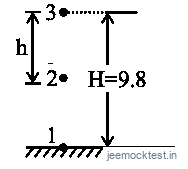
Select Option
Step-by-step Explanation
Let us solve the problem systematically, ensuring clarity at every step.
Core Formula & Concept:The problem involves uniformly accelerated motion under gravity. The key concepts and formulas are:
- Equation of motion for free fall:
where:
- = displacement (distance fallen from the nozzle),
- = initial velocity (0 for drops released from rest),
- = acceleration due to gravity ( downward),
- = time elapsed since release.
- Time to fall from height : Since , the time to fall a distance is:
- Regular interval of drops:
The drops are released at a fixed time interval . This means:
- Drop 1 is released at .
- Drop 2 is released at .
- Drop 3 is released at .
The problem states: When the first drop strikes the floor, the third drop begins to fall. This gives a crucial relationship between and the total fall time of the first drop.
Step-by-Step Derivation:Step 1: Compute total fall time of first drop
The first drop falls from height . Using :
Step 2: Relate drop interval to total fall time
When the first drop hits the floor at , the third drop is just beginning to fall. This means the third drop is released at . Hence:
Step 3: Determine release time of second drop
The second drop is released at . At the instant the first drop hits the floor (), the second drop has been falling for:
Step 4: Compute distance fallen by second drop
Using : This is the distance the second drop has fallen from the nozzle.
Step 5: Locate position of second drop from the floor
The nozzle is above the floor. The second drop has fallen from the nozzle, so its height above the floor is:
Conclusion: The position of the second drop from the floor when the first drop strikes the floor is , which corresponds to option D.
Common Traps & Exam Tip:Students often make these mistakes:
- Misinterpreting the drop numbering: Some assume the first drop is released at , leading to incorrect timing. Always clarify: first drop at , second at , third at .
- Incorrect fall time calculation: Using instead of is a common error. Remember: , so .
- Confusing distance fallen with height from floor: The question asks for position from the floor, not distance fallen. Subtract the fallen distance from total height.
- Assuming equal spacing in space: Drops are released at equal time intervals, not equal spatial intervals. Their positions are not equally spaced.
Exam Tip: Always draw a timeline marking release and impact events. Label each drop’s release time and compute fall duration carefully.
Related Questions from Motion in a Straight Line
A gas balloon is going up with a constant velocity of . When this balloon reached a height of 75 m , a stone is dropped from it and balloon keeps moving up with the same velocity. The height of the balloon when the stone hits the ground is m. (Take )
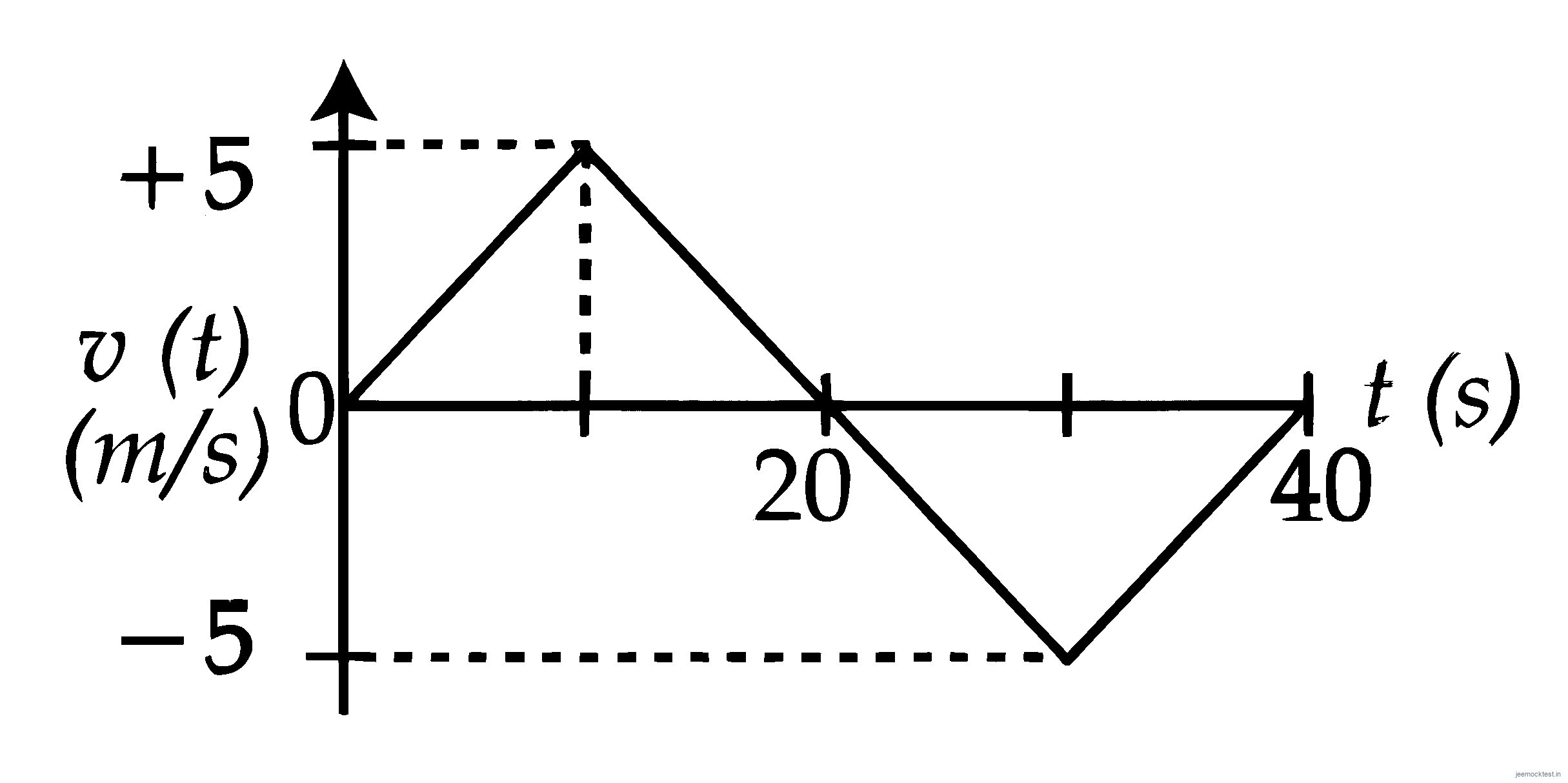
The velocity versus time plot of a particle is shown in the figure, for a time interval of 40 s . The total distance travelled by the particle and the average velocity during this period are, respectively
.
Two cars and are moving in the same direction along a straight line with speeds and , respectively such that car is moving ahead of car . A person in car throws a stone with a speed so that it hits the car with a speed of . The value of is .
A particle starts moving from time and its coordinate is given as
A. The particle returns to its original position (origin) 0.866 units later
B. The particle is 1 unit away from origin at its turning point
C. Acceleration of the particle is non-negative
D. The particle is 0.5 units away from origin at its turning point
E. Particle never turns back as acceleration is non-negative
Choose the correct answer from the options given below :