JEE PYQ: Motion in a Straight Line - Question ID 29b985827956 (JEE Main 2017)
Select Option
Step-by-step Explanation
When a body is thrown vertically upwards, it moves under the influence of Earth's gravitational force, which acts downward. This results in a constant acceleration directed opposite to the initial velocity. The key concepts and formulas involved are:
-
Velocity-Time Relationship:
For motion with constant acceleration, the velocity at any time is given by:
where:
- = initial velocity (positive, since the body is thrown upwards)
- = acceleration due to gravity = (negative because it acts downward, opposite to the initial velocity)
- = time
-
Nature of the v-t Graph:
Since is a linear equation in , the velocity-time graph is a straight line with:
- A positive intercept on the velocity axis (equal to at )
- A negative slope (equal to ), indicating decreasing velocity over time
- Velocity at Maximum Height: At the highest point, the velocity becomes zero. This occurs at time: After this time, the body begins to fall downward, and the velocity becomes negative (assuming upward as positive).
- Symmetry in Motion: The motion is symmetric. The velocity decreases linearly to zero on the way up and then increases in magnitude (but negative in direction) on the way down.
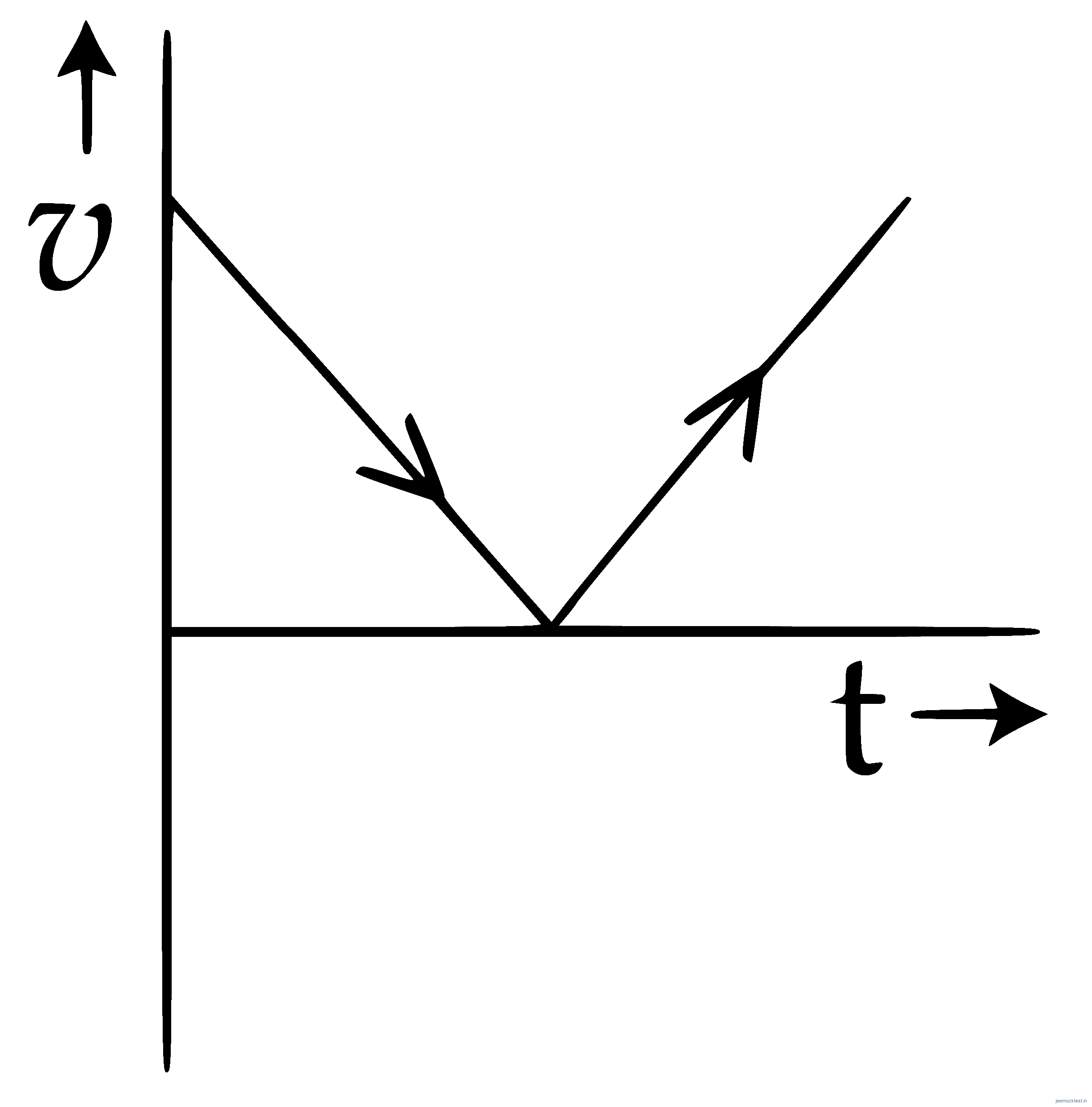
Thus, the correct – graph must be a straight line starting at , decreasing with constant slope, crossing zero at , and continuing into negative values.
--- Step-by-Step Derivation:Step 1: Define the coordinate system
Let’s take upward direction as positive. At , the body is thrown upwards with initial velocity .Step 2: Write the velocity equation
Under constant acceleration , the velocity at time is:Step 3: Analyze the graph characteristics
- The graph of vs is a straight line.
- At , → positive intercept on velocity axis.
- The slope of the line is , which is negative and constant.
- The line crosses the time axis (i.e., ) at .
- For , becomes negative, indicating downward motion.
Step 4: Compare with given options
Let’s analyze each option:- Option A: Shows a curve (not a straight line). Velocity decreases non-linearly. This is incorrect because acceleration is constant, so – must be linear.
- Option B: Shows a straight line starting from , but the slope is positive. This would imply acceleration in the same direction as velocity, which is wrong.
- Option C: Shows a straight line starting from and increasing. This would represent a body starting from rest and accelerating upward — not applicable here.
- Option D: Shows a straight line starting from a positive velocity , decreasing with constant negative slope, crossing zero, and going negative. This perfectly matches the derived equation .
Conclusion: Option D correctly represents the velocity-time graph for a body thrown vertically upwards.
--- Common Traps & Exam Tip:Students often make the following mistakes:
- Confusing acceleration direction: Many assume acceleration is positive because the body is moving upward. But acceleration due to gravity always acts downward, so it must be negative in the upward-positive coordinate system.
- Misinterpreting the v-t graph shape: Some expect a curved graph, thinking acceleration changes. But since is constant, the graph must be a straight line.
- Ignoring the zero crossing: Forgetting that velocity becomes zero at maximum height and then negative on the way down. The graph must cross the time axis.
- Choosing Option A due to misconception: Option A looks like a "slowing down" curve, which some associate with deceleration, but it’s not linear — hence incorrect.
Exam Tip: Always remember:
- For constant acceleration, – graph is a straight line.
- Slope of – graph = acceleration.
- If upward is positive, acceleration due to gravity is negative → negative slope.
- Initial velocity is positive → graph starts above zero.
So, the correct graph must be a straight line with negative slope, starting at , crossing zero, and continuing downward. That’s Option D.
Related Questions from Motion in a Straight Line
A gas balloon is going up with a constant velocity of . When this balloon reached a height of 75 m , a stone is dropped from it and balloon keeps moving up with the same velocity. The height of the balloon when the stone hits the ground is m. (Take )
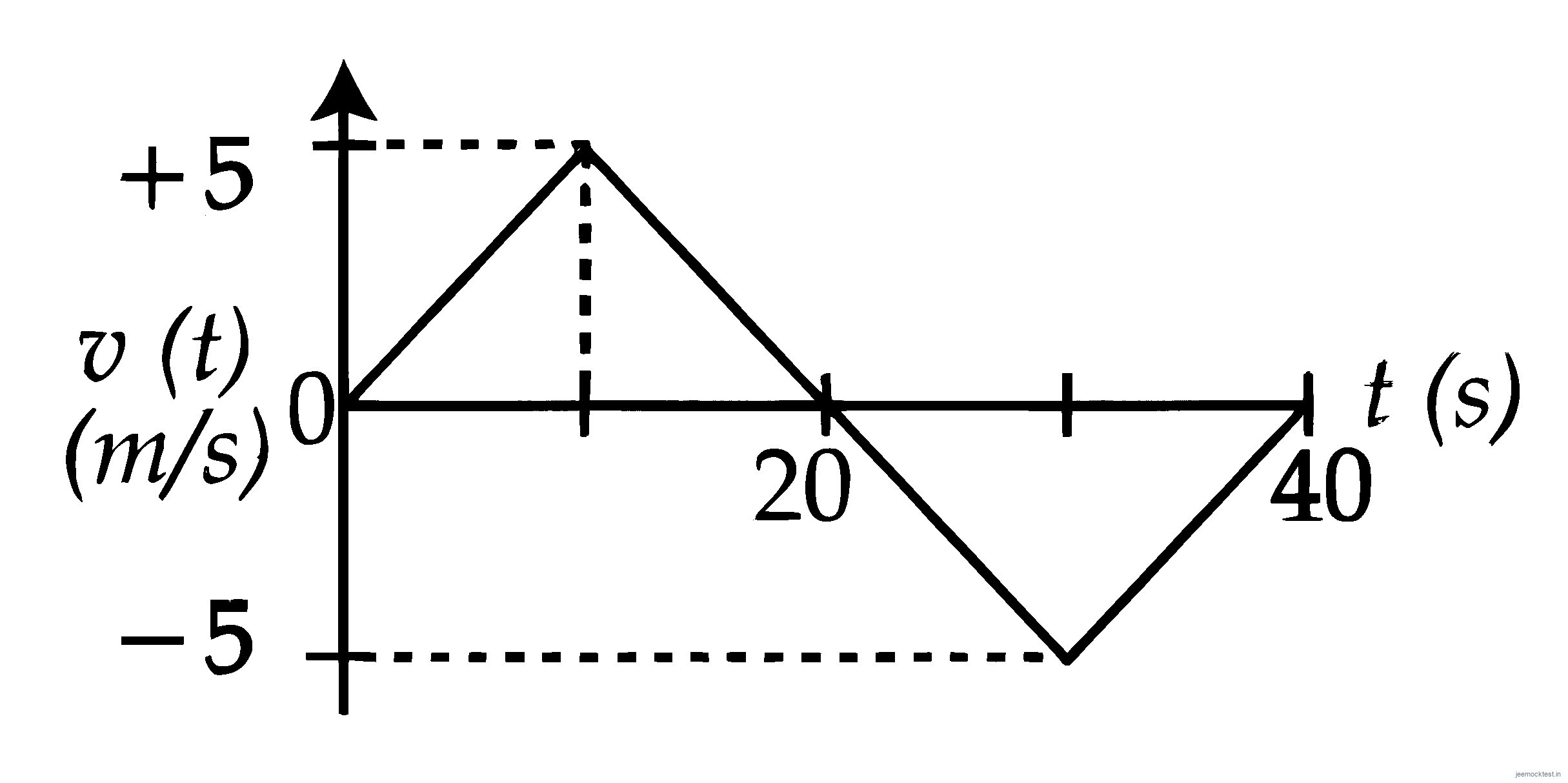
The velocity versus time plot of a particle is shown in the figure, for a time interval of 40 s . The total distance travelled by the particle and the average velocity during this period are, respectively
.
Two cars and are moving in the same direction along a straight line with speeds and , respectively such that car is moving ahead of car . A person in car throws a stone with a speed so that it hits the car with a speed of . The value of is .
A particle starts moving from time and its coordinate is given as
A. The particle returns to its original position (origin) 0.866 units later
B. The particle is 1 unit away from origin at its turning point
C. Acceleration of the particle is non-negative
D. The particle is 0.5 units away from origin at its turning point
E. Particle never turns back as acceleration is non-negative
Choose the correct answer from the options given below :