JEE PYQ: Vector Algebra - Question ID 296767d637ae (JEE Main 2020)
ID: 296767d637aeJEE Main 2020Numerical Value
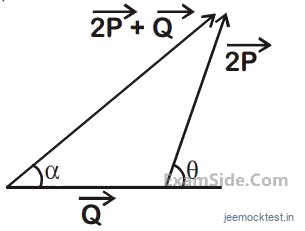
The sum of two forces P
and Q
is R
such that R=P
. The angle θ (in degrees) that the
resultant of 2P
and Q
will make with Q
is , ..............
Your Answer
Step-by-step Explanation
Core Formula & Concept:
In vector algebra, when two forces (or vectors) P and Q are combined, their resultant R is given by the vector sum:
R=P+Q
The magnitude of the resultant vector can be computed using the law of cosines:
∣R∣2=∣P∣2+∣Q∣2+2∣P∣∣Q∣cosα
where α is the angle between P and Q.
The problem states that ∣R∣=∣P∣. This condition imposes a specific geometric constraint on the vectors P and Q.
We are then asked to find the angle θ that the resultant of 2P and Q makes with Q.
Step-by-Step Derivation:
Step 1: Use the given condition ∣R∣=∣P∣
Given:
R=P+Q
and
∣R∣=∣P∣
Square both sides:
∣R∣2=∣P∣2⇒∣P+Q∣2=∣P∣2
Expand the left side using the dot product:
∣P∣2+∣Q∣2+2P⋅Q=∣P∣2
Simplify:
∣Q∣2+2P⋅Q=0⇒2P⋅Q=−∣Q∣2⇒P⋅Q=−2∣Q∣2
Step 2: Express the dot product in terms of magnitudes and angle
Let α be the angle between P and Q. Then:
P⋅Q=∣P∣∣Q∣cosα
From Step 1:
∣P∣∣Q∣cosα=−2∣Q∣2
Assuming ∣Q∣=0, divide both sides by ∣Q∣:
∣P∣cosα=−2∣Q∣
This gives a relationship between ∣P∣, ∣Q∣, and α.
Step 3: Find the resultant of 2P and Q
Let S=2P+Q. We need to find the angle θ that S makes with Q.
The angle θ between S and Q satisfies:
cosθ=∣S∣∣Q∣S⋅Q
Compute S⋅Q:
S⋅Q=(2P+Q)⋅Q=2P⋅Q+Q⋅Q
From Step 1, P⋅Q=−2∣Q∣2, so:
S⋅Q=2(−2∣Q∣2)+∣Q∣2=−∣Q∣2+∣Q∣2=0
Thus:
cosθ=∣S∣∣Q∣0=0
This implies:
θ=90∘
Conclusion:
The angle that the resultant of 2P and Q makes with Q is 90∘.
Common Traps & Exam Tip:
1. Misinterpreting the condition ∣R∣=∣P∣:
Many students overlook the geometric significance of this condition. It implies that the vector Q must be such that when added to P, the resultant has the same magnitude as P itself. This only happens when Q is perpendicular to the vector P+R or satisfies a specific dot product condition (as derived). Students often assume P and Q are perpendicular, which is not necessarily true.
2. Forgetting to use the dot product for angle calculation:
When finding the angle between two vectors, the dot product formula is essential. Students sometimes try to use trigonometric identities or the law of cosines directly without first computing the dot product, leading to incorrect results.
3. Incorrectly expanding the vector sum:
A common mistake is to incorrectly expand ∣P+Q∣2 as ∣P∣2+∣Q∣2 without the cross term 2P⋅Q. This omission leads to an incorrect relationship between P and Q.
Exam Tip:
Always start by writing down the given conditions in vector form and then translate them into algebraic equations using the dot product. This systematic approach minimizes errors and clarifies the geometric constraints.