JEE PYQ: Vector Algebra - Question ID 42a3e5fdc289 (JEE Main 2023)
Select Option
Step-by-step Explanation
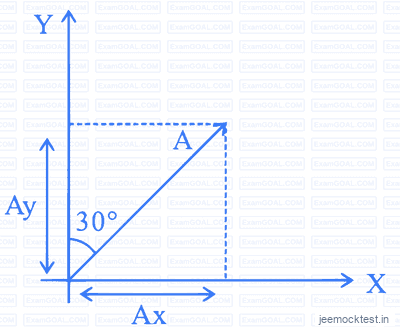
In vector algebra, any vector lying in the - plane can be resolved into its Cartesian components along the and axes. If the vector makes an angle with the -axis, then:
- The -component is given by .
- The -component is given by .
These relations arise from the definitions of cosine and sine in a right triangle formed by the vector and its projections on the axes.
Step-by-Step Derivation:Given:
- Angle with -axis, .
- Magnitude of -component, .
Step 1: Find the magnitude of the vector .
Using the relation for the -component: Substitute the known values: We know that , so: Solve for :
Step 2: Find the magnitude of the -component .
Using the relation for the -component: Substitute the known values: We know that , so:
Conclusion:
The magnitude of the -component of the vector is , which corresponds to option B.
Common Traps & Exam Tip:Students often confuse the angle given with respect to the -axis as the angle with the -axis. This leads to incorrect use of sine and cosine functions. Always:
- Draw a clear diagram to visualize the vector and its components.
- Identify which axis the angle is measured from (here, it is the -axis).
- Use and when the angle is with the -axis.
- Double-check the trigonometric values for standard angles (e.g., , , ).
A common mistake is to assume the angle is with the -axis and use , which would yield an incorrect result.
Related Questions from Vector Algebra
The velocity of a particle is given as m/s. The magnitude of acceleration at point (1, 2, 4) is ________ m/s2.
The angle between vector and the resultant of and is :
If two vectors and having equal magnitude are inclined at angle , then
When vector is subtracted from vector , it gives a vector equal to . Then the magnitude of vector will be :