JEE PYQ: Motion in a Straight Line - Question ID 285c0840dafb (JEE Main 2020)
(take the distance between the tracks as negligible)
Select Option
Step-by-step Explanation
In problems involving relative motion, the key concept is that the velocity of an object as observed from a moving frame depends on the velocity of the object and the velocity of the observer’s frame. The fundamental formula for relative velocity when two objects are moving along the same line is:
where:
- is the velocity of object A as observed from object B,
- is the velocity of object A with respect to the ground (or a stationary frame),
- is the velocity of object B with respect to the ground.
When the objects are moving in opposite directions, their relative velocities add up in magnitude. Additionally, if an object inside a moving frame (like a person walking inside a train) has its own velocity relative to that frame, we must account for it by vector addition.
In this problem:
- Train A and Train B are moving in opposite directions on parallel tracks.
- A person is walking inside Train A in the direction opposite to Train A’s motion.
- We need to find the velocity of the person as observed from Train B.
Step 1: Convert all speeds to SI units (m/s)
Since the final answer must be in , we first convert all given speeds from km/h to m/s using the conversion factor:
Convert the speeds:
- Speed of Train A:
- Speed of Train B:
- Speed of the person relative to Train A:
Step 2: Define directions and assign signs
We choose a coordinate system where the direction of Train A’s motion is positive. Since Train B is moving in the opposite direction, its velocity will be negative.
- Let the direction of Train A be positive:
- Train B moves opposite to Train A:
- The person walks opposite to Train A’s motion, so relative to Train A, the person’s velocity is
Step 3: Compute the person’s velocity relative to the ground
The person’s velocity relative to the ground () is the sum of Train A’s velocity and the person’s velocity relative to Train A:
Step 4: Compute the person’s velocity as observed from Train B
Using the relative velocity formula: Substitute the values:
Step 5: Match with the given options
The speed of the person as observed from Train B is , which corresponds to option B.
Common Traps & Exam Tip:Students often make the following mistakes in such problems:
- Incorrect sign assignment: Failing to assign proper signs to velocities based on direction leads to wrong results. Always define a positive direction and stick to it.
- Unit inconsistency: Forgetting to convert all speeds to the same unit (m/s in this case) before performing calculations. This is a common source of error.
- Misapplying relative velocity: Some students subtract the velocities in the wrong order or forget to account for the person’s motion relative to the train. Remember: , not the other way around.
- Direction of walking: The person is walking opposite to Train A’s motion, so their velocity relative to Train A is negative. Students sometimes overlook this and take it as positive.
Exam Tip: Always draw a quick sketch of the scenario, label directions, and write down all velocities with proper signs before plugging them into formulas. This minimizes errors and clarifies the problem.
Related Questions from Motion in a Straight Line
A gas balloon is going up with a constant velocity of . When this balloon reached a height of 75 m , a stone is dropped from it and balloon keeps moving up with the same velocity. The height of the balloon when the stone hits the ground is m. (Take )
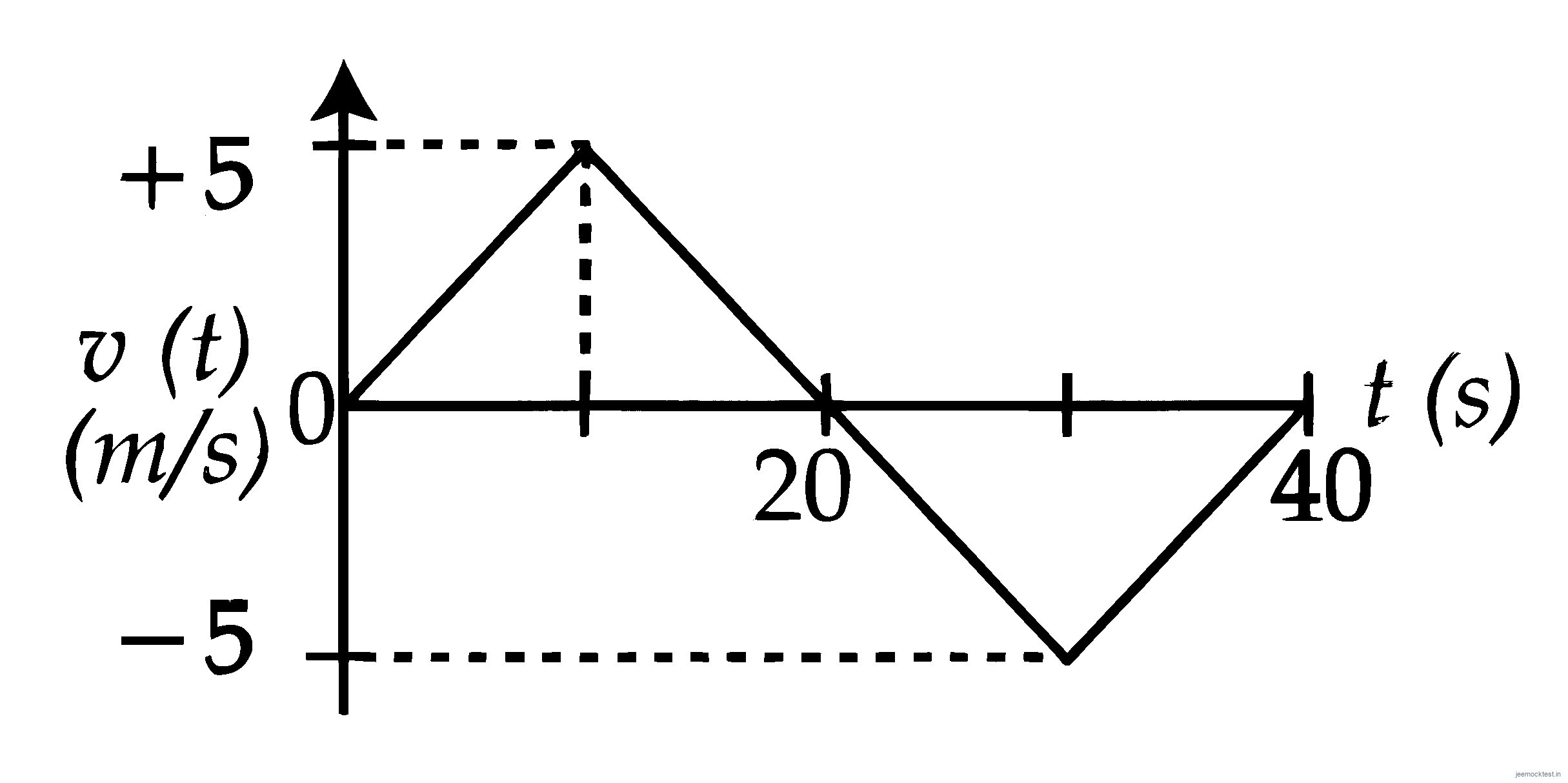
The velocity versus time plot of a particle is shown in the figure, for a time interval of 40 s . The total distance travelled by the particle and the average velocity during this period are, respectively
.
Two cars and are moving in the same direction along a straight line with speeds and , respectively such that car is moving ahead of car . A person in car throws a stone with a speed so that it hits the car with a speed of . The value of is .
A particle starts moving from time and its coordinate is given as
A. The particle returns to its original position (origin) 0.866 units later
B. The particle is 1 unit away from origin at its turning point
C. Acceleration of the particle is non-negative
D. The particle is 0.5 units away from origin at its turning point
E. Particle never turns back as acceleration is non-negative
Choose the correct answer from the options given below :