JEE PYQ: Motion in a Straight Line - Question ID 235a1db5d4ec (JEE Main 2023)
A person travels distance with velocity and then distance with velocity in the same direction. The average velocity of the person is , then the relation between and will be.
Select Option
Step-by-step Explanation
In kinematics, the average velocity () over a journey is defined as the total displacement divided by the total time taken. Mathematically,
When a person travels two equal distances ( each) with different velocities ( and ), the total displacement is , but the total time taken is the sum of the individual times for each segment: Thus, the average velocity is: This concept is crucial for solving problems involving non-uniform motion over equal distances.
Step-by-Step Derivation:Let’s derive the relationship systematically:
-
Define the journey segments:
- First segment: Distance = , Velocity = .
- Second segment: Distance = , Velocity = .
- Calculate time for each segment:
-
Compute total displacement and total time:
- Total displacement = .
- Total time = .
- Express average velocity ():
- Simplify the expression: Factor out from the denominator:
- Rearrange to match the given options: Take the reciprocal of both sides:
This matches Option D.
Common Traps & Exam Tip:Students often confuse average velocity with average speed or assume arithmetic mean applies here. Key mistakes include:
- Using arithmetic mean (Option B): Assuming is incorrect because average velocity depends on time spent at each velocity, not just the velocities themselves.
- Ignoring equal distances: If distances were unequal, the formula would differ. Here, equal distances simplify the problem.
- Reciprocal confusion: Students may misapply the harmonic mean. Remember: For equal distances, average velocity is the harmonic mean of the two velocities.
Exam Tip: Always write down the definition of average velocity first. For equal distances, the formula is a direct consequence of the definition.
Related Questions from Motion in a Straight Line
A gas balloon is going up with a constant velocity of . When this balloon reached a height of 75 m , a stone is dropped from it and balloon keeps moving up with the same velocity. The height of the balloon when the stone hits the ground is m. (Take )
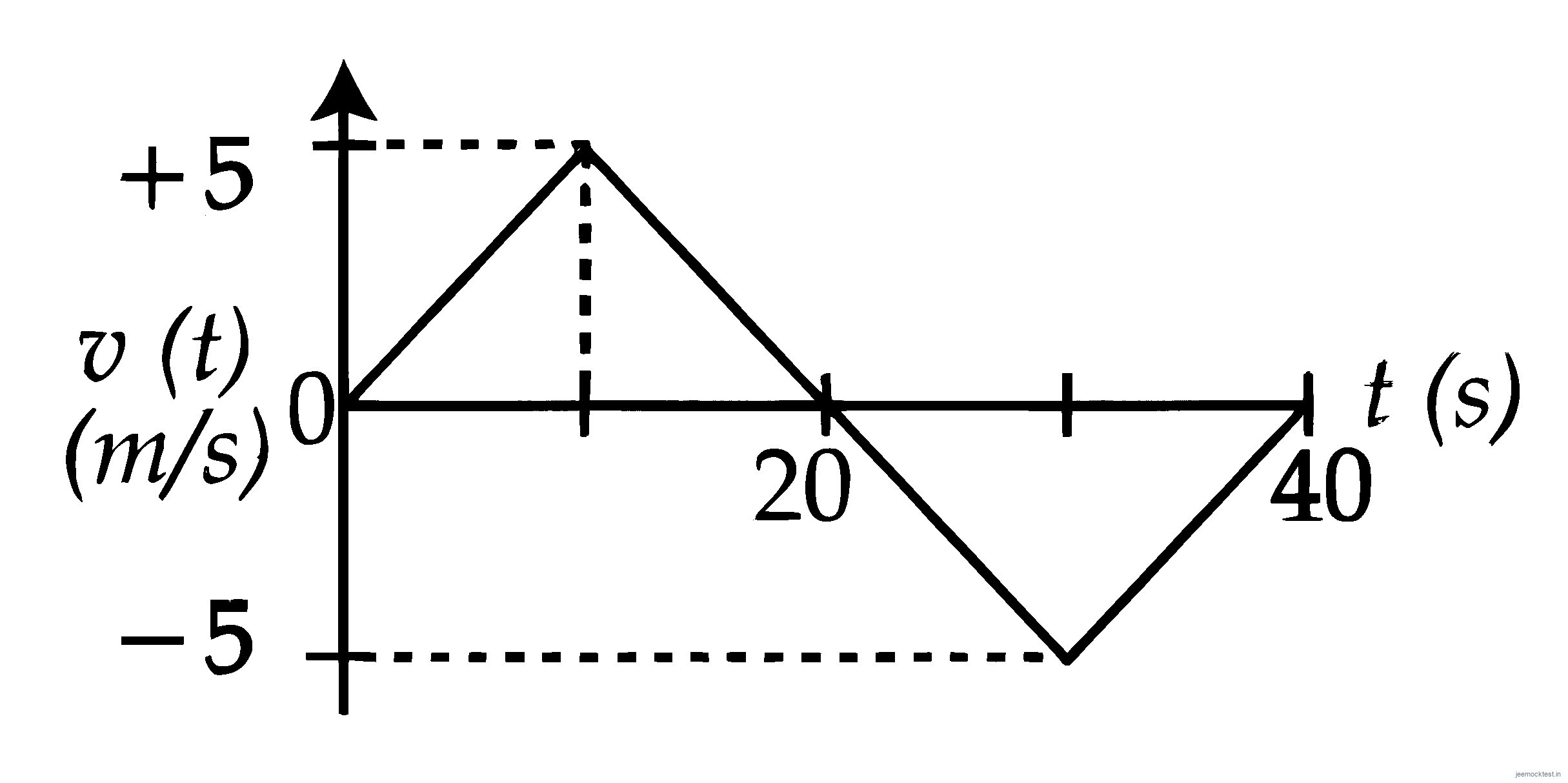
The velocity versus time plot of a particle is shown in the figure, for a time interval of 40 s . The total distance travelled by the particle and the average velocity during this period are, respectively
.
Two cars and are moving in the same direction along a straight line with speeds and , respectively such that car is moving ahead of car . A person in car throws a stone with a speed so that it hits the car with a speed of . The value of is .
A particle starts moving from time and its coordinate is given as
A. The particle returns to its original position (origin) 0.866 units later
B. The particle is 1 unit away from origin at its turning point
C. Acceleration of the particle is non-negative
D. The particle is 0.5 units away from origin at its turning point
E. Particle never turns back as acceleration is non-negative
Choose the correct answer from the options given below :