JEE PYQ: Vector Algebra - Question ID 211e8f6e499d (JEE Main 2021)

ID: 211e8f6e499dJEE Main 2021Single Correct MCQ
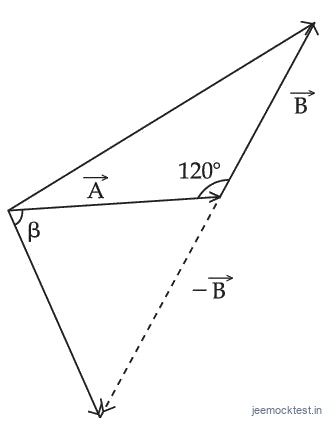
The angle between vector (A→)\left( {\overrightarrow A } \right) and (A→−B→)\left( {\overrightarrow A - \overrightarrow B } \right) is :

JEE Main 2021 (Online) 26th August Evening Shift Physics - Vector Algebra Question 23 English
JEE Question illustration 211e8f6e499d

Select Option

Step-by-step Explanation

Core Formula & Concept:

To find the angle between two vectors, we use the dot-product formula: cos⁡ϕ=P⃗⋅Q⃗∣P⃗∣ ∣Q⃗∣.\cos\phi = \frac{\vec{P} \cdot \vec{Q}}{|\vec{P}|\,|\vec{Q}|}. Here, the two vectors are P⃗=A⃗\vec{P} = \vec{A} and Q⃗=A⃗−B⃗\vec{Q} = \vec{A} - \vec{B}. We are given (from the diagram) that the angle between A⃗\vec{A} and B⃗\vec{B} is θ=60∘\theta = 60^\circ.

Step-by-Step Derivation:

1. Express the dot product
We need A⃗⋅(A⃗−B⃗)\vec{A} \cdot (\vec{A} - \vec{B}). Expand it: A⃗⋅(A⃗−B⃗)=A⃗⋅A⃗−A⃗⋅B⃗=A2−A Bcos⁡60∘=A2−A B⋅12=A2−A B2.\vec{A} \cdot (\vec{A} - \vec{B}) = \vec{A} \cdot \vec{A} - \vec{A} \cdot \vec{B} = A^2 - A\,B\cos60^\circ = A^2 - A\,B\cdot\frac12 = A^2 - \frac{A\,B}{2}.

2. Compute the magnitudes
  ∣A⃗∣=A\;|\vec{A}| = A, and ∣A⃗−B⃗∣2=A2+B2−2 A Bcos⁡60∘=A2+B2−A B.|\vec{A} - \vec{B}|^2 = A^2 + B^2 - 2\,A\,B\cos60^\circ = A^2 + B^2 - A\,B. Hence ∣A⃗−B⃗∣=A2+B2−A B.|\vec{A} - \vec{B}| = \sqrt{A^2 + B^2 - A\,B}.

3. Write the cosine of the desired angle
cos⁡ϕ=A⃗⋅(A⃗−B⃗)∣A⃗∣ ∣A⃗−B⃗∣=A2−A B2A A2+B2−A B=A−B2A2+B2−A B.\cos\phi = \frac{\vec{A}\cdot(\vec{A}-\vec{B})}{|\vec{A}|\,|\vec{A}-\vec{B}|} = \frac{A^2 - \tfrac{A\,B}{2}}{A\,\sqrt{A^2 + B^2 - A\,B}} = \frac{A - \tfrac{B}{2}}{\sqrt{A^2 + B^2 - A\,B}}.

4. Find tan⁡ϕ\tan\phi
We use tan⁡ϕ=sin⁡ϕcos⁡ϕ\tan\phi = \frac{\sin\phi}{\cos\phi}. From sin⁡2ϕ=1−cos⁡2ϕ\sin^2\phi = 1 - \cos^2\phi we get sin⁡ϕ=1−(A−B2)2A2+B2−A B=3 B/2A2+B2−A B.\sin\phi = \sqrt{1 - \frac{\bigl(A - \tfrac{B}{2}\bigr)^2}{A^2 + B^2 - A\,B}} = \frac{\sqrt{3}\,B/2}{\sqrt{A^2 + B^2 - A\,B}}. Therefore tan⁡ϕ=sin⁡ϕcos⁡ϕ=3 B/2A−B/2=3 B2A−B.\tan\phi = \frac{\sin\phi}{\cos\phi} = \frac{\sqrt{3}\,B/2}{A - B/2} = \frac{\sqrt{3}\,B}{2A - B}. Taking the inverse tangent gives ϕ=tan⁡−1 ⁣(3 B2A−B).\phi = \tan^{-1}\!\Bigl(\frac{\sqrt{3}\,B}{2A - B}\Bigr).

5. Match with the given options
The expression we derived is exactly option C.

Common Traps & Exam Tip:

1. Misidentifying the angle between A⃗\vec{A} and B⃗\vec{B}: The diagram shows 60∘60^\circ, not 90∘90^\circ.
2. Forgetting to take the square root when computing ∣A⃗−B⃗∣|\vec{A}-\vec{B}|.
3. Sign errors in the dot product: A⃗⋅B⃗=A Bcos⁡60∘\vec{A}\cdot\vec{B} = A\,B\cos60^\circ, not −A Bcos⁡60∘-A\,B\cos60^\circ.
4. Confusing tan⁡−1\tan^{-1} with cos⁡−1\cos^{-1}: The question asks for the angle in terms of tan⁡−1\tan^{-1}.

Tip: Always draw the vectors, label the known angle, and use the dot-product formula systematically.