JEE PYQ: Motion in a Straight Line - Question ID 1f68aae45b62 (JEE Main 2021)
Your Answer
Step-by-step Explanation
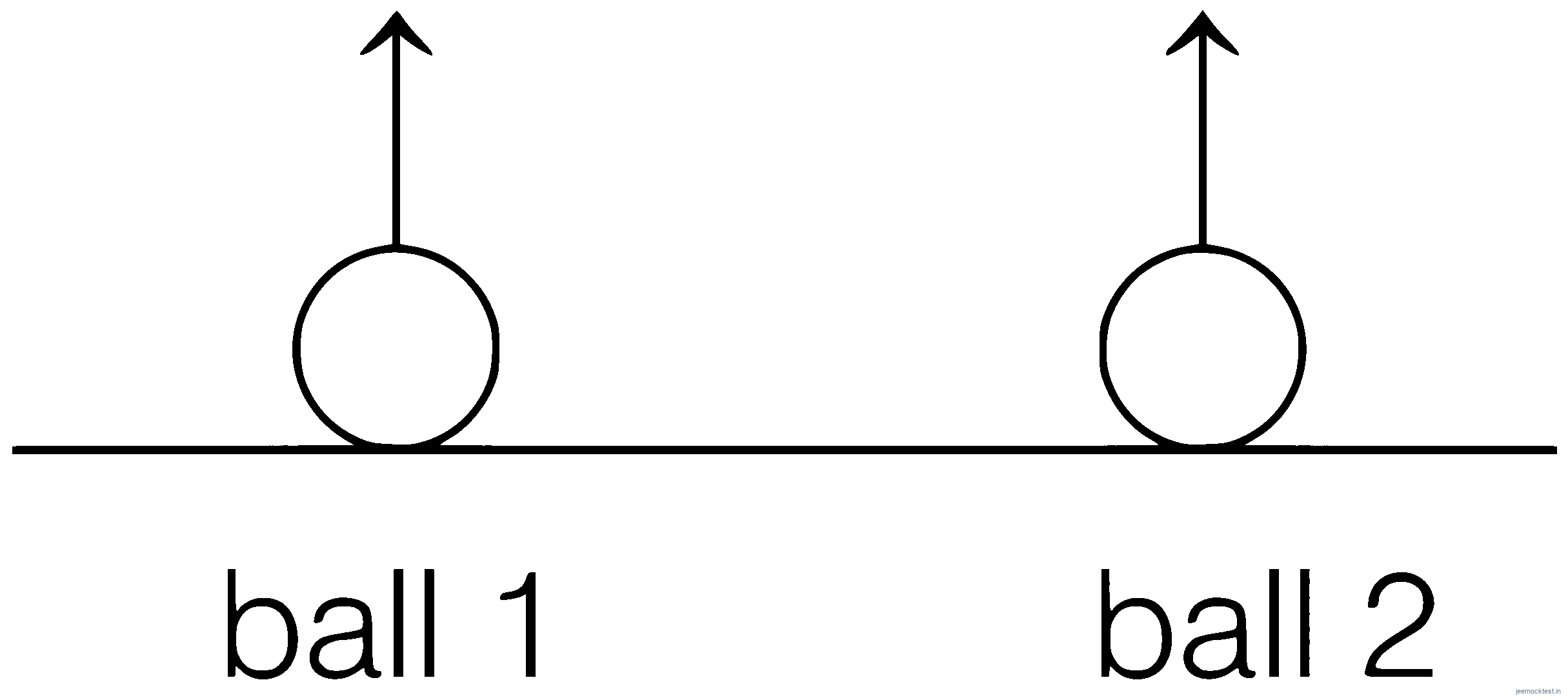
This problem involves the motion of two spherical balls under constant gravitational acceleration ( downward). The key concepts and formulas used are:
- Kinematic Equation for Vertical Motion: For an object thrown upward with initial velocity , its displacement at time is given by: This equation accounts for the deceleration due to gravity.
- Relative Motion: Since both balls are thrown along the same vertical line with the same initial velocity but at different times, we analyze their positions as functions of time and find the instant when they meet (collide).
- Time Interval Consideration: The second ball is thrown after the first. Thus, if is the time elapsed since the first ball was thrown, the second ball has been in motion for .
Let’s define:
- (initial velocity of both balls)
- (acceleration due to gravity)
- = time elapsed since the first ball was thrown (in seconds)
- = height of the first ball at time
- = height of the second ball at time
The second ball is thrown at , so for , (not yet thrown). For , the second ball has been in motion for .
Using the kinematic equation for vertical motion:
h_2(t) = u(t - 3) - \frac{1}{2}g(t - 3)^2 = 35(t - 3) - 5(t - 3)^2 \quad \text{(fort \geq 3)}The balls collide when . Thus, we set:
Simplify the right-hand side (RHS):
Substitute back into the equation:
Combine like terms on the RHS:
Subtract from both sides:
Thus, the balls collide at after the first ball is thrown.
Now, compute the height at using :
Verification: Check at :
Both heights match, confirming the collision at .
Common Traps & Exam Tip:
- Incorrect Time Reference: Students often confuse the time variables. The second ball’s motion must be referenced to its own launch time (), not the absolute time . Failing to adjust for the delay leads to incorrect equations.
- Sign Errors in Kinematic Equation: The equation assumes upward as positive. Some students mistakenly use , which reverses the direction of gravity and yields wrong results.
- Algebraic Mistakes: Expanding incorrectly or miscombining terms during simplification can lead to wrong values for . Double-check each algebraic step.
- Ignoring Physical Constraints: The collision must occur after the second ball is thrown (). If solving yields , it implies no collision, which is not the case here. Always verify the solution’s physical validity.
Exam Tip: For problems involving relative motion with time delays, always define a clear time reference (e.g., when the first object is launched). Write separate equations for each object’s position as a function of , then equate them to find the collision time. This systematic approach minimizes errors.
Related Questions from Motion in a Straight Line
A gas balloon is going up with a constant velocity of . When this balloon reached a height of 75 m , a stone is dropped from it and balloon keeps moving up with the same velocity. The height of the balloon when the stone hits the ground is m. (Take )
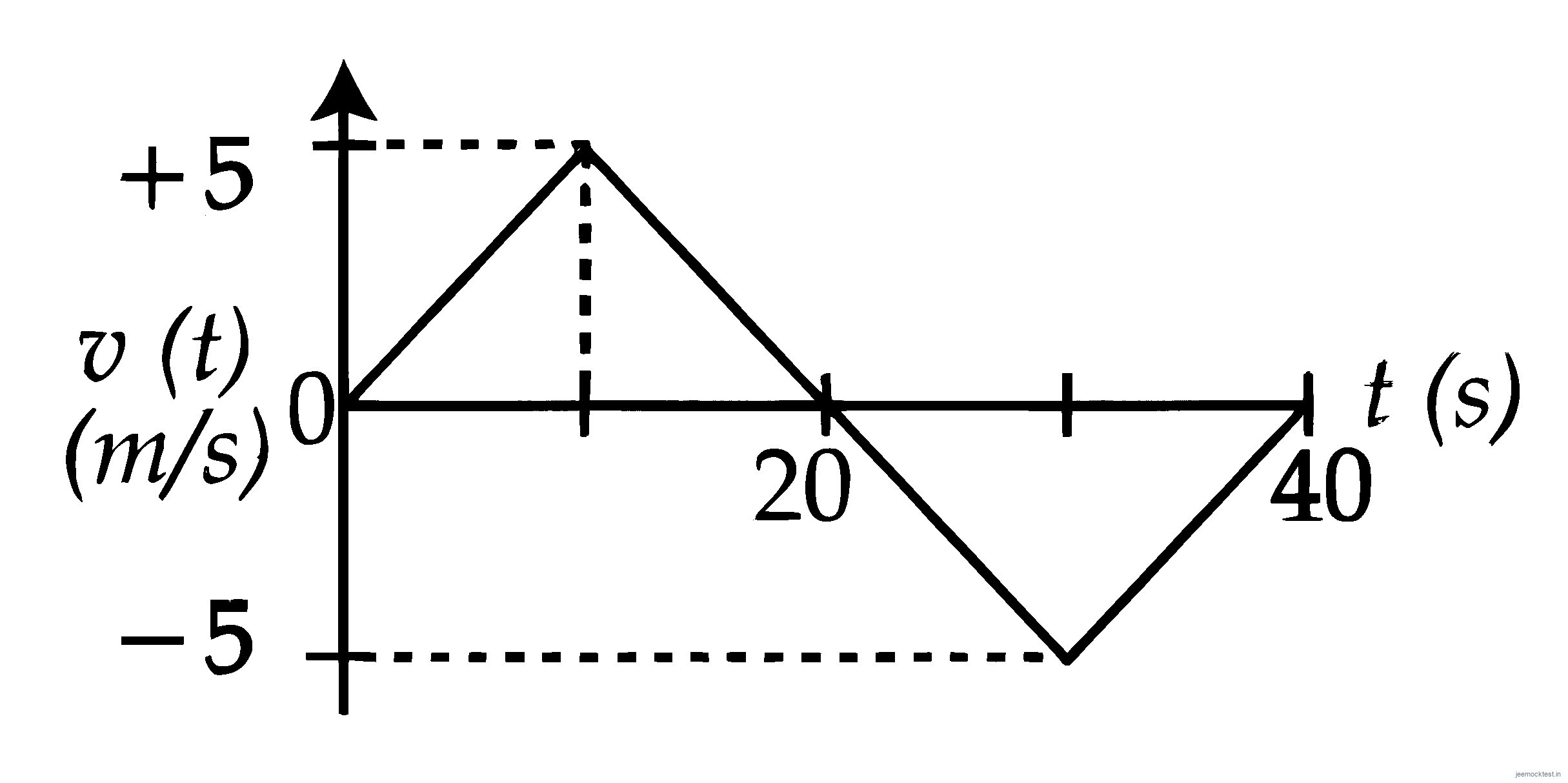
The velocity versus time plot of a particle is shown in the figure, for a time interval of 40 s . The total distance travelled by the particle and the average velocity during this period are, respectively
.
Two cars and are moving in the same direction along a straight line with speeds and , respectively such that car is moving ahead of car . A person in car throws a stone with a speed so that it hits the car with a speed of . The value of is .
A particle starts moving from time and its coordinate is given as
A. The particle returns to its original position (origin) 0.866 units later
B. The particle is 1 unit away from origin at its turning point
C. Acceleration of the particle is non-negative
D. The particle is 0.5 units away from origin at its turning point
E. Particle never turns back as acceleration is non-negative
Choose the correct answer from the options given below :