JEE PYQ: Motion in a Straight Line - Question ID 1d0bff9b5625 (JEE Main 2021)
Select Option
Step-by-step Explanation
In this problem, we analyze the motion of water droplets falling freely under gravity from an open tap. The key concept is uniformly accelerated motion (free-fall) with acceleration downward.
The position of a droplet at time after being released is given by: This formula assumes the droplet starts from rest () at .
The question involves two consecutive droplets. Let’s denote: - Droplet 1: released at time - Droplet 2: released at time , where is the time interval between successive droplets (i.e., the inverse of the drop rate).
We are told that at after the first droplet is released, the spacing between the two droplets is . This means: where is the distance fallen by the first droplet in 4 seconds, and is the distance fallen by the second droplet in seconds (since it was released seconds later).
Step-by-Step Derivation:Step 1: Express positions of both droplets
For Droplet 1 (released at ):
For Droplet 2 (released at ): At , it has been falling for seconds.
Step 2: Use the given spacing condition
The spacing between the droplets at is: Substitute the expressions: Simplify: Take square root: This gives two possibilities: - -
Step 3: Interpret the solutions
: This means droplets are released every 1 second → rate = 1 drop per second.
: This would mean droplets are released every 7 seconds → rate = 1 drop per 7 seconds.
Step 4: Validate the physical meaning
At , if , then the second droplet was released at , which is after . This means at , the second droplet hasn't even been released yet — so it cannot have fallen any distance. But the problem states that the spacing is observed at , implying both droplets exist and are in motion. Hence, is physically invalid in this context.
Therefore, the only valid solution is , corresponding to a drop rate of 1 drop per second.
Common Traps & Exam Tip:Trap 1: Students often forget that the second droplet was released later and thus has been falling for less time. They mistakenly assume both droplets have fallen for 4 seconds.
Trap 2: Ignoring the physical meaning of negative time. The solution leads to , which implies the second droplet hasn't been released yet. This is not consistent with the observation of spacing at . Always check the domain of validity.
Exam Tip: When dealing with relative motion of objects released at different times, always define the time of release clearly and express positions as functions of time since release. Use the difference in positions to set up the equation, and always interpret the physical meaning of mathematical solutions.
Final Answer: Option C: 1 drop / second
Related Questions from Motion in a Straight Line
A gas balloon is going up with a constant velocity of . When this balloon reached a height of 75 m , a stone is dropped from it and balloon keeps moving up with the same velocity. The height of the balloon when the stone hits the ground is m. (Take )
The velocity versus time plot of a particle is shown in the figure, for a time interval of 40 s . The total distance travelled by the particle and the average velocity during this period are, respectively
.
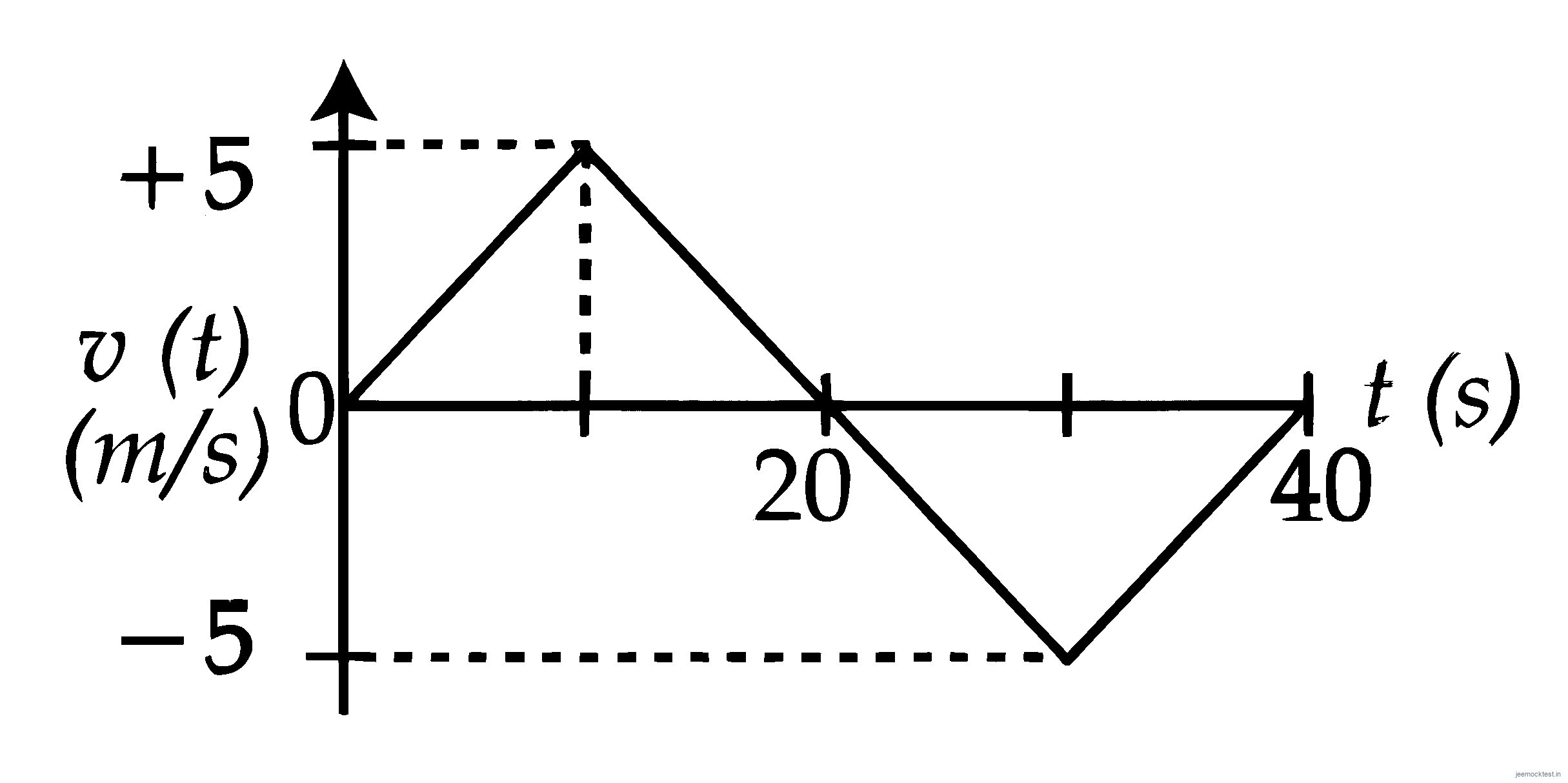
Two cars and are moving in the same direction along a straight line with speeds and , respectively such that car is moving ahead of car . A person in car throws a stone with a speed so that it hits the car with a speed of . The value of is .
A particle starts moving from time and its coordinate is given as
A. The particle returns to its original position (origin) 0.866 units later
B. The particle is 1 unit away from origin at its turning point
C. Acceleration of the particle is non-negative
D. The particle is 0.5 units away from origin at its turning point
E. Particle never turns back as acceleration is non-negative
Choose the correct answer from the options given below :