JEE PYQ: Motion in a Straight Line - Question ID 1ceeae2a9f19 (JEE Main 2020)
(graph are drawn schematically and on not to scale)
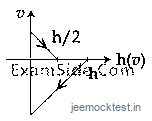
Select Option
Step-by-step Explanation
The problem involves the motion of a tennis ball under gravity, first falling freely from height \( h \) and then rebounding to height \( \frac{h}{2} \). The key physics concepts and formulas used are:
- Kinematic Equations for Free Fall: For an object in free fall (ignoring air resistance), the velocity \( v \) at any height \( y \) can be related to the initial height using energy conservation or kinematic equations. The velocity of the ball at height \( y \) during descent is given by: where \( g \) is the acceleration due to gravity.
- Velocity at Impact: When the ball hits the floor (\( y = 0 \)), its velocity just before impact is:
- Rebound Velocity: After rebounding, the ball reaches height \( \frac{h}{2} \). Using energy conservation, the velocity just after rebound (\( v_{\text{rebound}} \)) is: This shows that the rebound velocity is less than the impact velocity due to energy loss (e.g., deformation, sound, heat).
-
Velocity vs. Height Graph:
The graph of velocity \( v \) versus height \( y \) should reflect:
- During descent: \( v \) increases as \( y \) decreases (negative slope, since velocity is downward).
- At impact (\( y = 0 \)): Velocity abruptly changes direction (from downward to upward) but with reduced magnitude.
- During ascent: \( v \) decreases as \( y \) increases (negative slope, since velocity is upward but decreasing).
We analyze the motion in two phases: descent and ascent.
-
Descent Phase (Falling from \( h \) to \( 0 \)):
- The velocity at any height \( y \) during descent is: (The negative sign indicates downward direction.)
- At \( y = h \), \( v = 0 \) (initial release).
- At \( y = 0 \), \( v = -\sqrt{2gh} \) (maximum downward velocity before impact).
- The \( v \) vs. \( y \) graph for descent is a curve starting at \( (h, 0) \) and ending at \( (0, -\sqrt{2gh}) \), with a negative slope (since \( \frac{dv}{dy} = -\sqrt{\frac{g}{2(h - y)}} < 0 \)).
-
Ascent Phase (Rebounding from \( 0 \) to \( \frac{h}{2} \)):
- The velocity at any height \( y \) during ascent is: (The positive sign indicates upward direction.)
- At \( y = 0 \), \( v = +\sqrt{gh} \) (rebound velocity, less than \( \sqrt{2gh} \)).
- At \( y = \frac{h}{2} \), \( v = 0 \) (maximum height after rebound).
- The \( v \) vs. \( y \) graph for ascent is a curve starting at \( (0, +\sqrt{gh}) \) and ending at \( \left( \frac{h}{2}, 0 \right) \), with a negative slope (since \( \frac{dv}{dy} = -\sqrt{\frac{g}{2 \left( \frac{h}{2} - y \right)}} < 0 \)).
-
Graph Characteristics:
-
The graph must show two distinct curves:
- One for descent (negative \( v \), decreasing \( y \)).
- One for ascent (positive \( v \), increasing \( y \)).
- At \( y = 0 \), there is a discontinuity in \( v \) (from \( -\sqrt{2gh} \) to \( +\sqrt{gh} \)).
- The slope \( \frac{dv}{dy} \) is negative for both curves (since \( v \) decreases as \( y \) increases in both phases).
- The graph should not pass through the origin or show symmetry about \( y = 0 \), as the rebound velocity is smaller than the impact velocity.
-
The graph must show two distinct curves:
-
Matching with Options:
- Option A: Incorrect. Shows a single straight line, implying constant acceleration (which is true) but no discontinuity at \( y = 0 \) and no distinction between descent/ascent.
- Option B: Incorrect. Shows a symmetric graph about \( y = 0 \), implying equal impact and rebound velocities (not the case here).
-
Option C: Correct. Shows:
- Two separate curves for descent and ascent.
- A discontinuity at \( y = 0 \).
- Negative slope for both curves.
- Rebound velocity smaller than impact velocity.
- Option D: Incorrect. Shows a continuous curve with no discontinuity at \( y = 0 \), implying no rebound.
Students often make the following mistakes:
- Ignoring the Discontinuity: Many assume the velocity changes smoothly at \( y = 0 \), leading them to choose Option D. However, the rebound is instantaneous, causing a sudden change in velocity direction and magnitude.
- Assuming Symmetric Velocities: Some students assume the rebound velocity is equal in magnitude to the impact velocity (Option B), ignoring energy loss during the collision.
- Misinterpreting the Slope: The slope \( \frac{dv}{dy} \) is negative for both descent and ascent. A positive slope (as in some incorrect options) would imply increasing velocity with height, which is unphysical.
- Energy Conservation Misapplication: Students may forget that the rebound height is \( \frac{h}{2} \), not \( h \), leading to incorrect velocity calculations.
Exam Tip: Always sketch the motion phases separately (descent and ascent) and mark key points (initial/final heights, impact/rebound velocities). This helps visualize the \( v \) vs. \( y \) graph and avoid common pitfalls.
Related Questions from Motion in a Straight Line
A gas balloon is going up with a constant velocity of . When this balloon reached a height of 75 m , a stone is dropped from it and balloon keeps moving up with the same velocity. The height of the balloon when the stone hits the ground is m. (Take )
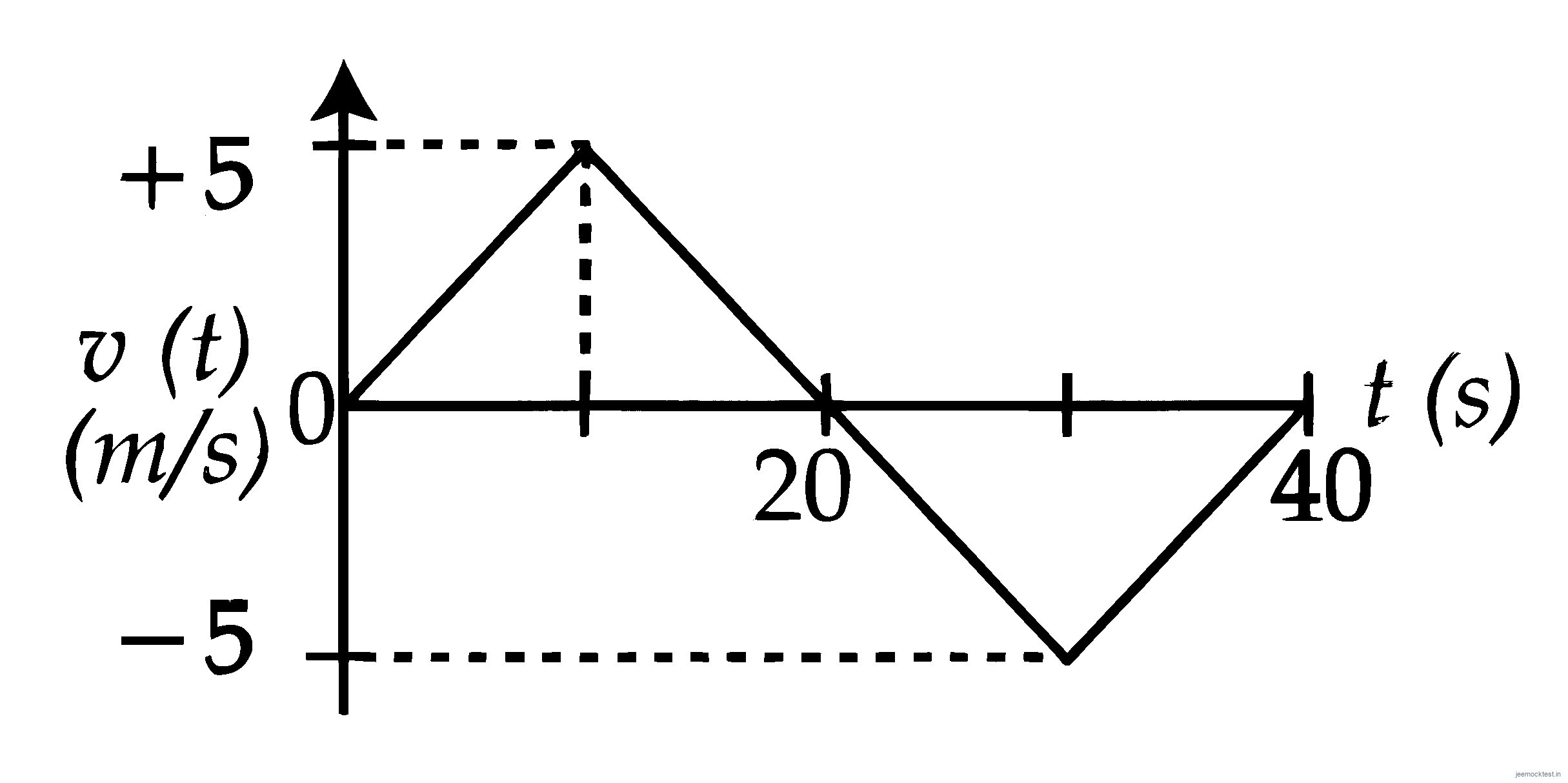
The velocity versus time plot of a particle is shown in the figure, for a time interval of 40 s . The total distance travelled by the particle and the average velocity during this period are, respectively
.
Two cars and are moving in the same direction along a straight line with speeds and , respectively such that car is moving ahead of car . A person in car throws a stone with a speed so that it hits the car with a speed of . The value of is .
A particle starts moving from time and its coordinate is given as
A. The particle returns to its original position (origin) 0.866 units later
B. The particle is 1 unit away from origin at its turning point
C. Acceleration of the particle is non-negative
D. The particle is 0.5 units away from origin at its turning point
E. Particle never turns back as acceleration is non-negative
Choose the correct answer from the options given below :