JEE PYQ: Motion in a Straight Line - Question ID 1ad94d5642e1 (JEE Main 2022)
The velocity of the bullet becomes one third after it penetrates 4 cm in a wooden block. Assuming that bullet is facing a constant resistance during its motion in the block. The bullet stops completely after travelling at (4 + x) cm inside the block. The value of x is :
Select Option
Step-by-step Explanation
This problem involves the motion of a bullet under a constant resistive force inside a wooden block. The key physics concepts and formulas are:
- Work-Energy Theorem: When a constant force acts on a body, the work done by the force equals the change in kinetic energy of the body. Here, the resistive force does negative work (since it opposes motion), so: where is the displacement, is the mass of the bullet, and , are initial and final velocities.
- Constant Resistance Implies Constant Deceleration: Since the resistive force is constant, the deceleration is also constant. We can use kinematic equations for uniformly decelerated motion: Here, is negative (deceleration), so:
We are given: - After penetrating , velocity becomes , where is the initial velocity. - The bullet stops after travelling a total distance . We need to find .
--- Step-by-Step Derivation:Step 1: Apply Work-Energy Theorem for the first 4 cm
Let = mass of bullet, = initial velocity, = velocity after 4 cm. Work done by resistive force over distance : Substitute : Multiply both sides by : Divide both sides by 4:
Step 2: Apply Work-Energy Theorem until bullet stops
Total distance travelled before stopping: Final velocity Work done by resistive force over total distance: Multiply both sides by :
Step 3: Substitute from Equation 1 into Equation 2
From Equation 1: Substitute into Equation 2: Cancel from both sides (assuming , ): Multiply both sides by 9: Subtract 4:
Conclusion: The value of is cm, which corresponds to option C.
--- Common Traps & Exam Tip:
Trap 1: Misapplying Kinematic Equations Without Considering Signs
Students often forget that deceleration is negative acceleration. If they use without accounting for the negative sign of , they get incorrect results. Always define deceleration as .
Trap 2: Incorrect Use of Work-Energy Theorem
Some students forget that the work done by a resistive force is negative. They write instead of . This leads to sign errors and wrong answers.
Trap 3: Assuming Linear Velocity-Distance Relationship
Students sometimes assume velocity decreases linearly with distance, which is incorrect under constant deceleration. Velocity decreases quadratically with distance (), not linearly.
Exam Tip:
Always start by writing down known quantities and the physics principle to apply. In this case, since force is constant, the work-energy theorem is the most straightforward approach. Avoid unnecessary use of kinematic equations unless explicitly required.
Related Questions from Motion in a Straight Line
A gas balloon is going up with a constant velocity of . When this balloon reached a height of 75 m , a stone is dropped from it and balloon keeps moving up with the same velocity. The height of the balloon when the stone hits the ground is m. (Take )
The velocity versus time plot of a particle is shown in the figure, for a time interval of 40 s . The total distance travelled by the particle and the average velocity during this period are, respectively
.
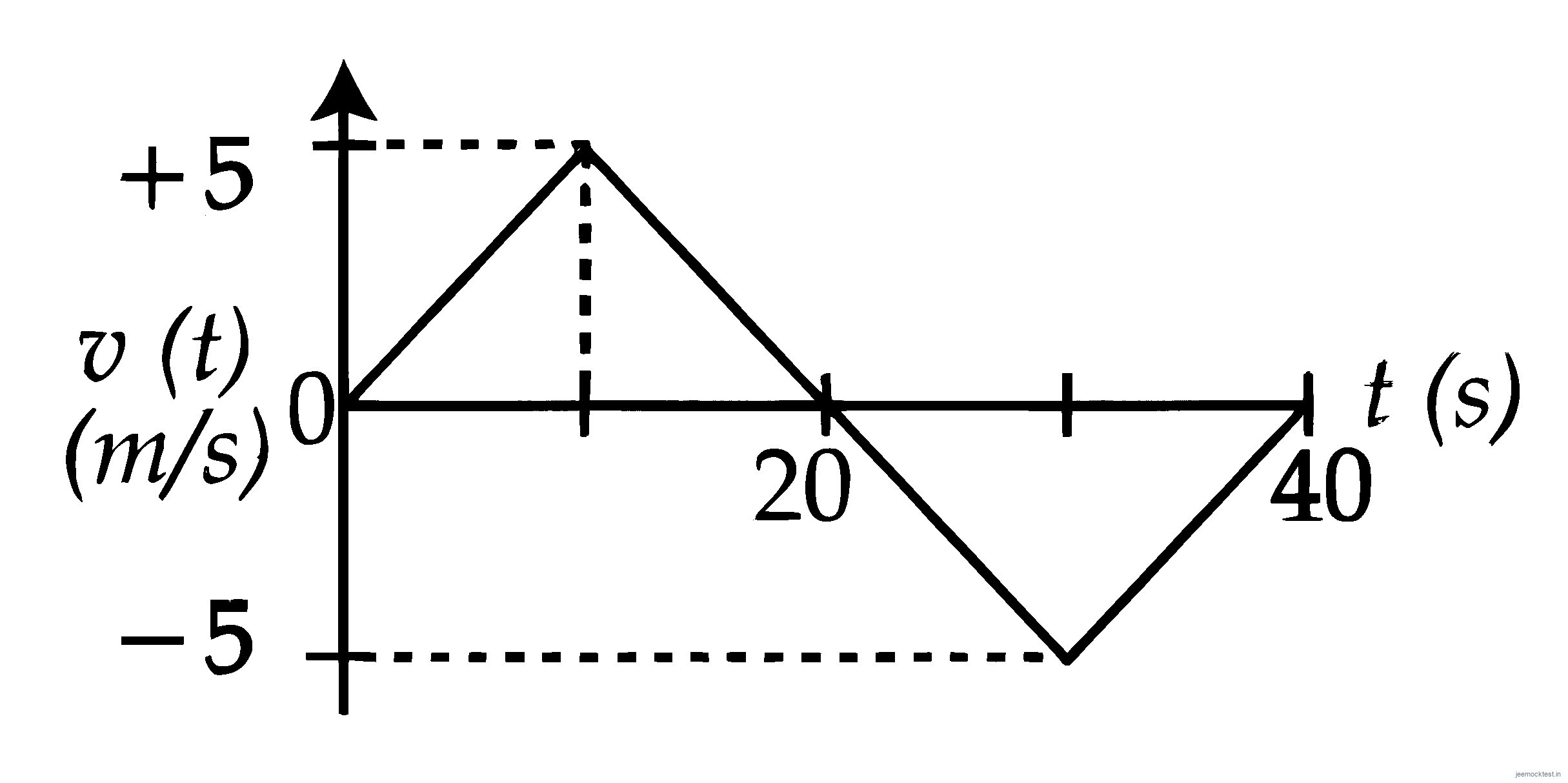
Two cars and are moving in the same direction along a straight line with speeds and , respectively such that car is moving ahead of car . A person in car throws a stone with a speed so that it hits the car with a speed of . The value of is .
A particle starts moving from time and its coordinate is given as
A. The particle returns to its original position (origin) 0.866 units later
B. The particle is 1 unit away from origin at its turning point
C. Acceleration of the particle is non-negative
D. The particle is 0.5 units away from origin at its turning point
E. Particle never turns back as acceleration is non-negative
Choose the correct answer from the options given below :