JEE PYQ: Motion in a Straight Line - Question ID 199346dbcaa3 (JEE Main 2024)
A bus moving along a straight highway with speed of is brought to halt within after applying the brakes. The distance travelled by the bus during this time (Assume the retardation is uniform) is ________ .
Your Answer
Step-by-step Explanation
When a body moves with uniform (constant) acceleration or retardation, its motion can be described using the three fundamental kinematic equations for straight-line motion. In this problem, the bus is decelerating uniformly (retardation is constant) until it comes to rest. The key formulas we use are:
-
where:- = final velocity (0 m/s, since the bus halts),
- = initial velocity (given in km/h, must be converted to m/s),
- = acceleration (negative for retardation),
- = time taken (4 s).
-
where is the distance travelled during the braking period.
The concept of uniform retardation implies that the acceleration is constant and negative (opposite to the direction of motion). We first determine using the first equation, then substitute it into the second to find .
Step-by-Step Derivation:Step 1: Convert the initial speed to SI units
The bus speed is given as . To convert to : Thus, .
Step 2: Determine the acceleration (retardation)
The bus comes to rest, so . Using : The negative sign indicates retardation (deceleration).
Step 3: Calculate the distance travelled during braking
Using :
Step 4: Verify using an alternative formula
We can also use : This confirms our previous result.
Common Traps & Exam Tip:Unit Conversion Error: Many students forget to convert km/h to m/s, leading to incorrect values for and consequently wrong and . Always ensure units are consistent (SI units are preferred in kinematics).
Sign of Acceleration: Students often confuse the sign of . Since the bus is slowing down, must be negative. Using would yield , which is incorrect.
Direct Use of Average Velocity: Another valid approach is using average velocity: . This is a quick sanity check.
Exam Tip: Always cross-verify using at least two different kinematic equations to ensure consistency and catch calculation errors.
Related Questions from Motion in a Straight Line
A gas balloon is going up with a constant velocity of . When this balloon reached a height of 75 m , a stone is dropped from it and balloon keeps moving up with the same velocity. The height of the balloon when the stone hits the ground is m. (Take )
The velocity versus time plot of a particle is shown in the figure, for a time interval of 40 s . The total distance travelled by the particle and the average velocity during this period are, respectively
.
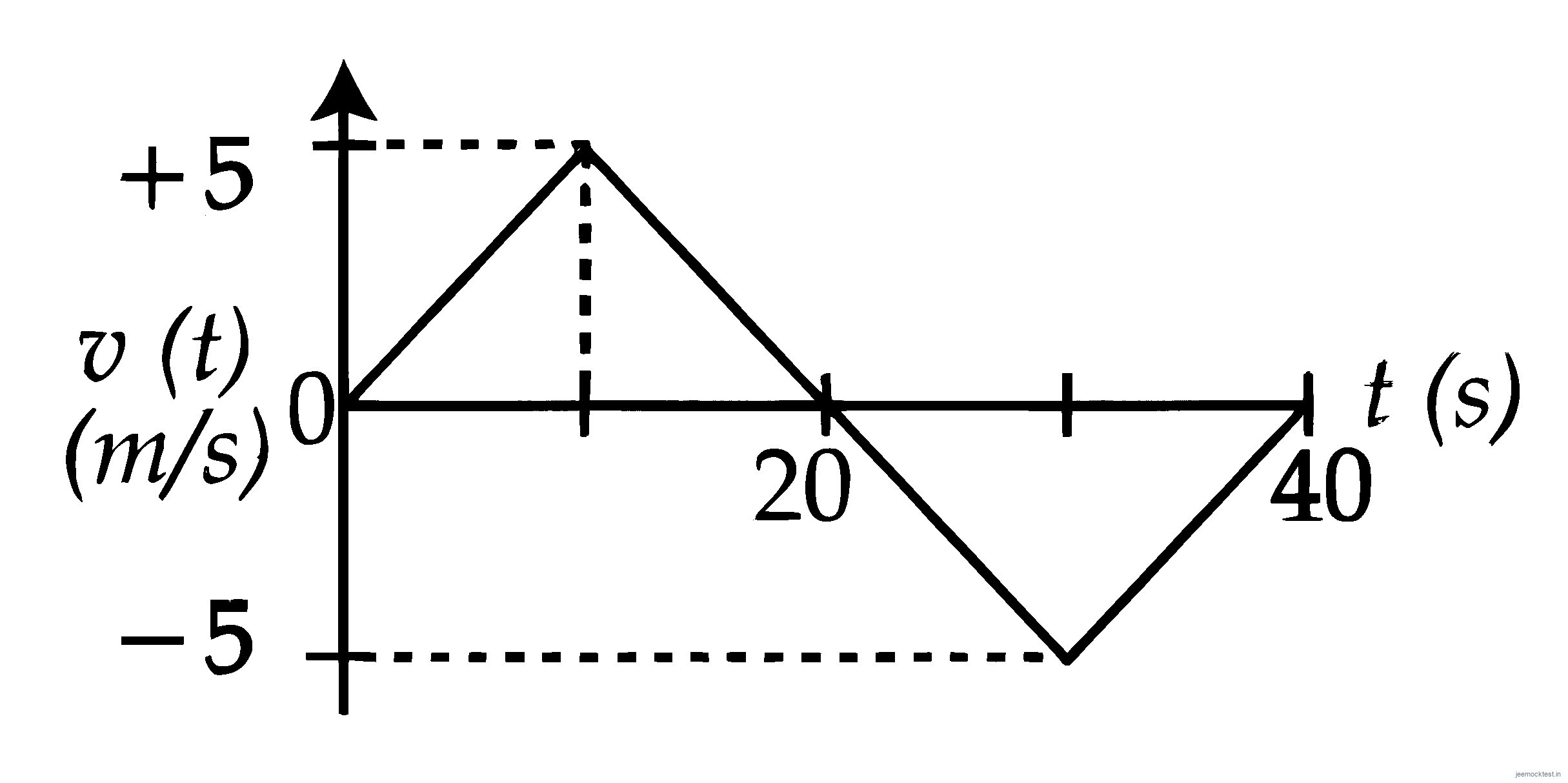
Two cars and are moving in the same direction along a straight line with speeds and , respectively such that car is moving ahead of car . A person in car throws a stone with a speed so that it hits the car with a speed of . The value of is .
A particle starts moving from time and its coordinate is given as
A. The particle returns to its original position (origin) 0.866 units later
B. The particle is 1 unit away from origin at its turning point
C. Acceleration of the particle is non-negative
D. The particle is 0.5 units away from origin at its turning point
E. Particle never turns back as acceleration is non-negative
Choose the correct answer from the options given below :