JEE PYQ: Motion in a Straight Line - Question ID 182ce3644b8f (JEE Main 2023)
A passenger sitting in a train A moving at observes another train moving in the opposite direction for . If the velocity of the train B is , then length of train B is:
Select Option
Step-by-step Explanation
When two objects move in opposite directions, their relative velocity is the sum of their individual velocities. This is a direct consequence of the principle of relative motion in one dimension.
Key formulas:
- Relative velocity when moving in opposite directions: where and are the speeds of the two objects.
- Distance covered under constant relative velocity: This distance corresponds to the length of the object being observed (here, train B).
Step 1: Convert velocities to consistent units (m/s)
Train A moves at . Convert to m/s:
Train B moves at . Convert to m/s:
Step 2: Compute relative velocity
Since the trains move in opposite directions, their relative velocity is the sum of their speeds:
Step 3: Calculate the length of train B
The passenger in train A observes train B for . During this time, the entire length of train B passes by the passenger. Hence, the length of train B is:
Step 4: Match with given options
The calculated length is , which corresponds to option D.
Common Traps & Exam Tip:
Trap 1: Incorrect relative velocity
Students often subtract velocities when objects move in opposite directions, leading to and an incorrect length of (option A). Always remember: opposite directions → add velocities.
Trap 2: Unit inconsistency
Failing to convert km/h to m/s results in nonsensical answers. Always ensure consistent units (preferably SI units) before calculations.
Exam Tip:
Visualize the scenario: two trains moving toward each other. The faster they approach, the quicker the second train passes by. This intuition reinforces that relative velocity is the sum of their speeds.
Related Questions from Motion in a Straight Line
A gas balloon is going up with a constant velocity of . When this balloon reached a height of 75 m , a stone is dropped from it and balloon keeps moving up with the same velocity. The height of the balloon when the stone hits the ground is m. (Take )
The velocity versus time plot of a particle is shown in the figure, for a time interval of 40 s . The total distance travelled by the particle and the average velocity during this period are, respectively
.
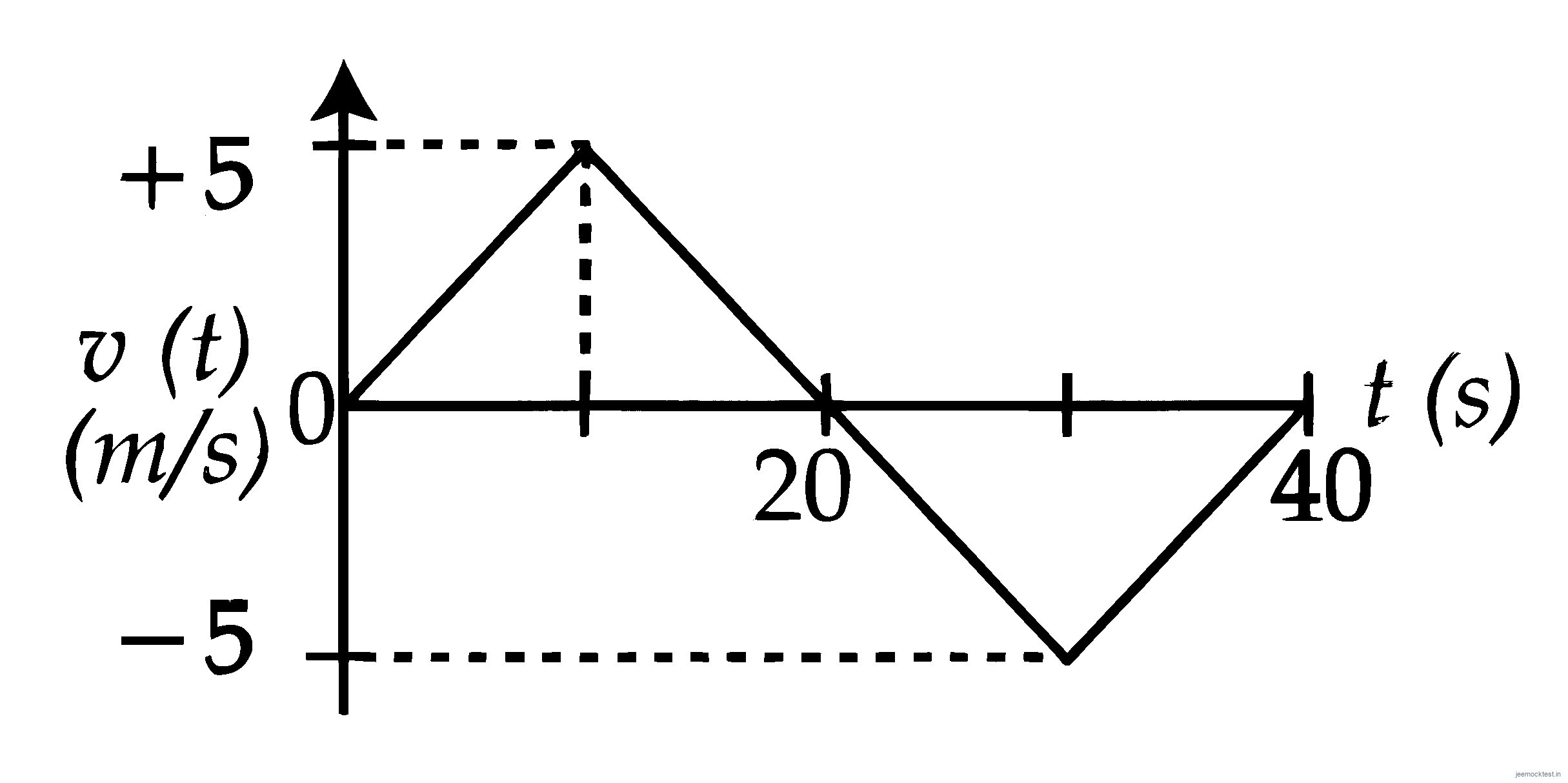
Two cars and are moving in the same direction along a straight line with speeds and , respectively such that car is moving ahead of car . A person in car throws a stone with a speed so that it hits the car with a speed of . The value of is .
A particle starts moving from time and its coordinate is given as
A. The particle returns to its original position (origin) 0.866 units later
B. The particle is 1 unit away from origin at its turning point
C. Acceleration of the particle is non-negative
D. The particle is 0.5 units away from origin at its turning point
E. Particle never turns back as acceleration is non-negative
Choose the correct answer from the options given below :