JEE PYQ: Motion in a Straight Line - Question ID 13a0147e02c0 (JEE Main 2017)
Select Option
Step-by-step Explanation
In problems involving relative motion with constant acceleration, the key idea is to express the positions of both moving objects as functions of time and then find the instant when their positions coincide.
For an object starting from rest and moving with constant acceleration , its position at time is given by:
When two objects start from different initial positions and move with different accelerations, the relative position between them changes over time. The car catches up with the bus when the distance covered by the car equals the initial separation plus the distance covered by the bus.
Step-by-Step Derivation:Let:
- : initial separation (car is 200 m behind the bus).
- : acceleration of the bus.
- : acceleration of the car.
At time , the position of the bus (starting from rest) is:
The position of the car (also starting from rest, but 200 m behind) is:
The car catches up with the bus when :
Rearrange: Wait — this leads to , which matches option C. However, let's double-check the setup.
Actually, the car is behind the bus by 200 m. So when the car catches up, its position equals the bus’s position: But starts 200 m behind, so: Wait — no. Let’s define a coordinate system where the bus starts at , and the car starts at . Then: The car catches the bus when :
Thus, the correct time is , which corresponds to option C.
Common Traps & Exam Tip:Students often make two critical mistakes:
- Incorrect sign for initial separation: Forgetting that the car starts 200 m behind the bus and incorrectly setting . This leads to , which is impossible.
- Misapplying relative acceleration: Trying to use and then solving , which ignores the initial 200 m gap. This gives , but the setup is flawed because relative acceleration alone doesn’t account for initial separation.
Exam Tip: Always define a clear coordinate system. Let one object start at , and the other at its initial position (positive or negative). Then write position equations for both and set them equal at the catch-up time.
Related Questions from Motion in a Straight Line
A gas balloon is going up with a constant velocity of . When this balloon reached a height of 75 m , a stone is dropped from it and balloon keeps moving up with the same velocity. The height of the balloon when the stone hits the ground is m. (Take )
The velocity versus time plot of a particle is shown in the figure, for a time interval of 40 s . The total distance travelled by the particle and the average velocity during this period are, respectively
.
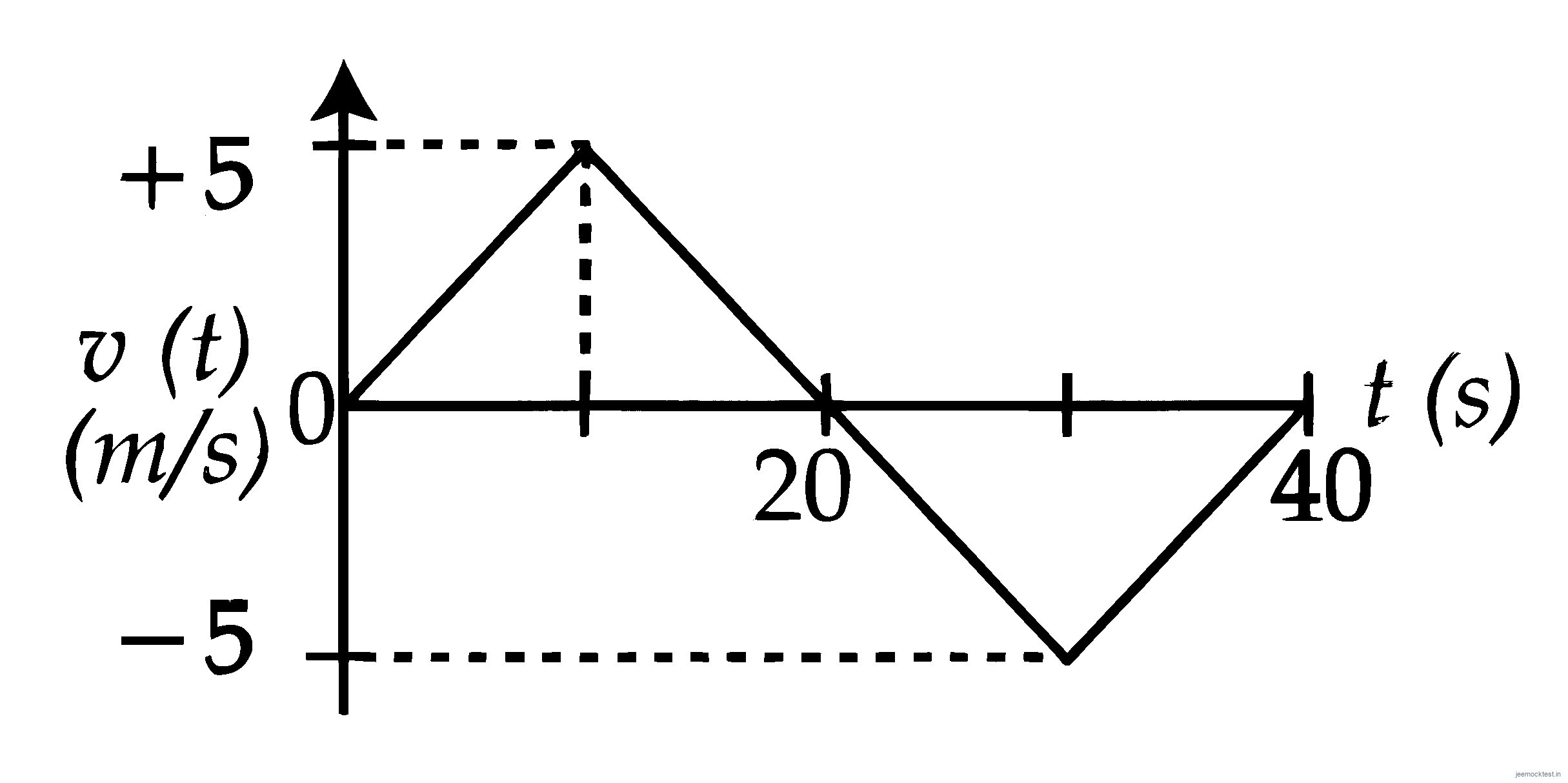
Two cars and are moving in the same direction along a straight line with speeds and , respectively such that car is moving ahead of car . A person in car throws a stone with a speed so that it hits the car with a speed of . The value of is .
A particle starts moving from time and its coordinate is given as
A. The particle returns to its original position (origin) 0.866 units later
B. The particle is 1 unit away from origin at its turning point
C. Acceleration of the particle is non-negative
D. The particle is 0.5 units away from origin at its turning point
E. Particle never turns back as acceleration is non-negative
Choose the correct answer from the options given below :