JEE PYQ: Motion in a Straight Line - Question ID 0ff985c0843f (JEE Main 2026)
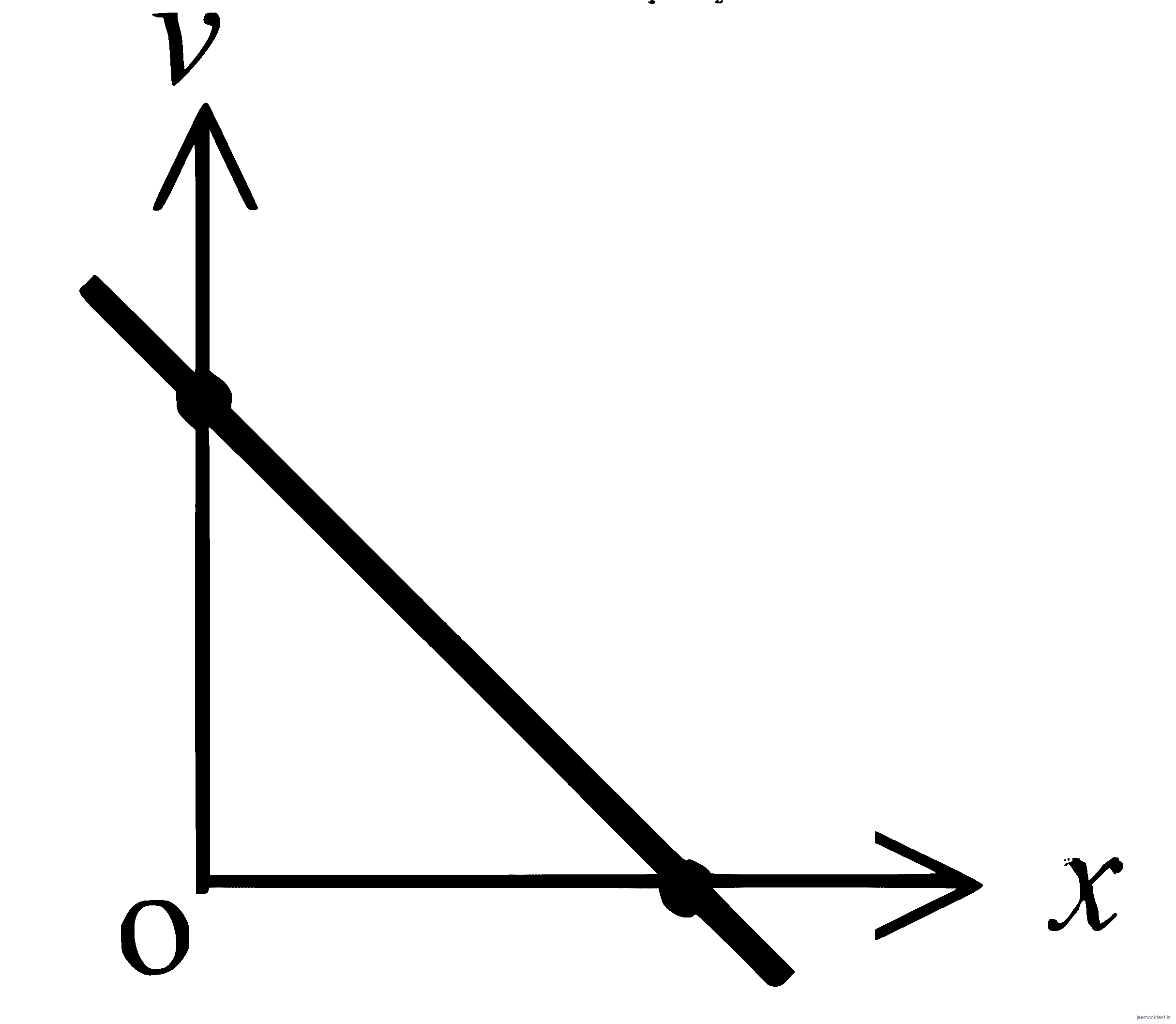
The velocity - Distance graph is shown in figure. Which graph represents acceleration(a) versus distance ( ) variation of this system?
Select Option
Step-by-step Explanation
To find the acceleration \( a \) as a function of distance \( x \) from a given velocity-distance (\( v \)-\( x \)) graph, we use the chain rule of calculus:
Here, \( \frac{dv}{dx} \) is the slope of the \( v \)-\( x \) graph at any point, and \( v \) is the velocity at that point. Thus, acceleration is the product of velocity and the slope of the \( v \)-\( x \) curve.
Step-by-Step Derivation:Step 1: Analyze the given \( v \)-\( x \) graph
The provided \( v \)-\( x \) graph consists of three distinct linear segments:
- From \( x = 0 \) to \( x = x_1 \): A straight line with positive slope \( m_1 \).
- From \( x = x_1 \) to \( x = x_2 \): A straight line with zero slope (horizontal line).
- From \( x = x_2 \) to \( x = x_3 \): A straight line with negative slope \( m_2 \).
Step 2: Compute acceleration in each segment
Using \( a = v \cdot \frac{dv}{dx} \):
-
Segment 1 (\( 0 \leq x < x_1 \)):
\( \frac{dv}{dx} = m_1 \) (constant positive slope).
Since \( v \) increases linearly with \( x \), \( v = m_1 x \).
Thus, This means acceleration increases linearly with \( x \) in this segment. -
Segment 2 (\( x_1 \leq x < x_2 \)):
\( \frac{dv}{dx} = 0 \) (horizontal line).
Thus, Acceleration is zero throughout this segment. -
Segment 3 (\( x_2 \leq x \leq x_3 \)):
\( \frac{dv}{dx} = m_2 \) (constant negative slope).
Since \( v \) decreases linearly with \( x \), \( v = v_2 + m_2 (x - x_2) \), where \( v_2 \) is the velocity at \( x = x_2 \).
Thus, Since \( m_2 < 0 \), \( a \) is negative and decreases linearly with \( x \).
Step 3: Sketch the \( a \)-\( x \) graph based on the above analysis
- From \( x = 0 \) to \( x = x_1 \): \( a \) increases linearly from 0 to \( a_1 = m_1^2 x_1 \).
- From \( x = x_1 \) to \( x = x_2 \): \( a = 0 \).
- From \( x = x_2 \) to \( x = x_3 \): \( a \) decreases linearly from 0 to a negative value.
This behavior matches the shape of option D, where:
- The acceleration starts at zero, increases linearly,
- Drops abruptly to zero,
- Then decreases linearly into negative values.
Students often confuse the \( v \)-\( x \) graph with the \( v \)-\( t \) graph and mistakenly assume that the slope of the \( v \)-\( x \) graph directly gives acceleration. This is incorrect because acceleration depends on both the slope \( \frac{dv}{dx} \) and the velocity \( v \) itself.
Another common error is overlooking the abrupt change in slope at \( x = x_1 \) and \( x = x_2 \), leading to incorrect conclusions about the continuity of acceleration. Remember that acceleration can change discontinuously if the slope of the \( v \)-\( x \) graph changes abruptly.
Exam Tip: Always use the relation \( a = v \cdot \frac{dv}{dx} \) when dealing with \( v \)-\( x \) graphs to avoid confusion.
Related Questions from Motion in a Straight Line
A gas balloon is going up with a constant velocity of . When this balloon reached a height of 75 m , a stone is dropped from it and balloon keeps moving up with the same velocity. The height of the balloon when the stone hits the ground is m. (Take )
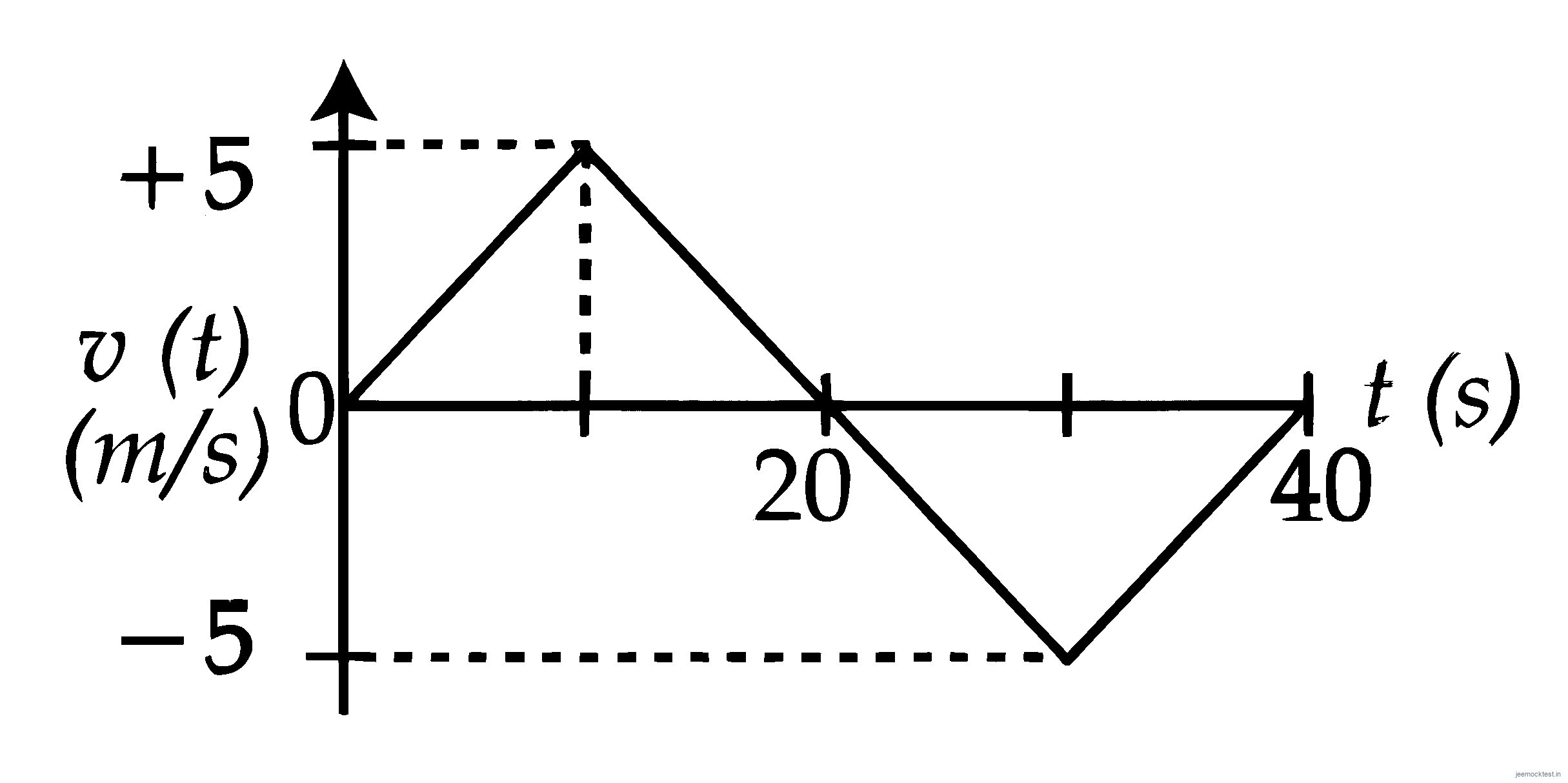
The velocity versus time plot of a particle is shown in the figure, for a time interval of 40 s . The total distance travelled by the particle and the average velocity during this period are, respectively
.
Two cars and are moving in the same direction along a straight line with speeds and , respectively such that car is moving ahead of car . A person in car throws a stone with a speed so that it hits the car with a speed of . The value of is .
A particle starts moving from time and its coordinate is given as
A. The particle returns to its original position (origin) 0.866 units later
B. The particle is 1 unit away from origin at its turning point
C. Acceleration of the particle is non-negative
D. The particle is 0.5 units away from origin at its turning point
E. Particle never turns back as acceleration is non-negative
Choose the correct answer from the options given below :