JEE PYQ: Motion in a Straight Line - Question ID 0e6377476781 (JEE Main 2024)
A train starting from rest first accelerates uniformly up to a speed of for time , then it moves with a constant speed for time . The average speed of the train for this duration of journey will be (in ) :
Select Option
Step-by-step Explanation
In problems involving motion in a straight line with varying acceleration, the average speed is defined as the total distance traveled divided by the total time taken. Mathematically,
When a body accelerates uniformly from rest, its velocity increases linearly with time. The distance covered during this phase can be calculated using the equation of motion: where is the initial velocity (here, ), is the acceleration, and is the time.
Once the body reaches a constant speed, it covers distance at that constant speed. The distance in this phase is simply: where is the constant speed and is the time spent at that speed.
In this problem, the train undergoes two phases:
- Uniform acceleration from rest to over time .
- Constant speed of for time .
Step 1: Convert units and define variables
The speed is given in , and time is in hours (implied by the units). Let:
- (final speed after acceleration)
- : time spent accelerating
- : time spent at constant speed
Step 2: Find acceleration during the first phase
The train starts from rest () and reaches in time . Using the equation:
Step 3: Calculate distance covered during acceleration ()
Using , with :
Step 4: Calculate distance covered at constant speed ()
The train moves at for :
Step 5: Compute total distance and total time
Total distance:
Total time:
Step 6: Calculate average speed
The cancels out, confirming the result is independent of .
Trap 1: Incorrectly assuming average speed is the arithmetic mean of speeds.
Many students mistakenly compute for the first phase and then average it with 80, leading to incorrect results. Average speed depends on distance and time, not just speeds.
Trap 2: Forgetting to convert units or misapplying equations of motion.
Ensure all units are consistent (here, km and hours are consistent). Also, remember that during acceleration, distance is not simply , but involves .
Exam Tip:
Always break the motion into distinct phases (accelerated and uniform). Calculate distance and time for each phase separately, then sum them to find average speed. This structured approach minimizes errors.
Thus, the correct answer is A: 70.
Related Questions from Motion in a Straight Line
A gas balloon is going up with a constant velocity of . When this balloon reached a height of 75 m , a stone is dropped from it and balloon keeps moving up with the same velocity. The height of the balloon when the stone hits the ground is m. (Take )
The velocity versus time plot of a particle is shown in the figure, for a time interval of 40 s . The total distance travelled by the particle and the average velocity during this period are, respectively
.
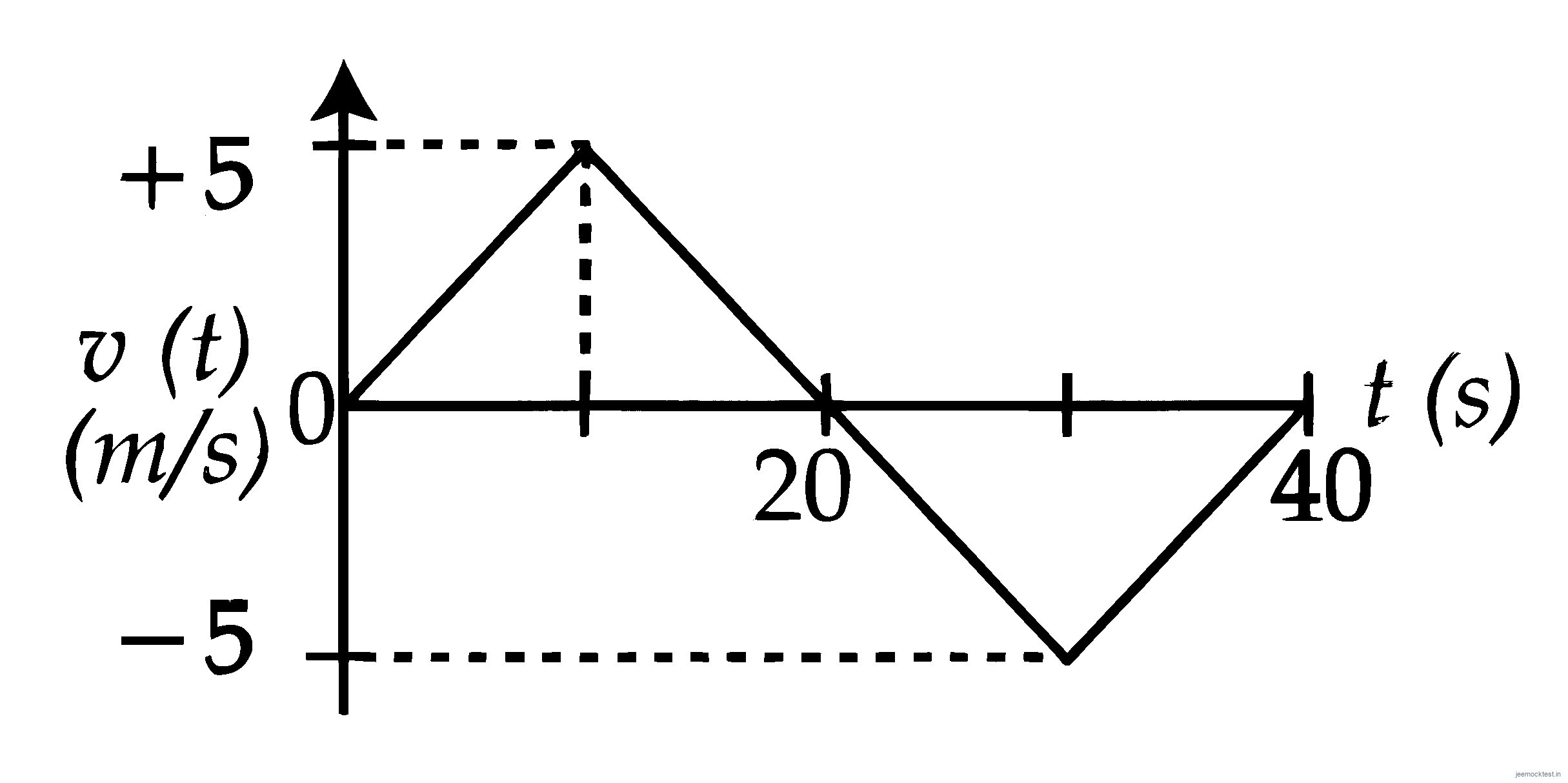
Two cars and are moving in the same direction along a straight line with speeds and , respectively such that car is moving ahead of car . A person in car throws a stone with a speed so that it hits the car with a speed of . The value of is .
A particle starts moving from time and its coordinate is given as
A. The particle returns to its original position (origin) 0.866 units later
B. The particle is 1 unit away from origin at its turning point
C. Acceleration of the particle is non-negative
D. The particle is 0.5 units away from origin at its turning point
E. Particle never turns back as acceleration is non-negative
Choose the correct answer from the options given below :