JEE PYQ: Motion in a Straight Line - Question ID 0c2d859eb175 (JEE Main 2022)
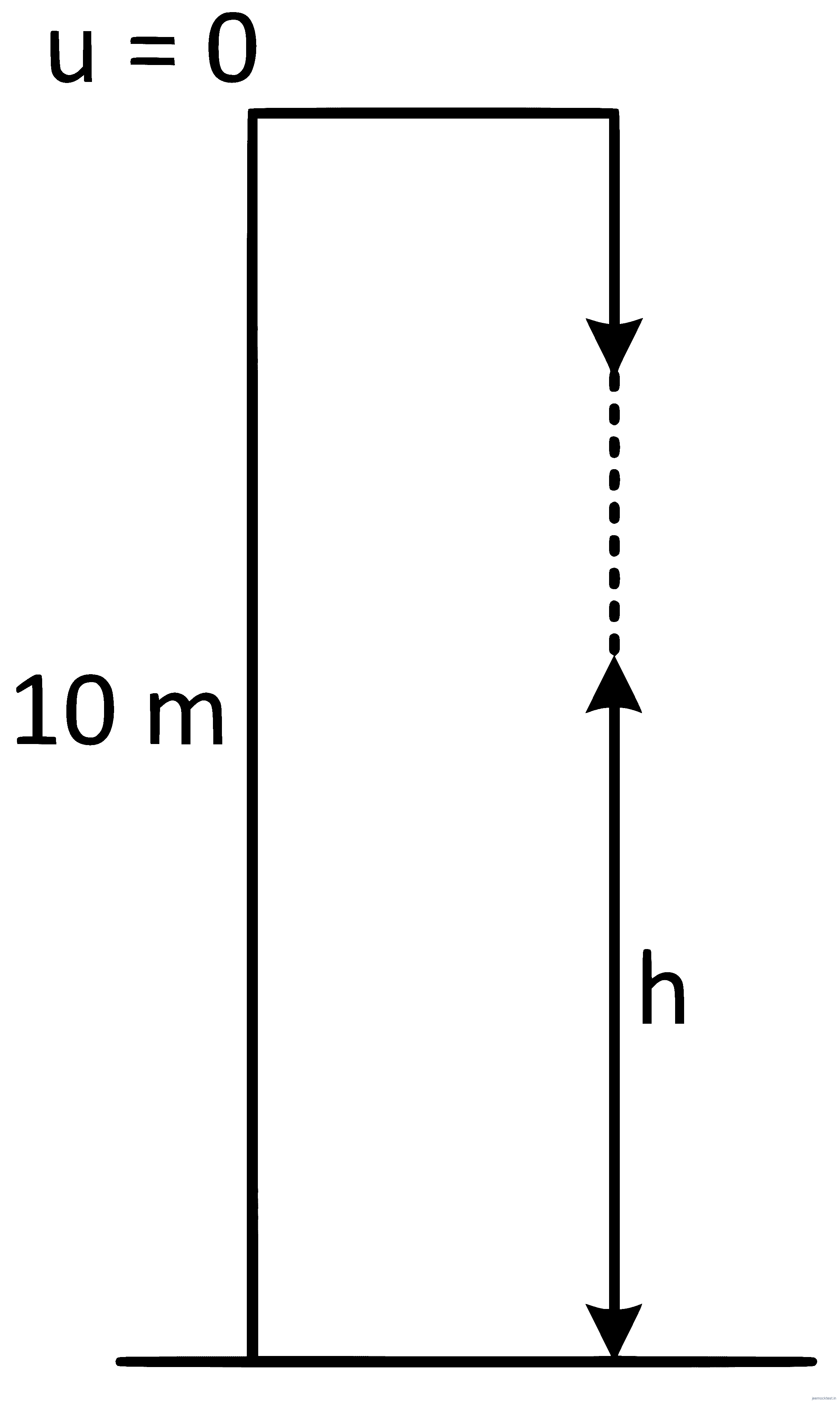
A ball of mass 0.5 kg is dropped from the height of 10 m. The height, at which the magnitude of velocity becomes equal to the magnitude of acceleration due to gravity, is ________ m. [Use g = 10 m/s2]
Your Answer
Step-by-step Explanation
When a ball is dropped from rest under gravity, it undergoes uniformly accelerated motion in a straight line. The key formulas governing this motion are:
- Velocity as a function of time: , where is initial velocity, is acceleration, and is time.
- Velocity as a function of displacement: , where is displacement.
- Displacement as a function of time: .
Here, the ball is dropped from height m, so initial velocity . The acceleration due to gravity is m/s² downward. We are asked to find the height at which the magnitude of velocity equals the magnitude of acceleration due to gravity, i.e., m/s.
Step-by-Step Derivation:Step 1: Define Variables and Setup
Let be the height above the ground at which the velocity equals m/s. Since the ball is falling downward, the displacement from the initial drop point to this height is .
Step 2: Apply the Velocity-Displacement Relation
Using the kinematic equation for velocity in terms of displacement: Since , m/s², and , we substitute: We are given that m/s, so:
Step 3: Solve for
Simplify the equation: Divide both sides by 20: Rearrange:
Step 4: Verification
At m, the ball has fallen m from the initial height. Using : This matches the condition , confirming our solution.
Common Traps & Exam Tip:Trap 1: Misinterpreting the condition. Students often confuse the condition with . While gives the velocity at time , the question asks for the height where , not the time. Using leads to incorrect results because it doesn't directly relate velocity to height.
Trap 2: Incorrect displacement sign. The displacement is the distance fallen, so . Some students mistakenly use , leading to wrong calculations.
Exam Tip: Always use the velocity-displacement relation for problems involving velocity and height. It avoids the need to calculate time and simplifies the solution.
Related Questions from Motion in a Straight Line
A gas balloon is going up with a constant velocity of . When this balloon reached a height of 75 m , a stone is dropped from it and balloon keeps moving up with the same velocity. The height of the balloon when the stone hits the ground is m. (Take )
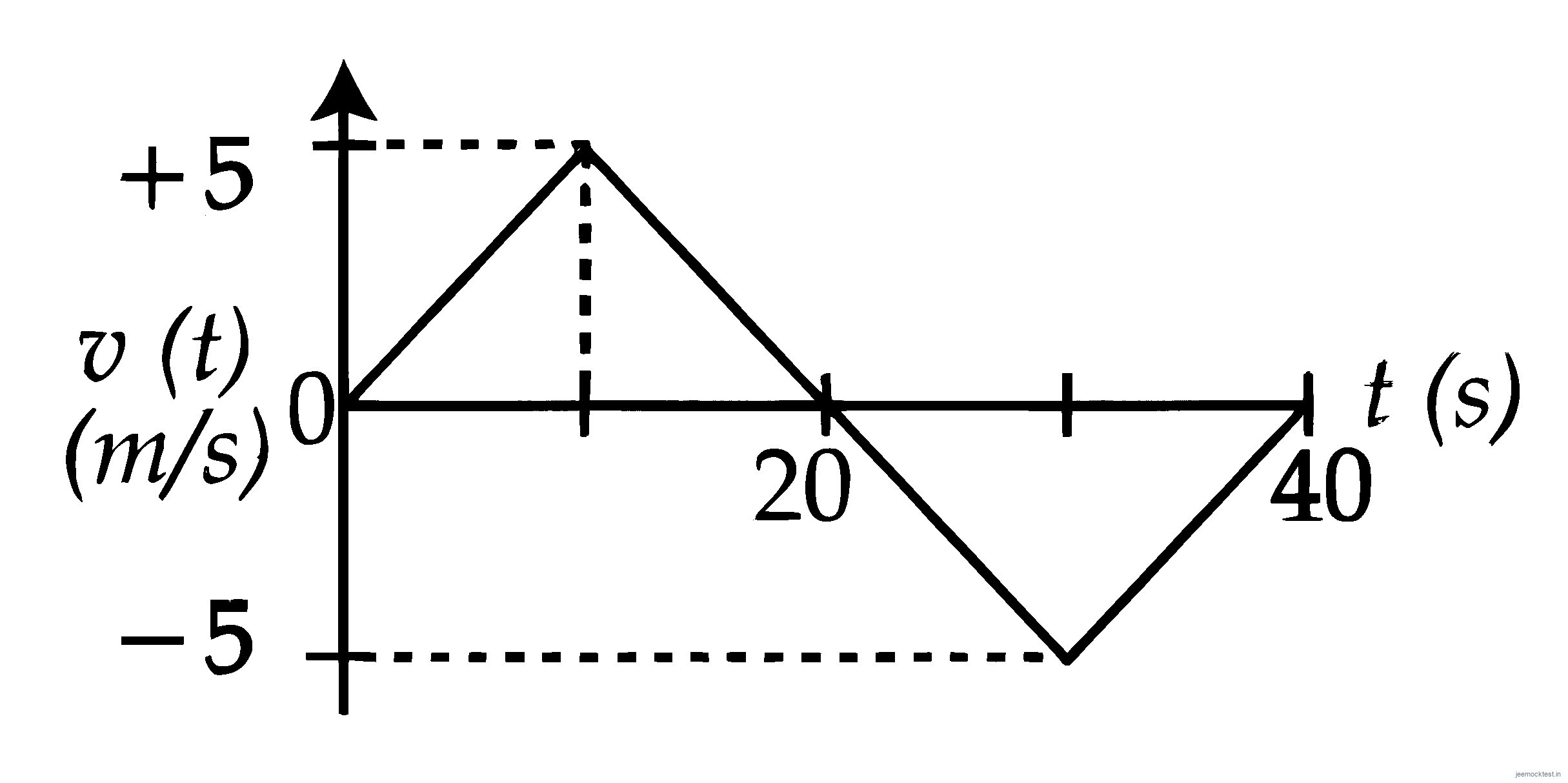
The velocity versus time plot of a particle is shown in the figure, for a time interval of 40 s . The total distance travelled by the particle and the average velocity during this period are, respectively
.
Two cars and are moving in the same direction along a straight line with speeds and , respectively such that car is moving ahead of car . A person in car throws a stone with a speed so that it hits the car with a speed of . The value of is .
A particle starts moving from time and its coordinate is given as
A. The particle returns to its original position (origin) 0.866 units later
B. The particle is 1 unit away from origin at its turning point
C. Acceleration of the particle is non-negative
D. The particle is 0.5 units away from origin at its turning point
E. Particle never turns back as acceleration is non-negative
Choose the correct answer from the options given below :