JEE PYQ: Motion in a Straight Line - Question ID 0b98e9f6f263 (JEE Main 2015)
(Assume stones do not rebound after hitting the ground and neglect air resistance, take )
(The figures are schematic and not drawn to scale)
Select Option
Step-by-step Explanation
When two objects move along the same straight line under constant acceleration (here, gravity), their relative position is simply the difference between their individual positions at any time. The key formulas are:
- Position of a stone thrown upward from height with initial speed :
- Relative position of stone 2 with respect to stone 1:
Since both stones start from the same height ( m) and experience the same acceleration ( m/s²), the relative motion is uniformly accelerated with initial relative speed and zero relative acceleration.
Step-by-Step Derivation:-
Write the individual position equations.
Stone 1 (initial speed m/s): Stone 2 (initial speed m/s): -
Form the relative position.
The quadratic terms cancel, leaving a linear function of time. -
Determine the domain of validity.
Both stones eventually hit the ground (). Solve for each stone’s impact time:- Stone 1:
- Stone 2:
-
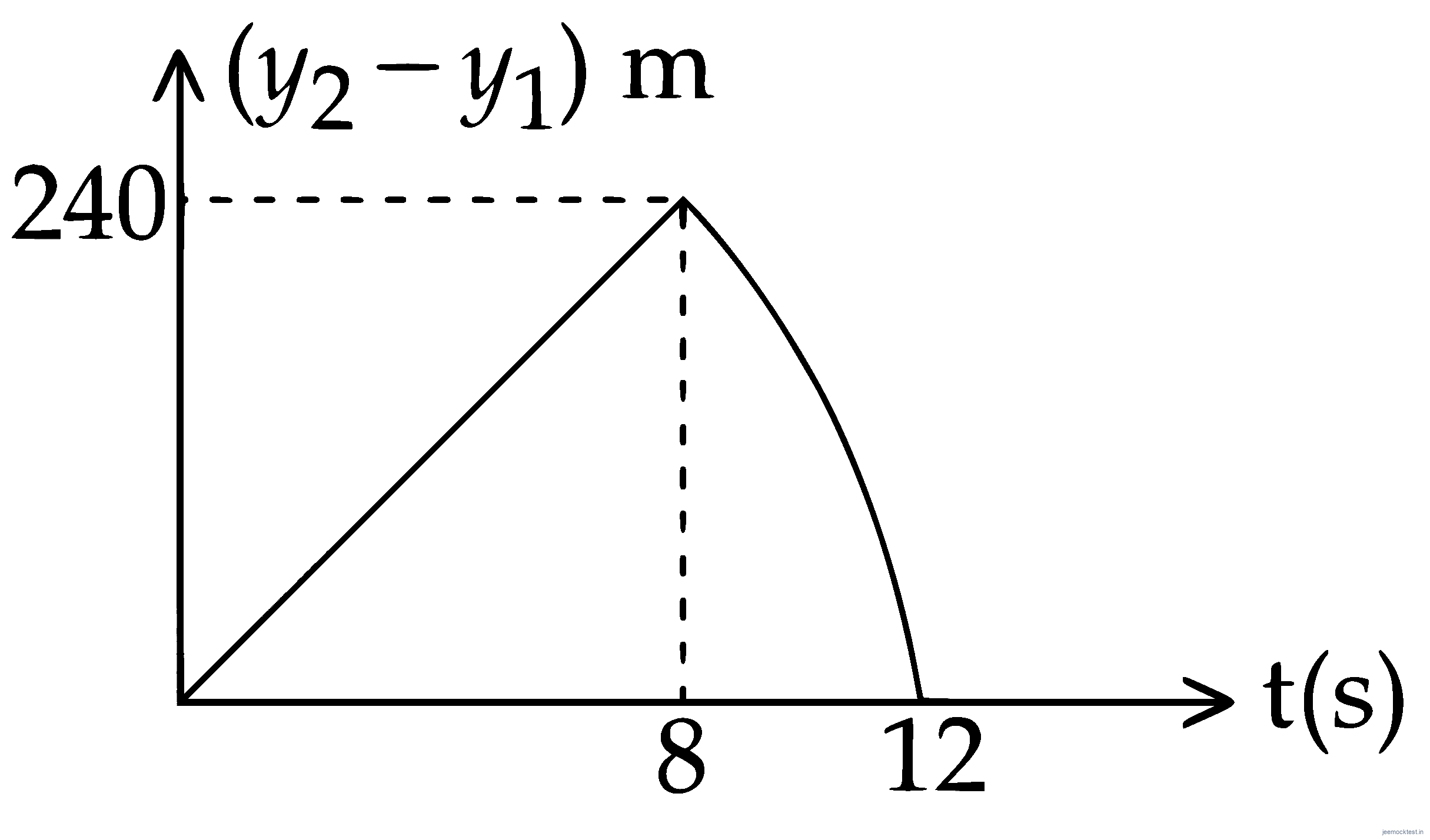
Sketch the graph.
- s: straight line through the origin with slope m/s.
- s: parabolic arc starting at m and ending at .
- For s both stones are on the ground, so .
Students often forget that the relative acceleration is zero only while both stones are in flight. As soon as the first stone hits the ground, the relative motion switches from linear to parabolic. Always check the domain of validity of your equations and match the graph’s shape to the physical phases of motion.
Related Questions from Motion in a Straight Line
A gas balloon is going up with a constant velocity of . When this balloon reached a height of 75 m , a stone is dropped from it and balloon keeps moving up with the same velocity. The height of the balloon when the stone hits the ground is m. (Take )
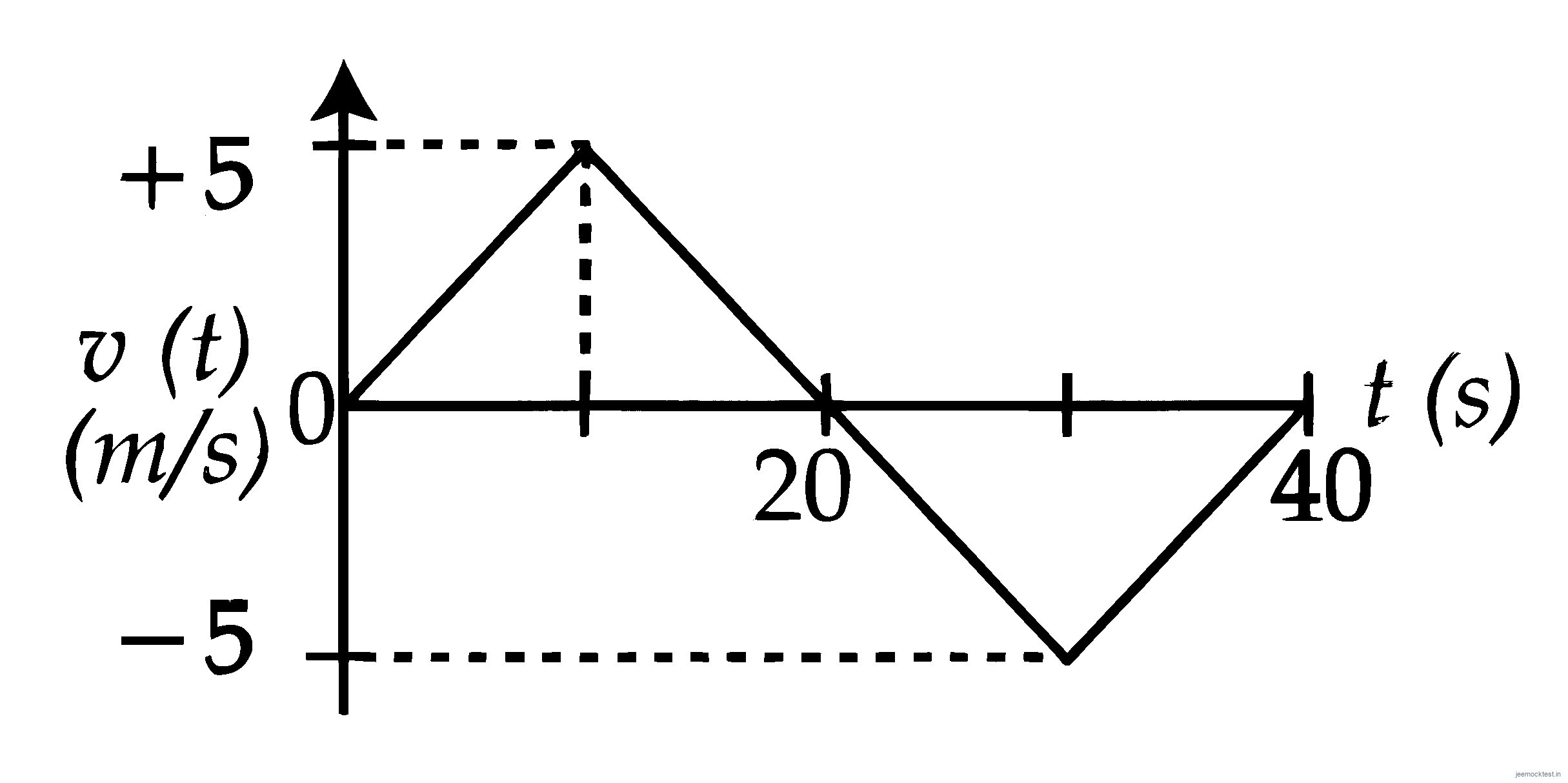
The velocity versus time plot of a particle is shown in the figure, for a time interval of 40 s . The total distance travelled by the particle and the average velocity during this period are, respectively
.
Two cars and are moving in the same direction along a straight line with speeds and , respectively such that car is moving ahead of car . A person in car throws a stone with a speed so that it hits the car with a speed of . The value of is .
A particle starts moving from time and its coordinate is given as
A. The particle returns to its original position (origin) 0.866 units later
B. The particle is 1 unit away from origin at its turning point
C. Acceleration of the particle is non-negative
D. The particle is 0.5 units away from origin at its turning point
E. Particle never turns back as acceleration is non-negative
Choose the correct answer from the options given below :