JEE PYQ: Motion in a Straight Line - Question ID 0a26df99a390 (JEE Main 2017)
Select Option
Step-by-step Explanation
In the study of motion in a straight line, the relationship between velocity (), acceleration (), and time () is governed by the following fundamental equations:
- Velocity-Time Relation: The velocity of an object under constant acceleration changes linearly with time: where is the initial velocity, is the constant acceleration, and is time.
-
Interpretation of Signs:
- Positive velocity (): The object is moving in the positive direction of the chosen coordinate axis.
- Negative acceleration (): The object is slowing down if velocity is positive, or speeding up if velocity is negative (i.e., acceleration opposes the direction of velocity).
-
Graphical Interpretation:
On a velocity-time ( vs ) graph:
- The slope of the line represents the acceleration:
- A negative slope indicates negative acceleration.
- The y-intercept gives the initial velocity.
- If the velocity is positive and the slope is negative, the object is moving forward but slowing down.
The question asks: Which graph corresponds to an object moving with a constant negative acceleration and a positive velocity?
This means:
- for all relevant (or at least initially and decreasing),
- (constant negative slope).
Hence, the - graph must be a straight line with:
- Positive y-intercept (initial positive velocity),
- Negative slope (constant negative acceleration).
Let’s analyze each option based on the above criteria.
-
Option A:
The graph shows a velocity-time plot with a positive slope and positive velocity.
Slope = → Positive acceleration.
But we need negative acceleration. So, Option A is incorrect.
-
Option B:
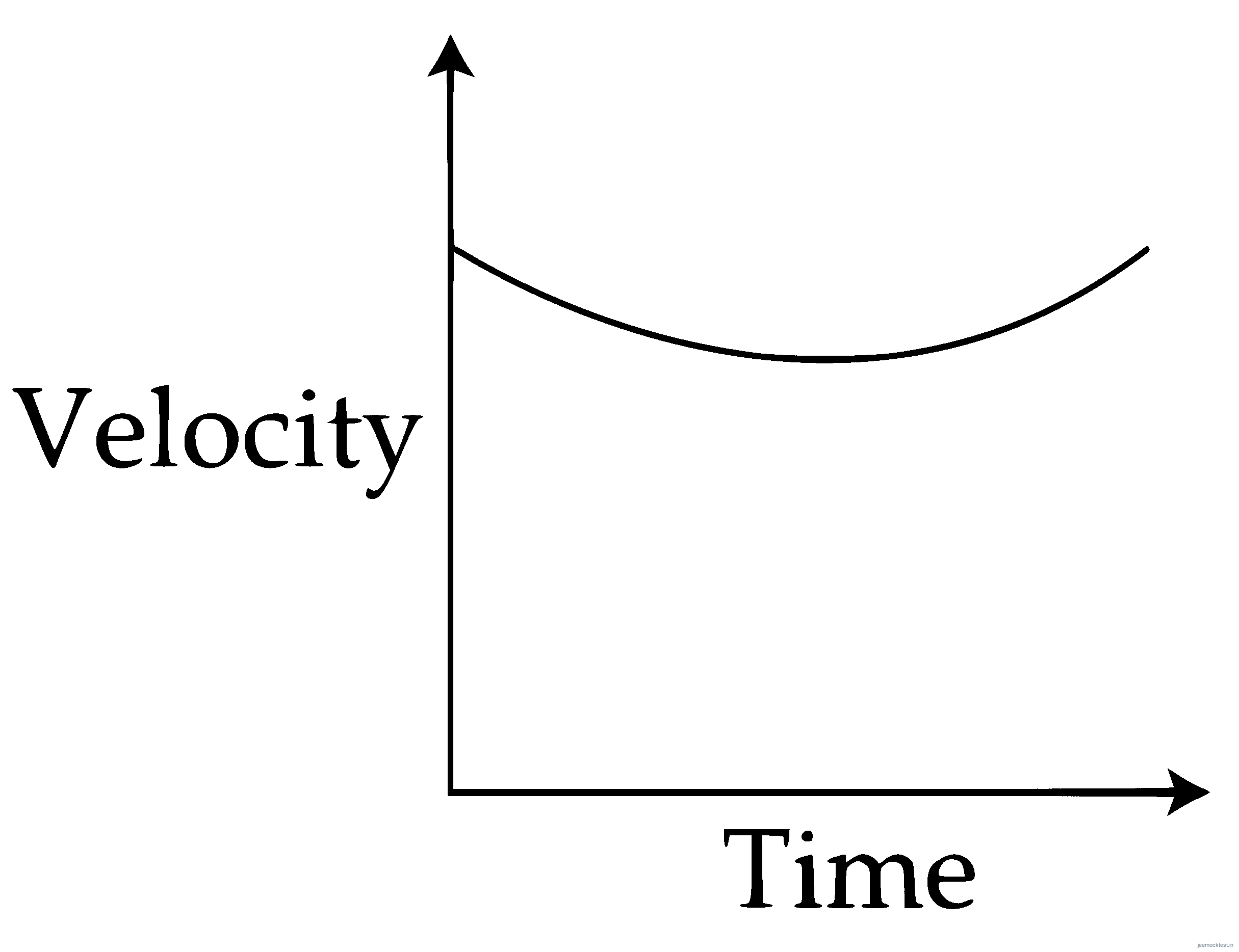
The graph shows a curved velocity-time plot with velocity decreasing from positive to zero.
However, the question specifies constant negative acceleration. A curved - graph implies non-constant acceleration (since slope changes).
So, Option B is incorrect.
-
Option C:
The graph shows a straight line with:
- Positive y-intercept (initial velocity ),
- Negative slope (constant negative acceleration ),
- Velocity decreasing linearly over time, remaining positive initially.
This perfectly matches the condition: constant negative acceleration and positive velocity.
So, Option C is correct.
-
Option D:
The graph shows a positive slope starting from a negative velocity.
This means:
- Initial velocity (negative),
- Positive acceleration .
This does not satisfy the condition of positive velocity. So, Option D is incorrect.
Students often confuse the following:
- Sign of acceleration vs. direction of motion: Negative acceleration does not always mean the object is moving backward. It means the acceleration is in the negative direction of the coordinate axis. If velocity is positive, negative acceleration means the object is slowing down.
- Curved vs. straight - graphs: A curved graph implies changing acceleration. The question specifies constant acceleration, so only a straight line is acceptable.
- Initial velocity sign: The question states positive velocity, so the graph must start above the time axis (i.e., at ).
Exam Tip: Always check:
- Is the - graph a straight line? → Constant acceleration.
- Is the slope negative? → Negative acceleration.
- Does the graph start above the time axis? → Positive initial velocity.
Only Option C satisfies all three.
Related Questions from Motion in a Straight Line
A gas balloon is going up with a constant velocity of . When this balloon reached a height of 75 m , a stone is dropped from it and balloon keeps moving up with the same velocity. The height of the balloon when the stone hits the ground is m. (Take )
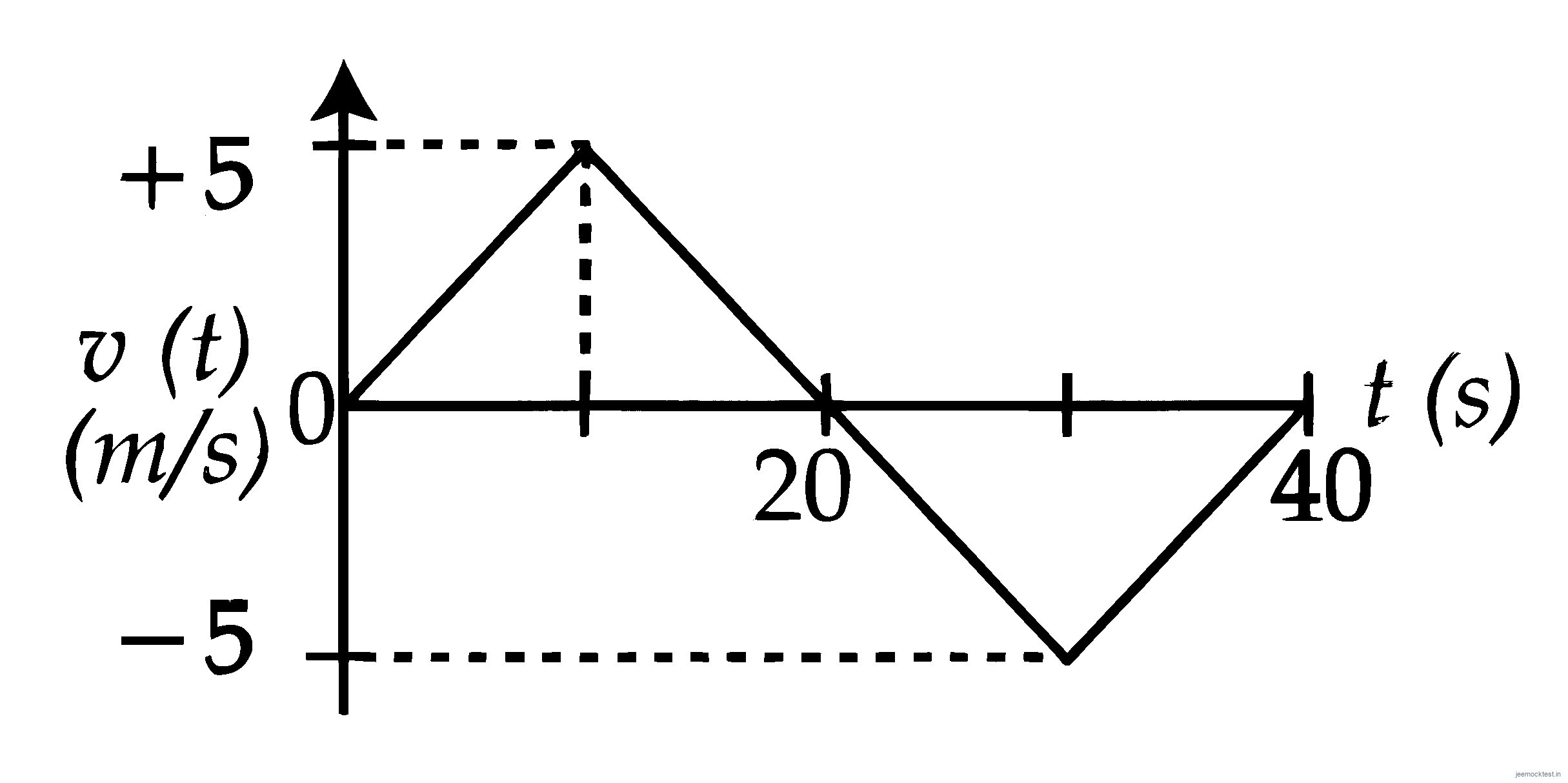
The velocity versus time plot of a particle is shown in the figure, for a time interval of 40 s . The total distance travelled by the particle and the average velocity during this period are, respectively
.
Two cars and are moving in the same direction along a straight line with speeds and , respectively such that car is moving ahead of car . A person in car throws a stone with a speed so that it hits the car with a speed of . The value of is .
A particle starts moving from time and its coordinate is given as
A. The particle returns to its original position (origin) 0.866 units later
B. The particle is 1 unit away from origin at its turning point
C. Acceleration of the particle is non-negative
D. The particle is 0.5 units away from origin at its turning point
E. Particle never turns back as acceleration is non-negative
Choose the correct answer from the options given below :