JEE PYQ: Motion in a Straight Line - Question ID 077d8a0dda5d (JEE Main 2022)
A NCC parade is going at a uniform speed of under a mango tree on which a monkey is sitting at a height of . At any particular instant, the monkey drops a mango. A cadet will receive the mango whose distance from the tree at time of drop is: (Given )
Select Option
Step-by-step Explanation
This problem combines two fundamental concepts in kinematics:
1. Free-fall under gravity: When the mango is released, it falls vertically downward with constant acceleration . The vertical displacement of the mango in time is given by: Here, , so we can solve for , the time the mango takes to reach the ground. 2. Uniform horizontal motion: The cadet is moving horizontally at a constant speed . We convert this to : The horizontal distance covered by the cadet in time is: This is the distance of the cadet from the tree at the instant the mango is dropped, such that the mango lands exactly on the cadet.The key insight is that the mango and the cadet must meet at the same point at the same time. The time is determined solely by the vertical fall, and the horizontal distance is determined by the cadet’s speed over that same time.
Step-by-Step Derivation:Step 1: Convert the cadet’s speed to SI units
Step 2: Calculate the time for the mango to fall 19.6 m
Using the free-fall equation: Substitute and :Step 3: Calculate the horizontal distance covered by the cadet in 2 s
Using the uniform motion equation:Step 4: Match the result with the given options
The calculated distance is , which corresponds to option A. Common Traps & Exam Tip:1. Unit inconsistency: Many students forget to convert the cadet’s speed from to . This leads to incorrect distance calculations. Always ensure all units are consistent (preferably SI units) before substituting values into equations. 2. Misinterpreting the scenario: Some students assume the cadet is stationary or that the mango has an initial horizontal velocity. The mango is dropped (not thrown), so its initial horizontal velocity is zero. The cadet’s motion is purely horizontal and uniform. 3. Incorrect use of kinematic equations: Students sometimes use the wrong equation for free-fall, such as , when displacement is the required quantity. Always identify what is given and what is asked before selecting the appropriate equation. 4. Sign errors in displacement: While the direction of motion doesn’t affect the magnitude of the answer here, it’s good practice to define a coordinate system (e.g., downward as positive) to avoid confusion in more complex problems.
Exam Tip: In problems involving relative motion or projectile motion, always break the problem into horizontal and vertical components. Solve for the time using the vertical motion (since gravity acts vertically), then use that time to find the horizontal distance. This approach simplifies the problem and reduces errors.
Related Questions from Motion in a Straight Line
A gas balloon is going up with a constant velocity of . When this balloon reached a height of 75 m , a stone is dropped from it and balloon keeps moving up with the same velocity. The height of the balloon when the stone hits the ground is m. (Take )
The velocity versus time plot of a particle is shown in the figure, for a time interval of 40 s . The total distance travelled by the particle and the average velocity during this period are, respectively
.
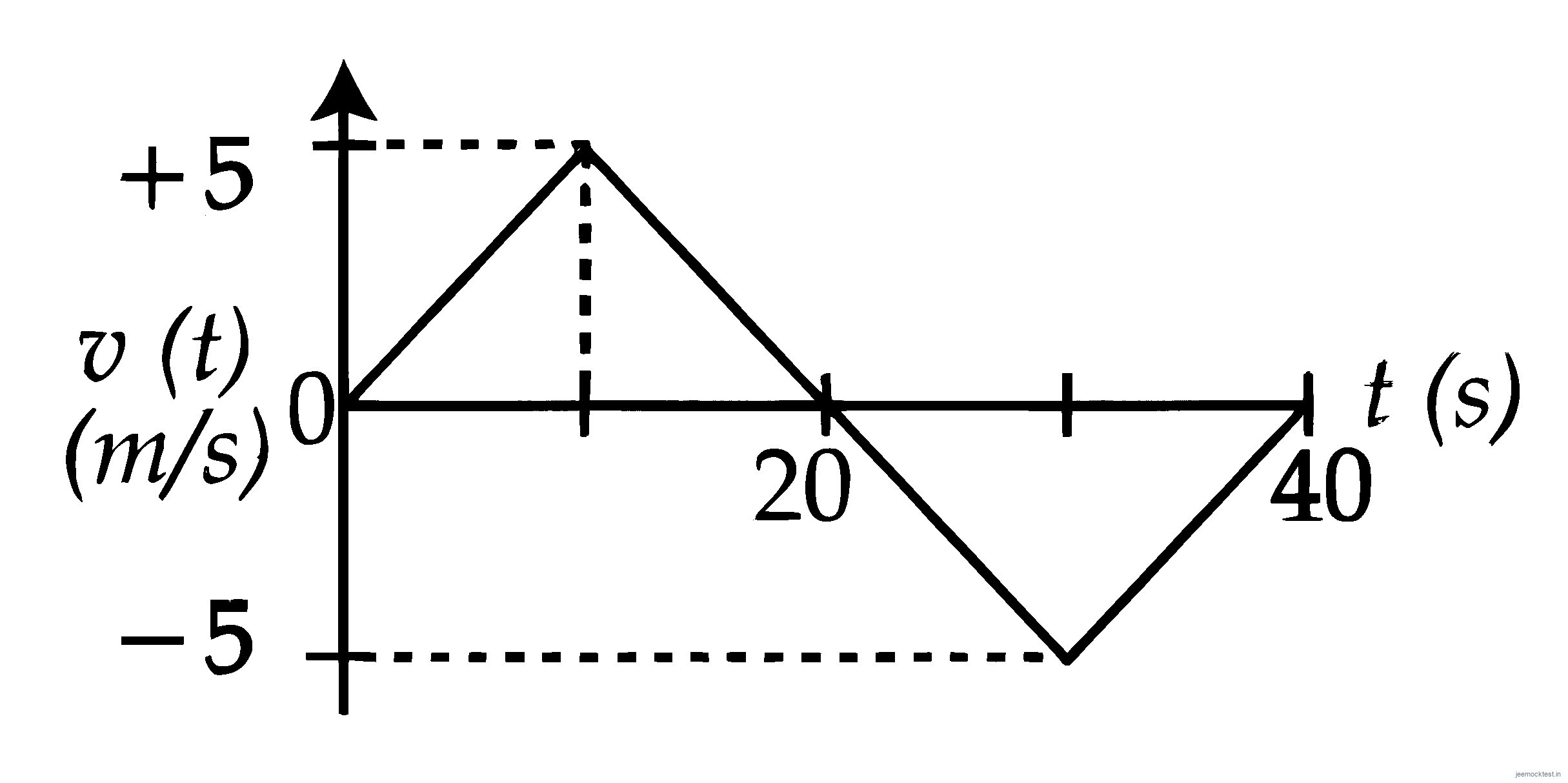
Two cars and are moving in the same direction along a straight line with speeds and , respectively such that car is moving ahead of car . A person in car throws a stone with a speed so that it hits the car with a speed of . The value of is .
A particle starts moving from time and its coordinate is given as
A. The particle returns to its original position (origin) 0.866 units later
B. The particle is 1 unit away from origin at its turning point
C. Acceleration of the particle is non-negative
D. The particle is 0.5 units away from origin at its turning point
E. Particle never turns back as acceleration is non-negative
Choose the correct answer from the options given below :