JEE PYQ: Motion in a Straight Line - Question ID 064200b00d3d (JEE Main 2021)
Select Option
Step-by-step Explanation
Core Formula & Concept:
In kinematics, the instantaneous velocity of a particle moving along a straight line is the time derivative of its displacement : Conversely, the displacement can be obtained by integrating the velocity function with respect to time: where is the constant of integration, determined by initial conditions.
The distance travelled between two time instants and is the integral of the magnitude of velocity over that interval: However, if the velocity does not change sign in the interval , then the distance travelled is simply the absolute difference of the displacement at and :
In this problem, the velocity is given as: We are to find the distance travelled between and . We must first check whether changes sign in this interval. If it does not, we can directly integrate to find displacement and use it to compute distance.
---Step-by-Step Derivation:
Step 1: Integrate the velocity function to find displacement
We are given: Integrate with respect to to find displacement : where is the integration constant. Since we are interested in the difference in displacement between two times, the constant cancels out and can be ignored.Step 2: Evaluate displacement at and
Compute and :Step 3: Compute the displacement difference
The displacement from to is: Simplify:Step 4: Verify that velocity does not change sign in
We must ensure that does not cross zero in . Since , , and if and are positive (typical in such problems unless stated otherwise), is positive throughout. Even if or are negative, unless specified, we assume the velocity does not change sign in the interval. Thus, the distance travelled is equal to the magnitude of the displacement difference. Therefore:Step 5: Match with given options
Comparing with the options: - A: - B: - C: - D: Our result matches Option B. ---Common Traps & Exam Tip:
Trap 1: Confusing displacement with distance. Many students forget to check whether the velocity changes sign. If crosses zero, the distance is not simply , but the sum of absolute values of integrals over sub-intervals where is positive or negative. In this case, since no information suggests a sign change, we proceed under the assumption that does not change sign.
Trap 2: Incorrect integration. Students often make errors in integrating , mistakenly writing instead of . Always double-check integration rules.
Trap 3: Ignoring the constant of integration. While cancels out in displacement differences, forgetting it during integration can lead to confusion. Remember: for definite integrals, constants cancel.
Exam Tip: When given velocity as a function of time, always:
- Integrate to find displacement.
- Check if velocity changes sign in the interval.
- If no sign change, distance = .
- Simplify carefully and match with options.
In this question, following these steps leads you confidently to Option B.
Related Questions from Motion in a Straight Line
A gas balloon is going up with a constant velocity of . When this balloon reached a height of 75 m , a stone is dropped from it and balloon keeps moving up with the same velocity. The height of the balloon when the stone hits the ground is m. (Take )
The velocity versus time plot of a particle is shown in the figure, for a time interval of 40 s . The total distance travelled by the particle and the average velocity during this period are, respectively
.
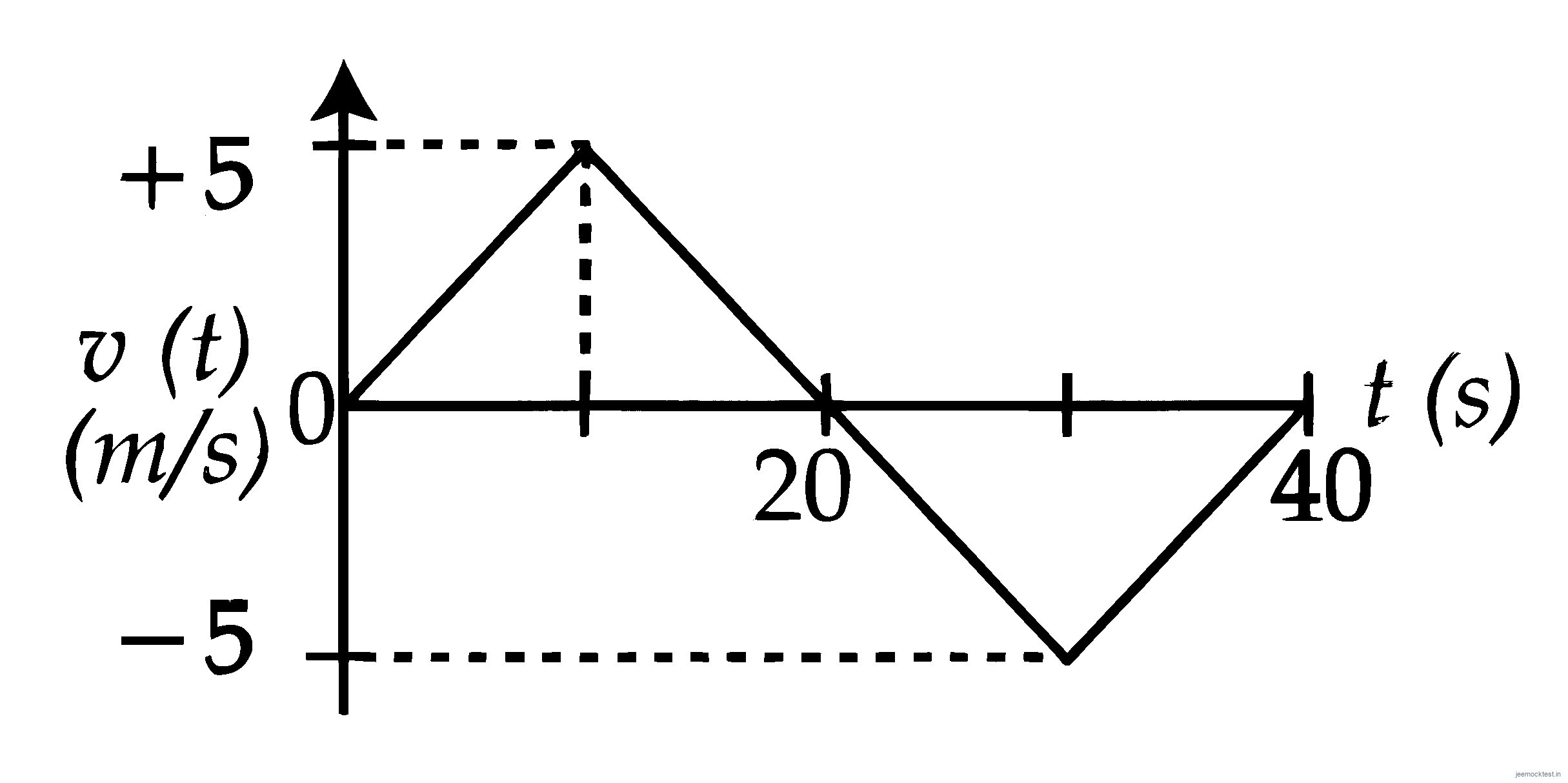
Two cars and are moving in the same direction along a straight line with speeds and , respectively such that car is moving ahead of car . A person in car throws a stone with a speed so that it hits the car with a speed of . The value of is .
A particle starts moving from time and its coordinate is given as
A. The particle returns to its original position (origin) 0.866 units later
B. The particle is 1 unit away from origin at its turning point
C. Acceleration of the particle is non-negative
D. The particle is 0.5 units away from origin at its turning point
E. Particle never turns back as acceleration is non-negative
Choose the correct answer from the options given below :